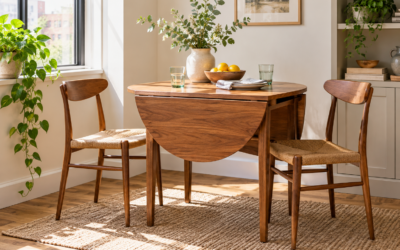
As an Amazon Associate I earn from qualifying purchases. Links marked “Affiliate link” may earn us a commission at no extra cost to you. Learn more.
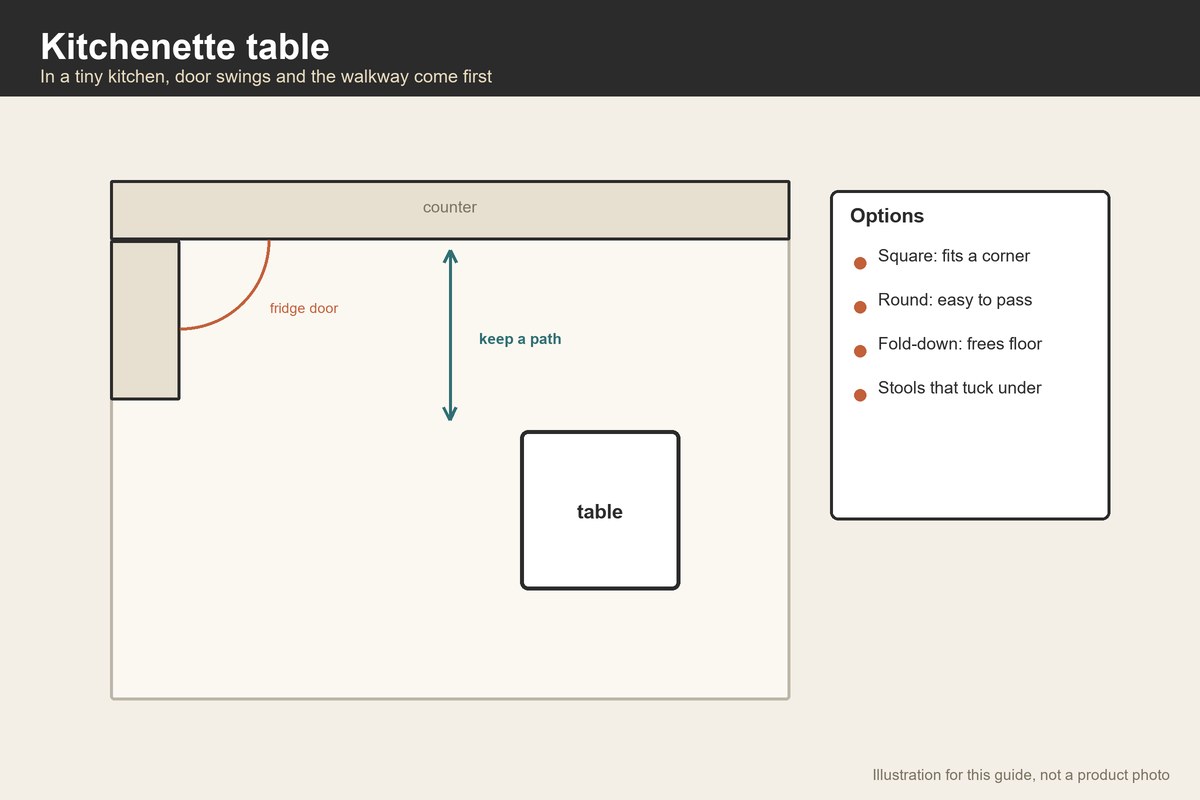
Quick answer
A kitchenette table is a very small table for a tiny kitchen, a studio or a corner between the kitchen and the living area. The right one seats one or two people, has a footprint of about 27 to 32 inches across and leaves the work area clear. Because a kitchenette often has a fridge and cabinets within a few feet, the question is less “which table looks good” than “where does a chair go”.
The listings we read on Amazon on 2026-09-30 give a square bamboo table of 27.6 by 27.6 by 29.5 inches and about 23.3 pounds, an oval three-piece set of 31.5 by 21 by 29.9 inches and about 28.6 pounds, and a round three-piece set of 31.5 by 31.5 by 29.5 inches and about 44.1 pounds. We have not tested any of them. The sets list two chairs, so count their pull-out space.
If your kitchen is larger, see small kitchen table and chairs. If you need an island instead, see kitchen island.
Start from the work area
In a kitchenette, the work area comes first: the sink, the stove and the refrigerator door. Stand in the kitchenette and open each door. Measure the floor that is not swept by a door. The U.S. Access Board uses 36 inches as a minimum clear width for a route, and 32 inches at short obstructions. It is written for public accessible design, not for a studio, but it is a useful yardstick: a table that leaves less than about that much room to pass will be bumped daily.
Then decide whether the table must stay in place. A table on casters, a fold-down table or a small table you can push against a wall frees the floor when not in use.
Square, round or oval
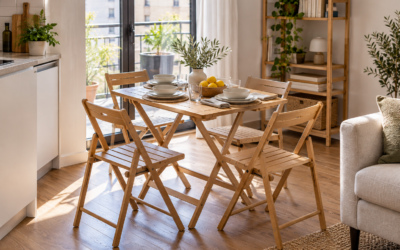
Square. Fits neatly in a corner and seats two on adjacent sides. The bamboo table we read is 27.6 inches square, about 762 square inches of top. Two plates and a laptop fit, but not more.
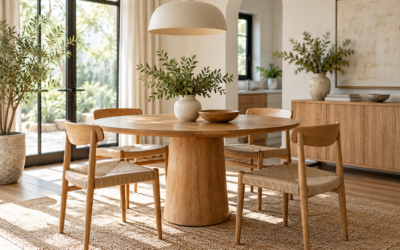
Round. No corners to bump, easy to walk around, and a pedestal frees knee room. The round set we read is 31.5 inches across, about 779 square inches of top (π × 15.75²), slightly more than the square one.
Oval. Softens corners and suits a wall. The oval set we read is 31.5 by 21 inches, about 661 square inches if it were a rectangle, and less for an oval, so it is the slimmest.
The differences are small; the shape that works is the one that matches the corner and the route.
Seats and chairs
For one or two people, a table 27 to 32 inches across is enough. Chairs need about 18 to 20 inches to pull out, a working estimate. A stool that tucks under the table is easier in a kitchenette than a chair with arms. See dining chairs for seat height against table height, and bistro table and chairs for two-seat sets.
Height
The tables we read are about 29.5 to 29.9 inches high. The Access Board’s accessible-design standard places dining surfaces between 28 and 34 inches high, which shows the general range that suits seated use, though it does not apply to a private home. A table about 30 inches high works with a chair seat of about 17 to 19 inches.
Materials and weight
Bamboo is light and durable and is used for the square table we read, at about 23.3 pounds. Engineered wood with a metal frame is heavier and cheaper. Federal rules limit formaldehyde emissions from composite wood products sold in the United States, and listings may state compliance. Ask if it does not. A light table moves easily, which is helpful in a kitchenette but can wobble.
Power, cooking and safety
Keep cords off the table and out of the path. Do not place the table where a stove or hot pan can reach it. Keep a clear route from the door to the exit, and keep the smoke alarm clear. The U.S. Fire Administration recommends working smoke alarms and clear exits.
A worked example
These are invented numbers for planning. A kitchenette is 7 feet wide (84 inches) and 8 feet deep (96 inches). Counters run along one 96 inch wall, 25 inches deep. The refrigerator door swings 24 inches into the room.
Free floor width: 84 − 25 = 59 inches between the counter and the opposite wall. Consider the 27.6 inch square table against that wall: 59 − 27.6 = 31.4 inches left to the counter. That is below the 36 inch yardstick and below the 32 inch figure for short obstructions, so the table blocks the work area when someone sits.
Try the round 31.5 inch table: 59 − 31.5 = 27.5 inches, worse. The oval at 21 inches deep placed with its long side against the wall: 59 − 21 = 38 inches, above the 36 inch yardstick, and with a chair pulled out 20 inches the route closes.
So in this kitchenette, the only table that leaves a route is the oval, and only if you sit on one side. A fold-down table or a wall-mounted shelf would serve better. The arithmetic shows why the table is often the wrong first purchase.
Questions to ask before you order
Ask the seller for the leg spacing so you can see knee room, the weight limit and whether the legs are adjustable. Ask whether the set includes chairs or stools and what their pull-out size is. Ask whether the top is wipeable. If the listing shows several sizes, confirm that the photos match the size you choose.
A quick decision path
If the route after the table is under about 36 inches, do not add a fixed table. If you can tuck the table into a corner, choose a square one. If people pass close, choose a round one. If you need to free the floor, choose a folding or wall-mounted table.
Making a tiny table work harder
In a kitchenette, a table is often also a desk, a prep surface and a serving counter. Choose a top that wipes clean, and keep a cutting board that fits. Use hooks or a rail on the wall for utensils so the table stays clear. A drop-leaf or fold-down table doubles the use of a small corner: closed, it is a shelf; open, it seats two. If you need to eat with a guest, consider a table you can pull away from the wall and push back after the meal.
What to ask the seller
Ask whether the legs are adjustable for uneven floors, since small tables wobble more. Ask about the top thickness and the edge finish, because a thin edge chips. Ask whether the table can be assembled in a different layout for left or right corners, and whether the chairs or stools stack. Ask for a photo of the underside if the listing does not show how the legs attach.
The day it arrives
Unpack, check the parts and assemble near where the table will live, since a small table is easy to carry once built. Check the legs for wobble on your floor, and add pads. Try the table with your chairs or stools before you throw away the box, because a kitchenette leaves no room for mistakes.
Budget without prices
We leave prices out. A small table is a small purchase, but a set with chairs adds items that may not fit. Count the total footprint of the set, including pulled-out chairs, before you buy, and consider stools that tuck under to save floor.
Mistakes to avoid
- Buying before measuring door swings. Open every door.
- Ignoring chair pull-out. Add about 20 inches per side.
- Choosing a heavy table. You may need to move it.
- Forgetting the route. Aim for about 36 inches.
- Overloading a light table. Check the limit.
When to skip a kitchenette table
If you eat at a counter or on the sofa, a table may be unused furniture. A rolling cart or a fold-down shelf can serve as a table when needed. See kitchen island on wheels for a movable option.
Related guides
See small kitchen table and chairs, dinette sets for small spaces and breakfast nook dining set.
Frequently asked questions
What size is a kitchenette table?
The ones we read are about 27 to 32 inches across. Measure your floor first.
Square or round for a tiny kitchen?
Square fits a corner; round is easier to walk around. The route decides.
Can a kitchenette table seat two?
Yes, if chairs can pull out. Stools that tuck under help.
How tall should it be?
About 29.5 to 30 inches is common for dining height.
Is a fold-down table better?
For a very tight kitchenette, yes, because it frees the floor.
Bottom line
Choose a kitchenette table by measuring the free floor after door swings and leaving about 36 inches to pass. If no table leaves a route, use a fold-down or wall-mounted surface instead.
Products worth checking
We have not tested these products. Sizes and features come from the Amazon listings, checked on September 30, 2026; where a listing does not say, we say so.
HOOBRO Bamboo Dining Table, Square Dining Table for 2, 27.6 inch
The listing gives 27.6 x 27.6 x 29.5 in; 23.3 lb. We re-opened the page on September 30, 2026 and found these figures; other details are on the product page.
- Good for: a light square table for a corner.
- Keep in mind: it seats two at most.
VECELO 3-Piece Dining Table Set for Kitchen Breakfast Nook, Oval Top
The listing gives 31.5 x 21 x 29.9 in; 28.6 lb. We re-opened the page on September 30, 2026 and found these figures; other details are on the product page.
- Good for: a slim oval set against a wall.
- Keep in mind: the listed size looks like the table, so add chair pull-out space.
YATINEY 3-Piece Round Dining Table Set for 2
The listing gives 31.5 x 31.5 x 29.5 in; 44.1 lb. We re-opened the page on September 30, 2026 and found these figures; other details are on the product page.
- Good for: a round set for two.
- Keep in mind: it takes more floor than the square table.
Sources checked
- Accessible routes guide
- ADA Standards
- Formaldehyde emission standards for composite wood products
- Smoke alarm guidance
- HOOBRO Bamboo Dining Table, Square Dining Table for 2, 27.6 inch
- VECELO 3-Piece Dining Table Set for Kitchen Breakfast Nook, Oval Top
- YATINEY 3-Piece Round Dining Table Set for 2
Specifications checked on September 30, 2026. Product details and availability can change, so confirm on the product page before you buy.