As an Amazon Associate I earn from qualifying purchases. Links marked “Affiliate link” may earn us a commission at no extra cost to you. Learn more.
Quick answer
A kitchen island on wheels adds counter and storage without a permanent island, but it only helps if it is stable when you chop or lean on it, small enough to leave a workable aisle and easy to park when you are done. The checks that matter are the listed footprint, the counter height, whether the casters lock, the weight limit and where the cart parks.
The listings we read on Amazon on 2026-09-30 give carts that are about 15 to 16 inches deep and 23 to 35 inches wide, with heights of about 33 to 34 inches. Weights are about 20 to 44 pounds, and one model states a 55 pound maximum weight recommendation. Those numbers come from the listings, and we have not tested any product. Some carts include a drop leaf, a power outlet or a drawer, and each feature adds cost, weight or a limit worth reading.
A rolling island helps a small kitchen mostly when there is a clear aisle to roll it into, and when a permanent island would not fit.
Counter height and use
A standard kitchen counter is about 36 inches high, and the carts we read are about 33 to 34 inches, slightly lower. A lower height is comfortable for kneading or rolling, and less comfortable for someone tall who bends to chop. If you want the cart to match your counters, measure yours and compare with the listing. Note that the listed height often excludes casters or includes them; check.
Decide the job. Prepping vegetables needs a stable top and a cutting board. Serving needs a top that wipes clean. A drop leaf adds surface but reduces stability when open, so keep heavy work on the fixed part.
Footprint and the aisle
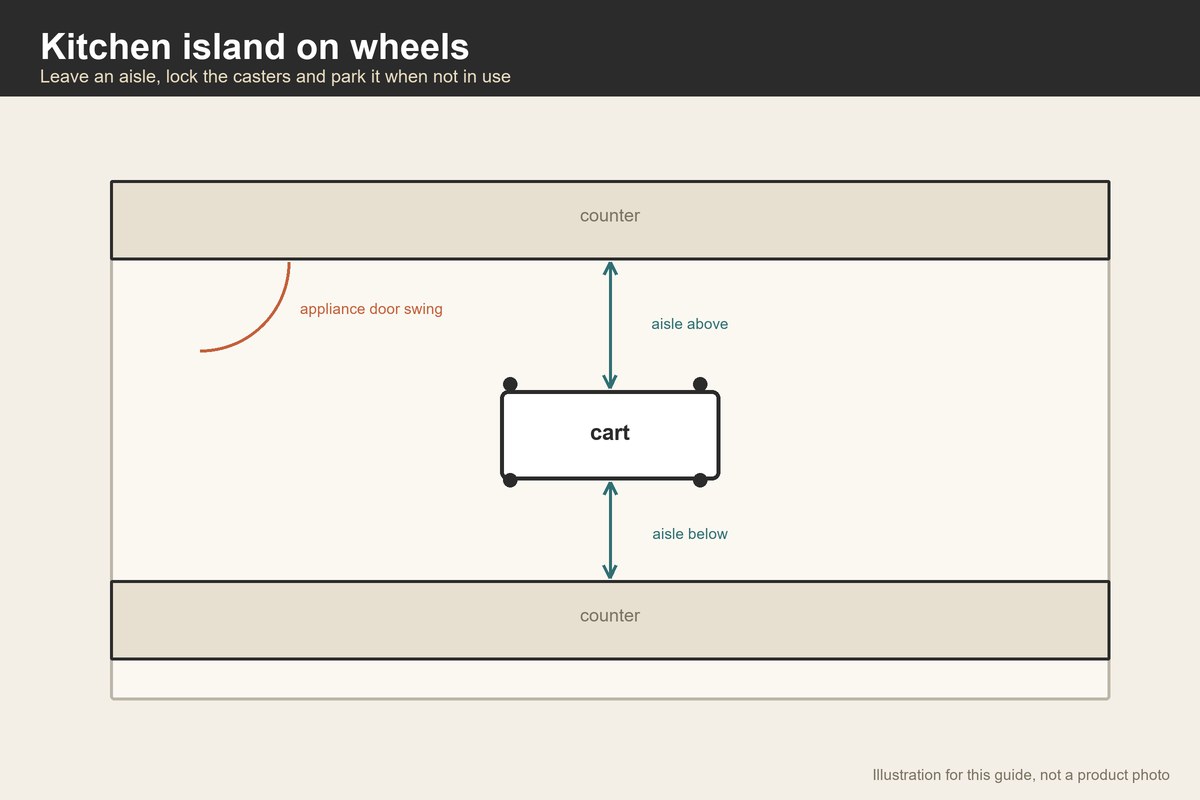
The cart’s depth is the number that matters. A cart that is 15.8 inches deep plus a person standing at it needs about 30 inches in front of it, so you need a clear aisle. The U.S. Access Board’s accessible-route guidance uses 36 inches as a minimum clear width for a route, narrowing to 32 inches at short obstructions. That is for public accessible design, not your kitchen, but it is a helpful reference. In a galley kitchen with 42 inches between counters, a 15.8 inch cart leaves 42 − 15.8 = 26.2 inches, which is too tight to pass. In that kitchen, park the cart elsewhere.
Also consider door swings. A dishwasher door, an oven door or a refrigerator door may hit the cart. Tape the outline on the floor and open every door.
Casters and stability
Wheels make the cart useful and less stable. Look for locking casters, ideally on all four wheels. A cart that rolls while you chop is a hazard. Check the listing for the number of locking wheels, and treat a missing statement as unknown.
Weight matters too. A heavy cart resists tipping; a light cart moves too easily. The carts we read range from about 20 to 44 pounds. A drop leaf changes the balance, so lift and lock it as the maker says.
Do not lean or sit on a cart unless the listing says it is designed for it. A stated weight limit may refer to the top or to the whole cart, so read it carefully. One model we read states 55 pounds; others state none.
Storage: shelves, drawers, hooks and outlets
Storage varies. Open shelves are easy to reach and show everything. Drawers hide small items and need pull-out space. Hooks hold towels and utensils. A spice rack adds convenience but not capacity. A power outlet on the cart can run a mixer or charge a phone, but it must be plugged into a wall outlet, which limits where the cart can go and adds a cord to manage.
Match storage to what you own. Measure the tallest item you want to put on a shelf, and compare it with the listed shelf spacing, which is often not stated.
Materials and food safety
Carts use engineered wood tops with metal frames. Engineered wood can swell if wet, so wipe spills. Federal rules limit formaldehyde emissions from composite wood products sold in the United States, and a listing may state compliance. Ask if it does not. Use a cutting board rather than cutting directly on the top, and do not put hot pans on the surface unless the listing says it is heat resistant.
Assembly and moving
Carts ship flat and take about an hour to assemble. Two people help with the top. Check the box size and weight against your stairs. Once assembled, roll the cart across your floor to test it. Some wheels leave marks on soft floors.
A worked example
These are invented numbers for planning. A galley-style kitchen has counters facing each other across an aisle that is 58 inches wide.
You consider a cart 15.8 inches deep and 35.4 inches wide. In the aisle, the cart leaves 58 − 15.8 = 42.2 inches, which is above the 36 inch reference, so it fits in the aisle as a work station. If a person stands at the cart, they need about 20 inches, leaving 42.2 − 20 = 22.2 inches behind them, so no one passes. So the cart works as an occasional station, but you would park it against a wall when you cook with two people.
A cart 23.7 inches wide and 15.8 inches deep has a smaller footprint: 23.7 × 15.8 = 374 square inches versus 35.4 × 15.8 = 559 square inches, about 33 percent smaller. If you have only a small corner to park, the narrow cart is easier to store.
Questions to ask before you order
Carts vary in what they state, so send a short message if a detail matters. Ask how many casters lock and whether the locks hold on your floor type. Ask for the top’s material and thickness, and whether it is treated for water. Ask whether the drop leaf has a support that locks. Ask how tall the shelves are and whether the shelf spacing can be changed. If you plan to use the power outlet, ask for the wattage limit and whether the cord is long enough for your kitchen.
Setting up and using the cart safely
Assemble the cart on a flat floor and check that all four wheels touch the ground. Lock the wheels and push the top from each side to test the stability. Keep heavy items on the lower shelf. Do not stand or sit on the cart. If you use a knife on the top, always use a cutting board, since engineered-wood tops scratch. Wipe spills promptly. Roll the cart slowly over thresholds, and do not move it with heavy items on a drop leaf.
Caring for the cart
Wipe the top with a damp cloth and dry it. Tighten the screws after a month, since casters and hinges loosen with use. Check the casters for hair or debris. Keep the cart away from a stove or oven, where heat can warp a top or damage a finish.
A quick decision path
If you cook for one or two people, a narrow cart of about 24 inches wide is usually enough. If you bake or prepare large meals, a wider top helps, but only if the aisle allows it. If your kitchen has no outlet near the cart, skip the power outlet feature. If you have young children, prefer a heavier cart with locking casters on all four wheels. Choose one job, then check the listing for that job.
Mistakes to avoid
- Ignoring the aisle. Measure the space left when the cart is in use.
- Skipping locking casters. A rolling cart while chopping is unsafe.
- Leaning on a light cart. Check the weight limit.
- Choosing by features. Storage is useful only if it fits your items.
- Forgetting the park spot. Where does it live when not in use?
- Placing it near a stove. Keep it clear of heat and flame.
When to skip a kitchen island on wheels
If your aisle is under about 42 inches, a fixed island does not fit either, and a wall-mounted shelf or a foldable table may be better. If you have a dining area, a table may double as an island; see small kitchen table and chairs.
Related guides
For seating, see kitchen table and chairs for 4 and dinette sets for small spaces. For dishes and glassware, consider buffet cabinet.
Frequently asked questions
How big should a kitchen island on wheels be?
Small enough to leave a workable aisle. The carts we read are about 15 to 16 inches deep and 23 to 35 inches wide.
Do the wheels lock?
Many do, but check the listing for the number of locking casters.
Can I chop on it?
Use a cutting board on a stable, locked cart, and keep heavy work on the fixed part of the top.
What weight can it hold?
Check the listing. One model we read states 55 pounds; others state none.
Where do I keep it when I am not using it?
Choose a park spot before buying, such as beside the refrigerator or against a wall.
Bottom line
A kitchen island on wheels helps when the aisle, casters and storage all fit your routine. Tape the footprint, open every door and pick the narrower cart if the aisle is tight.
Products worth checking
We have not tested these products. Sizes and features come from the Amazon listings, checked on September 30, 2026; where a listing does not say, we say so.
MAHANCRIS Kitchen Island on Wheels with Drop Leaf
The listing gives 15.8 x 23.7 x 33.3 in; 39.2 lb. We re-opened the page on September 30, 2026 and found these figures; other details are on the product page.
- Good for: a narrow cart whose top expands with a leaf.
- Keep in mind: the page also shows 15.75 x 25.98 x 32.68 in, so confirm the size; the text we read does not give a weight limit.
HOOBRO Kitchen Island with Power Outlet, Storage Island with Spice Rack
The listing gives 14.8 x 28.5 x 33.8 in; 20.5 lb. We re-opened the page on September 30, 2026 and found these figures; other details are on the product page.
- Good for: a rolling cart with an outlet and a spice rack.
- Keep in mind: the outlet needs a wall plug, and 55 lb is a modest limit for a work surface.
AURINEST Kitchen Island with Storage, 35.4 inch Rolling Cart
The listing gives 15.8 x 35.4 x 33.5 in; 44 lb. We re-opened the page on September 30, 2026 and found these figures; other details are on the product page.
- Good for: a wider cart with a larger top.
- Keep in mind: at 35.4 in wide it takes more room, and the text we read does not say how many wheels lock.
Sources checked
- Accessible routes guide
- Formaldehyde emission standards for composite wood products
- MAHANCRIS Kitchen Island on Wheels with Drop Leaf
- HOOBRO Kitchen Island with Power Outlet, Storage Island with Spice Rack
- AURINEST Kitchen Island with Storage, 35.4 inch Rolling Cart
Specifications checked on September 30, 2026. Product details and availability can change, so confirm on the product page before you buy.