As an Amazon Associate I earn from qualifying purchases. Links marked “Affiliate link” may earn us a commission at no extra cost to you. Learn more.
Quick answer
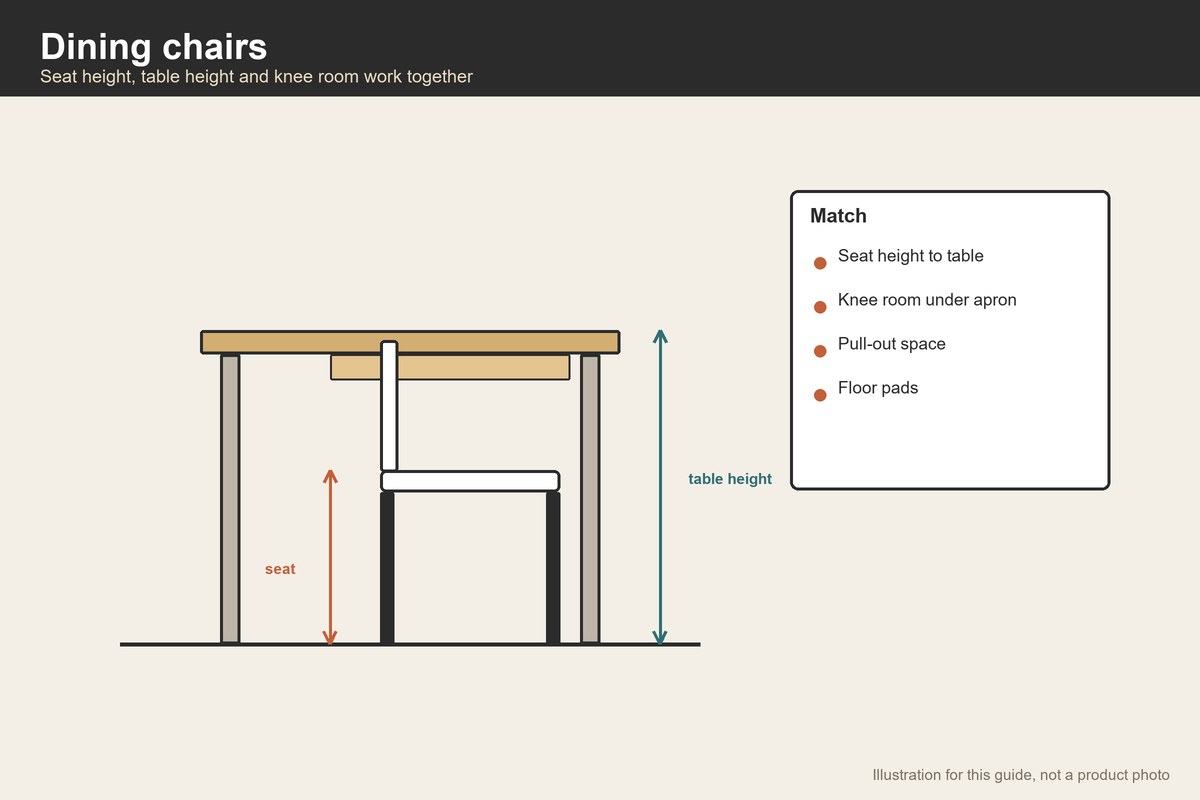
Dining chairs work when the seat height suits the table, the width lets you fit the number of chairs you need and the design is comfortable for the time you sit. A common pairing is a table about 29 to 31 inches high with chairs about 17 to 19 inches in seat height, leaving roughly 10 to 12 inches between the seat and the underside of the tabletop for legs. That is a rule of thumb, and you should measure your own table.
The listings we read on Amazon on 2026-09-30 give a set of four stackable metal chairs at 17 by 21 by 33 inches and about 40 pounds, a single metal chair at 20.1 by 17.1 by 33.5 inches with a 17 inch seat height and about 9.4 pounds, and a set of four faux-leather chairs at 18.5 by 15.74 by 38.58 inches and about 35 pounds. Two of the metal chairs state a 330 pound capacity. We have not tested any of them.
Sit on a chair for ten minutes before you decide, or read the seat depth and back height in the listing.
Match seat height to the table
Measure from the floor to the top of the table and to the underside of the apron or tabletop. Standard dining tables are about 29 to 31 inches high, and dining chairs are about 17 to 19 inches in seat height. The U.S. Access Board’s standards, written for accessible design, place dining surfaces between 28 and 34 inches high with knee clearance beneath, which shows the general range of comfortable seated use. They do not apply to a private dining room.
If your table is 30 inches high and your chair seat is 17 inches, the gap between the seat and the tabletop is 13 inches; if the table’s apron is 3 inches thick, the leg space is 10 inches, a comfortable amount for most adults. A chair with arms may not slide under the table if the arms are higher than the apron. Check the arm height in the listing.
Width, depth and the pull-out zone
Chairs take floor. A chair 17 to 21 inches wide fits about three per 5 feet of table edge if you allow about 24 inches per person, a rule of thumb. Depth matters when you pull out: a chair needs about 18 to 20 inches to slide out and sit. In a small room, choose armless chairs and tuck them fully under the table.
The U.S. Access Board’s accessible-route guidance uses 36 inches as a minimum clear width for a path. It is for public accessible design, not a dining room, but a similar path behind seated diners is comfortable. See kitchen table and chairs for 4 for a full layout and small kitchen table and chairs for tight kitchens.
Stackable, folding, upholstered or wood
Stackable metal chairs. Light, inexpensive and easy to store. A set of four we read weighs about 40 pounds, or 10 pounds each; a single lightweight chair we read is about 9.4 pounds. They are hard, so a cushion helps. Check the stated capacity of 330 pounds. If a listing gives none, treat it as unknown.
Upholstered chairs. More comfortable for long meals, but fabric stains. Faux leather wipes clean but can crack. The set of four we read has a high back of 38.58 inches, which is taller than many, and gives more support.
Wood chairs. Sturdy and repairable. Heavier, and joints can loosen.
Folding chairs. Store flat, but comfort is limited and they are less stable.
Choose by use. For daily long meals, choose upholstered or cushioned. For guests or a small space, choose stackable.
Seat depth, back height and posture
Seat depth affects comfort. A depth of about 16 to 18 inches suits many people, although the listing may not give it. A back that reaches the shoulder blades supports posture. A high back like 38.58 inches gives more support but hides sight lines across the table. A curved back suits long sitting.
If a listing does not state seat depth, treat it as unknown. Test a similar chair.
Floors and noise
Metal chair legs scratch wood and scrape loudly. Add felt pads or plastic glides. On carpet, check the legs do not sink. A chair with a flat foot spreads weight. Replace pads when they wear.
Materials and emissions
Metal frames avoid composite wood. Upholstered chairs may use engineered wood in the frame. Federal rules limit formaldehyde emissions from composite wood products sold in the United States, and a listing may state compliance. Ask if it does not. New foam and fabric can have an odor; air them before use.
Safety
Do not stand on chairs, and do not lean back on two legs. Check that legs are tight. A chair with a stated capacity of 330 pounds is the maker’s claim; heavy loads on a light chair can strain joints.
Assembly and delivery
Sets of four ship in one or two boxes. A set of about 40 pounds is a two-person lift on stairs. Assembly usually takes minutes per chair with an included tool. Check that all screws are included, and tighten after the first week.
A worked example
These are invented numbers for planning. A dining table is 30 inches high with a 3 inch apron, 36 inches wide and 60 inches long. You want four chairs, two on each long side.
Seat height: a 17 inch seat leaves 30 − 17 = 13 inches to the tabletop and 30 − 3 − 17 = 10 inches to the apron, a comfortable leg space.
Width: two chairs per 60 inch side at 21 inches wide take 42 inches, leaving 18 inches between them, so they fit with elbow room. At 24 inches of edge per person, 60 ÷ 24 = 2.5, so two per side is comfortable.
Room: the table is 36 inches wide, and with chairs pulled out 20 inches on each side the footprint is 36 + 40 = 76 inches. In a 108 inch (9 foot) wide room, 108 − 76 = 32 inches remain, or 16 inches per side, tight against the 36 inch reference. A narrower armless chair or a bench would help.
If you choose the single 17.1 inch wide chair with a 20.1 inch depth, the pull-out is about 20 inches, close to the figure above. The set of 21 inch wide chairs would leave less elbow room if you added a third per side.
Questions to ask before you order
Ask the seller for the seat height, seat depth and back height if the listing does not state them. Ask whether the chair’s legs have pads or glides and whether replacements are sold. Ask whether the upholstered seat is removable for cleaning. Ask whether the set is sold as four chairs or as four separate purchases. If you need stackable chairs, ask how many can be stacked and how tall the stack is.
Testing after delivery
Sit in one chair and eat a meal, or sit for ten minutes at the table. Check that your knees clear the table’s apron. Lean back gently to test the stability. Check that each chair is level on the floor. Tighten all screws after a week. If the chairs scrape, add felt pads at once, rather than waiting until the floor is scratched.
Mixing chairs and benches
A mix can work well in a small room: a bench on one side, chairs on the other. Choose a bench with the same seat height as the chairs. Keep the finish family similar, and vary the shape for interest. Remember that a bench has no back and no arms, so it suits shorter sits. Mixing also helps guests, since a bench can seat an extra person.
Mistakes to avoid
- Ignoring seat height. Match the table.
- Forgetting the pull-out zone. Add about 20 inches.
- Choosing arms for tight tables. They may not tuck under.
- Skipping floor pads. Metal scratches.
- Buying for looks. Sit for ten minutes.
- Trusting a missing capacity. Look for a stated limit.
When to skip new chairs
If your table is fine and the chairs are only worn, new cushions may be enough. If space is very tight, a bench on one side saves room; see breakfast nook dining set.
Related guides
See dinette sets for small spaces, bistro table and chairs and card table and chairs.
Frequently asked questions
What seat height should dining chairs have?
A common pairing is 17 to 19 inches for a table about 29 to 31 inches high. Measure your table.
How many chairs fit at a table?
About 24 inches of edge per person is a rule of thumb.
Are metal chairs comfortable?
They are firm. Add a cushion for long meals.
Do I need arms?
Arms add comfort but need width and may not tuck under.
How do I stop chairs scratching floors?
Use felt pads or plastic glides, and replace them when worn.
Bottom line
Choose dining chairs by matching seat height to the table, checking width and pull-out space and testing comfort. Add floor pads and use a bench or stackable chairs if the room is tight.
Products worth checking
We have not tested these products. Sizes and features come from the Amazon listings, checked on September 30, 2026; where a listing does not say, we say so.
FDW Metal Dining Chairs, Set of 4, Stackable Tolix Side Chairs
The listing gives 17 x 21 x 33 in; 40 lb (set). We re-opened the page on September 30, 2026 and found these figures; other details are on the product page.
- Good for: stackable chairs for a small table or guests.
- Keep in mind: metal seats are firm, and the page shows several seat heights across variants.
Amazon Basics Metal Dining Chairs, Stackable
The listing gives 20.1 x 17.1 x 33.5 in; 9.4 lb. We re-opened the page on September 30, 2026 and found these figures; other details are on the product page.
- Good for: a light stackable chair with a stated seat height.
- Keep in mind: it is firm without a cushion.
Karl home Dining Chairs Set of 4, PU Leather and High Back
The listing gives 18.5 x 15.74 x 38.58 in; 35 lb (set). We re-opened the page on September 30, 2026 and found these figures; other details are on the product page.
- Good for: a padded high-back chair for longer meals.
- Keep in mind: faux leather can crack over time, and the text we read gives no weight limit.
Sources checked
- ADA Standards
- Accessible routes guide
- Formaldehyde emission standards for composite wood products
- FDW Metal Dining Chairs, Set of 4, Stackable Tolix Side Chairs
- Amazon Basics Metal Dining Chairs, Stackable
- Karl home Dining Chairs Set of 4, PU Leather and High Back
Specifications checked on September 30, 2026. Product details and availability can change, so confirm on the product page before you buy.