As an Amazon Associate I earn from qualifying purchases. Links marked “Affiliate link” may earn us a commission at no extra cost to you. Learn more.
Quick answer
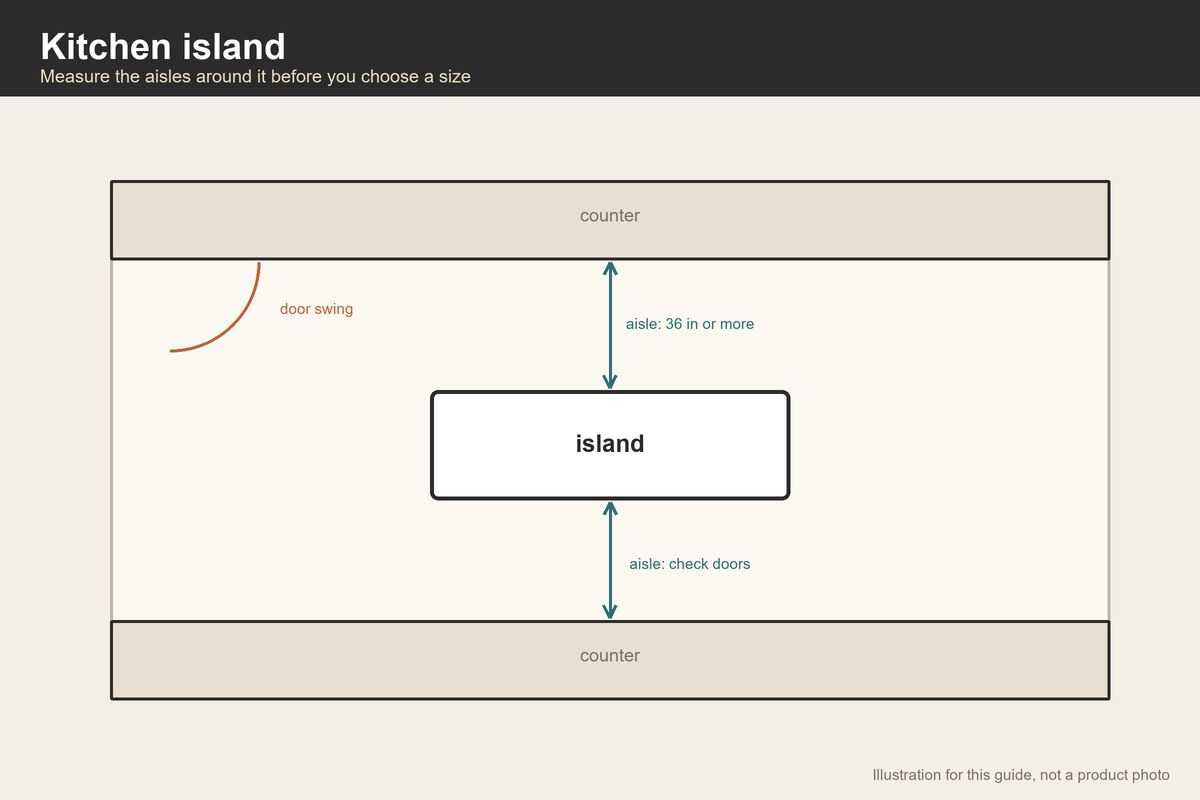
A kitchen island works when the aisles around it stay wide enough to walk and open appliance doors, and when its top and storage match how you cook. There is no single right size. Start from the floor: measure the clear space, subtract the island, and check what is left on each side. The U.S. Access Board uses 36 inches as a minimum clear width for a route and 32 inches at short obstructions. That is guidance for accessible design in public buildings, not a rule for homes, but it is a helpful yardstick for a workable aisle.
The islands we read on Amazon on 2026-09-30 are small movable or freestanding pieces, not built-in cabinetry. One lists 18.9 by 35.4 by 38.2 inches (the variant we opened) with a 43 pound shelf load and 66 pounds of weight; another lists 18.9 by 35.4 by 35.8 inches at 36 pounds with a 66 pound load rating; a third lists 15 by 32.8 by 32.7 inches at 41.4 pounds. We have not tested any of them. If your kitchen can take a larger, fixed island, you will need a contractor or a cabinet maker, and this guide cannot size that for you.
For a movable cart, see kitchen island on wheels, which covers casters and parking.
Decide what the island is for
Extra prep surface is the most common reason. Storage comes second, seating third. An island that tries to do all three is large. In a small kitchen, choose one job.
Prep surface. You need a flat top and knee-free access to the edge. Work close to the sink and stove.
Storage. Drawers, shelves and hooks. Count what you would store and compare it with the shelf sizes and load limits in the listing.
Seating. Stools need overhang, space behind them and legs that clear the island. This is the hardest job in a small kitchen. See small kitchen table and chairs as an alternative.
Measure the aisles first
Measure the free floor between counters or between a counter and the wall. Then subtract the island’s depth. The remainder is split between two aisles, or one aisle if the island sits against a wall.
For a work aisle, many kitchen designers suggest a wider clearance than the 36 inch route reference, because people stand at counters and open appliances. Figures such as 42 to 48 inches are often quoted; we have not opened a published standard for those, so treat them as common design advice rather than a rule. The 36 inch Access Board figure is a route width, not a work-aisle width.
Open every appliance door and drawer with tape on the floor. A dishwasher door, an oven door and a refrigerator door can all swing into the aisle. If a door hits the island, the island is too close.
Height and top
The islands we read are about 32.7 to 35.8 inches high. Many kitchen counters are about 36 inches, which is a common height, not a standard. A lower island suits baking and kneading; a higher one suits chopping. If you want stools, a counter-height island needs stools whose seat is about a foot lower than the top, a rule of thumb.
A top of engineered wood or particleboard scratches and swells if wet. Use a cutting board, wipe spills promptly and keep hot pans off unless the listing says the top is heat resistant.
Storage and load limits
The listings we read include shelves, drawers, hooks, a spice rack and a power outlet. Load limits differ: one lists a 43 pound load for the wooden shelf, another 66 pounds, and a third states a static load of up to 66 pounds. Those numbers are the makers’ claims. A stand mixer can weigh about 20 pounds or more, so check that the top can hold your heaviest appliance. If the listing does not say what the number applies to, treat it as unknown.
Power, cords and safety
A power outlet on an island is convenient but needs a wall outlet and a cord that does not cross the aisle. Keep cords away from the stove. Do not place a hot appliance on a top that is not rated for it. Tall wobbly pieces should not be climbed on, and a fixed island should be secured according to the instructions.
Composite wood is covered by federal formaldehyde emission rules in the United States, and a listing may state compliance. Ask if it does not.
A worked example
These are invented numbers for planning. A kitchen has two counters facing each other, each 25 inches deep, with 9 feet (108 inches) between the walls. The aisle between the counters is 108 − 25 − 25 = 58 inches.
You consider an island 18.9 inches deep. The remaining aisle is 58 − 18.9 = 39.1 inches. Centered, that is 39.1 ÷ 2 = 19.55 inches on each side, far too tight for two people to pass or for an oven door to open. If the island sits against one counter, the single aisle is 39.1 inches, above the 36 inch route reference but below the 42 to 48 inch figures often quoted for work aisles.
Try the 15 inch deep island: 58 − 15 = 43 inches, or 21.5 inches each side if centered. Against a counter, the single aisle is 43 inches, comfortable for one cook.
So, in this kitchen, neither island fits in the middle, and the shallower one works against a counter. A cart on wheels that you park elsewhere would be a better fit.
Fixed island or cart?
A fixed island is stable and can hold heavy tops and sinks, but it needs planning and often a contractor. A movable island or cart costs less and can move to where you work. The islands we read are the freestanding kind, with shelves, drawers and hooks, and they weigh from about 36 to 66 pounds. That is heavy enough to feel steady but light enough to shift by pushing.
Seating at an island
Seating needs overhang so knees have somewhere to go. The islands we read do not state an overhang. A common design habit is to allow about 12 inches of overhang for stool seating, but we have not opened a published source for that number, so treat it as advice, not a rule. Add space behind the stools for people to pass. In a small kitchen the overhang, the stools and the aisle add up quickly; see kitchen island on wheels for a movable option that avoids the problem.
Power, light and safety
An island in the middle of a kitchen may need power for a mixer or a lamp. A fixed island needs a qualified electrician; a freestanding one needs a cord and a wall outlet. Keep cords away from the stove and the aisle. Good task lighting over the work area matters as much as the island itself. Tall islands can obstruct the cook’s view of children; place them with that in mind.
A quick decision path
If your aisle after the island is under about 36 inches, do not add one. If it is between 36 and about 42 inches, choose a shallow movable cart and park it when you cook with two people. If it is above that, a fixed or freestanding island with storage may fit. Decide the main job first, then compare only the models that serve it, and tape the outline before you order.
Mistakes to avoid
- Buying before measuring the aisles. The island takes floor from both sides.
- Ignoring appliance doors. Open them with tape on the floor.
- Expecting seating in a small kitchen. Stools need overhang and space behind.
- Trusting a load number. Check what it covers.
- Putting an island where the cords cannot reach. Plan power first.
When to skip an island
If the aisle after the island is under about 36 inches, do not add one. A rolling cart, a wall shelf or a table may serve better. If you only need more counter, a foldable table can appear when needed.
Related guides
See kitchen island on wheels, buffet cabinet and kitchen table and chairs for 4.
Frequently asked questions
How much space do I need around a kitchen island?
Enough for a comfortable aisle. The Access Board’s 36 inch route width is a yardstick; many kitchen guides quote 42 to 48 inches for work aisles.
Can I fit seating at a small island?
Only if the island has overhang and there is room behind the stools. In a small kitchen, a table may be simpler.
How big is a small kitchen island?
The ones we read are about 15 to 19 inches deep, 33 to 35 inches wide and 33 to 36 inches high.
Can an island hold a stand mixer?
Check the load rating and where the number applies.
Should I choose fixed or movable?
Movable if the room is tight or the island is occasional; fixed if you need stable storage and a built-in look.
Bottom line
A kitchen island fits only if the aisles around it stay usable. Measure the free floor, tape the island and the appliance doors, and choose a shallower or movable piece if the numbers are tight.
Products worth checking
We have not tested these products. Sizes and features come from the Amazon listings, checked on September 30, 2026; where a listing does not say, we say so.
HOOBRO Kitchen Island with Storage, Industrial Kitchen Counter
The listing gives 18.9 x 38.2 in listed footprint and height (variant opened); 66 lb. We re-opened the page on September 30, 2026 and found these figures; other details are on the product page.
- Good for: a freestanding island with three shelves.
- Keep in mind: the page lists several heights (35.8 to 38.2 in) across variants, and the shelf load is only 43 lb.
HOOBRO Kitchen Island with Wine Rack, Industrial Island Counter
The listing gives 18.9 x 35.4 x 35.8 in (D x W x H); 36 lb. We re-opened the page on September 30, 2026 and found these figures; other details are on the product page.
- Good for: a lighter island with a wine rack and drawers.
- Keep in mind: it is 35.4 in wide, which takes real floor in a small kitchen.
MAHANCRIS Kitchen Island with Power Outlet, Storage Island with Drawer
The listing gives 15 x 32.8 x 32.7 in (D x W x H); 41.4 lb. We re-opened the page on September 30, 2026 and found these figures; other details are on the product page.
- Good for: a shallower island with an outlet and a spice rack.
- Keep in mind: the outlet needs a wall plug and the page lists other sizes across variants.
Sources checked
- Accessible routes guide
- Formaldehyde emission standards for composite wood products
- HOOBRO Kitchen Island with Storage, Industrial Kitchen Counter
- HOOBRO Kitchen Island with Wine Rack, Industrial Island Counter
- MAHANCRIS Kitchen Island with Power Outlet, Storage Island with Drawer
Specifications checked on September 30, 2026. Product details and availability can change, so confirm on the product page before you buy.