As an Amazon Associate I earn from qualifying purchases. Links marked “Affiliate link” may earn us a commission at no extra cost to you. Learn more.
Quick answer
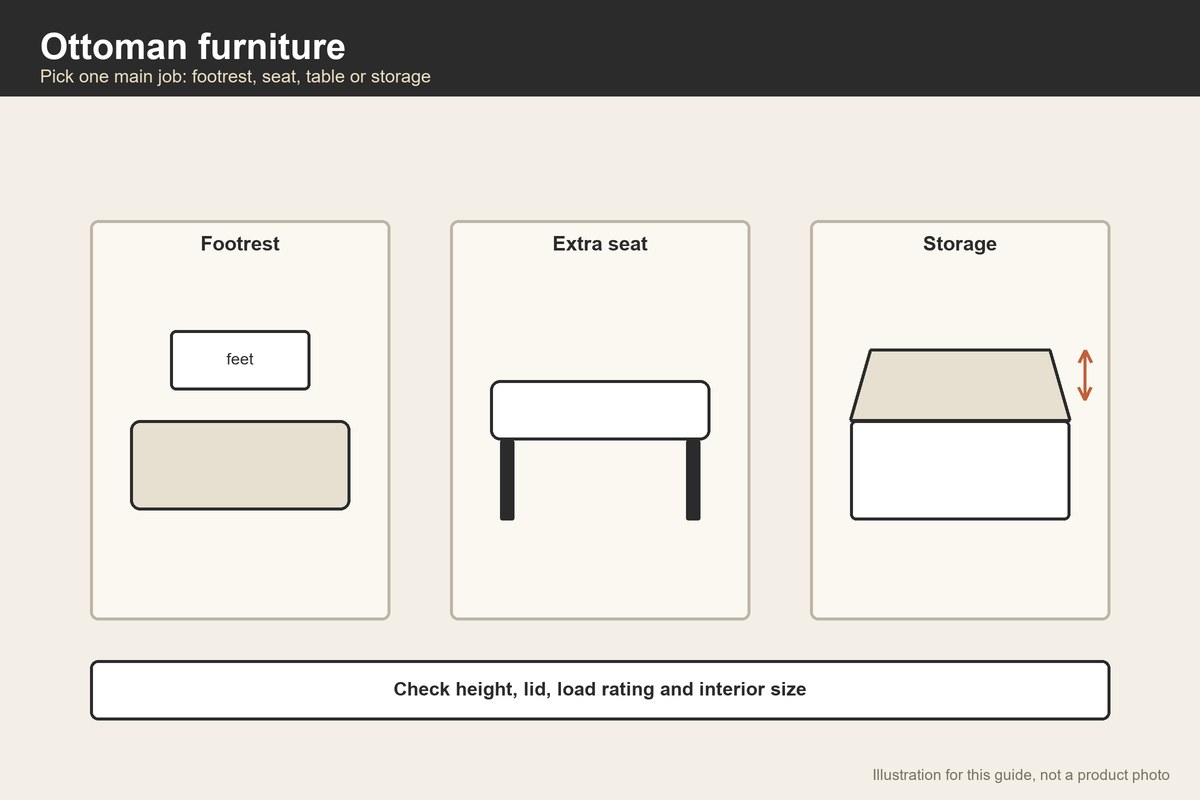
An ottoman is a low upholstered piece that can be a footrest, an extra seat, a coffee table or storage, and the right one depends on the job. The numbers to check are the height, the weight capacity of the top, the inside storage size and how the lid opens. The listings we read on Amazon on 2026-09-30 give folding storage ottomans about 30 inches wide, 13 to 15 inches deep and 13 to 15 inches high, weighing about 9.5 to 12.3 pounds, and a small folding cube of about 16.1 by 12.2 by 12.2 inches. One title states a 660 pound load. We have not tested any of them.
If you want an ottoman mainly for storage, compare it with a bench or a chest. If you want a footrest, height and firmness matter most.
Pick the job
Footrest. The top should be about the height of your seat, or a few inches lower. A footrest that is too high tilts your pelvis; one too low does not help. A height of about 15 inches suits many sofas, but measure yours.
Extra seat. A firm top with a stated weight capacity and a stable base. A folding ottoman that says it holds 660 pounds is designed as a bench; the listing may not say how the load is tested, so treat the figure as the maker’s claim.
Coffee table. A large, flat top and a wipeable surface. Add a tray to hold cups.
Storage. Interior size, lid weight and how the lid opens.
Match the job to the design, since a soft round pouf is a poor table and a firm rectangle is a poor footrest for someone who wants to sink in.
Height, width and depth
Ottomans range from small cubes of about 12 inches to benches of 30 inches or more. A 30 by 15 inch rectangle covers 450 square inches, or 3.1 square feet; a 16.1 by 12.2 inch cube covers 196 square inches, or 1.4 square feet. That means the cube takes about 44 percent of the bench’s floor.
Choose a footprint that leaves a path. The U.S. Access Board’s accessible-route guidance uses 36 inches as a minimum clear width for a path. That is for public accessible design, not your living room, but a similar clear path is comfortable. An ottoman that is easy to move helps: the folding models we read weigh 9.5 to 12.3 pounds.
Storage: inside size and lid
A folding storage ottoman opens with a lid that lifts off or hinges. The interior size is not always listed, and the walls and lid take part of the outside size. A listing may give a capacity in gallons; the small cube we read lists capacities of about 6.8 to 11 gallons across variants. If a listing does not state the interior, treat it as unknown.
Check the lid. A loose lid slides off. A hinged lid can pinch fingers unless it is a soft-close design. If you use the ottoman as a seat, the lid must carry weight, so check the load rating and the thickness of the lid material. Engineered wood and foam lids can dent under repeated sitting.
Store items you rarely use, such as blankets, toys and out-of-season clothing. Avoid heavy items that can jam the folding walls.
Folding, collapsing and moving
Folding ottomans collapse flat, which is helpful in a small apartment. Check that the sides lock open and that the folds do not sag. A folding design is lighter but less rigid than a solid one. If you move often, a folding ottoman is easier to carry.
Fabric and cleaning
Linen-look, velvet, faux leather and polyester are common. Faux leather wipes clean but can crack. Linen-look hides dust but stains. For pets and children, choose a tightly woven fabric, and consider a cover you can remove. The small cube we read is described with linen-look fabric and foam; other details are model-specific.
Safety
A soft ottoman is a tripping risk in a dark room. Place it where you do not walk at night. A folding ottoman can pinch fingers. Do not let children climb on lightweight tops. Keep cords away.
Composite wood parts fall under federal formaldehyde emission rules in the United States, and a listing may state compliance. Ask if it does not.
Using an ottoman with a sofa or bed
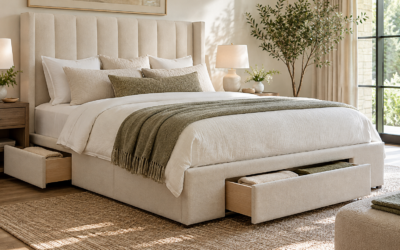
At the end of a bed, a 30 inch bench-style ottoman holds a blanket and gives a place to sit while putting on shoes. It should not block a walkway; a bed with a footboard leaves less room. See bed frame with storage if you want storage under the bed instead. In a living room, an ottoman can slide under a console when not in use or sit in front of an accent chair. Compare with a small coffee table if you want a surface.
A worked example
These are invented numbers for planning. A living room has a sofa 84 inches wide and a coffee table 30 by 18 inches placed 16 inches from the sofa. You want an ottoman for two roles: a footrest and a blanket store.
A 30 by 15 inch ottoman that is 15 inches high: the sofa seat is 18 inches high, so the top is 3 inches lower, a comfortable footrest. It replaces the coffee table if you add a tray, freeing 30 × 18 = 540 square inches minus 30 × 15 = 450 square inches, so the ottoman takes 90 square inches (0.6 square feet) less floor than the table.
Path: the ottoman sits 16 inches from the sofa and is 15 inches deep, ending 31 inches from the sofa. If the TV stand is 72 inches from the sofa, 72 − 31 = 41 inches remain, above the 36 inch reference.
Capacity: if the interior is 28 by 13 by 12 inches (an assumption, since the listing does not state it), it holds 28 × 13 × 12 = 4,368 cubic inches, about 18.9 gallons (231 cubic inches per gallon). That is roughly three folded blankets. Treat that as an estimate.
Questions to ask before you order
Ask for the interior dimensions, the lid weight and how the lid stays open. Ask whether the top is padded and how thick the foam is. Ask whether the folding walls include a stiffener and whether the bottom is a solid panel. Ask what the load rating covers, such as a person sitting or a static load. If you want it as a coffee table, ask whether the top is wipeable and whether a tray is included.
Testing after delivery
Unfold the ottoman and press each wall to check that it locks. Sit for a short time to test the top. Open and close the lid several times to check for pinch points. Put a stack of blankets inside to see how much fits. Check that the ottoman does not wobble on your floor. If the fabric has a smell, air the piece outside before use.
Keeping it useful
An ottoman that stores things should be used weekly, or it becomes a place to dump items. Keep a small list of what is inside. Rotate seasonal items. Empty it once a year and wipe the interior. If you use it as a table, keep a tray on top to protect the fabric.
A quick decision path
If you want a footrest, choose a firm top at about seat height. If you want storage, choose a larger box with a stated interior. If you want a bench at the end of a bed, choose a long, low ottoman with a firm lid. If the room is tiny, choose a folding cube that disappears when not in use. Write your main job first, then ignore designs that do not serve it. An ottoman that does three jobs poorly is less useful than one that does a single job well.
Mistakes to avoid
- Ignoring height. A footrest that is too high or low does not help.
- Trusting a load figure. It is the maker’s claim.
- Overlooking the lid. A heavy or loose lid is a nuisance.
- Filling folding walls with heavy items. They can sag.
- Blocking the path. Tape the footprint.
- Buying by fabric alone. Check structure and capacity.
When to skip an ottoman
If you rarely rest your feet up, a slim bench or a stool may be enough. If you need storage more than seating, a chest of drawers or a shelf may hold more; see chest of drawers.
Related guides
See loveseat, accent chairs and coffee table with storage.
Frequently asked questions
How tall should an ottoman be?
For a footrest, about the height of your seat or a few inches lower. Measure your sofa.
Can I sit on a storage ottoman?
Only if the listing says it is designed to hold weight. Check the stated load.
How much can a folding ottoman store?
Check the listing for capacity. Interior size is often not stated, so treat it as unknown.
Is an ottoman a good coffee table?
It can be, with a tray. A flat firm top helps.
Are folding ottomans sturdy?
They can be, but they are less rigid than solid ones. Check the lock and the reviews.
Bottom line
Choose an ottoman by job, height and capacity. Measure the space, check the lid and load rating and skip it if a stool or bench would serve better.
Products worth checking
We have not tested these products. Sizes and features come from the Amazon listings, checked on September 30, 2026; where a listing does not say, we say so.
SONGMICS 30 Inches Folding Storage Ottoman Bench
The listing gives 15 x 30 x 15 in; 12.3 lb. We re-opened the page on September 30, 2026 and found these figures; other details are on the product page.
- Good for: a foldable bench-size ottoman for storage and seating.
- Keep in mind: the 660 lb figure is the maker’s claim, and the interior size is not in the text we read.
Snuvid 30-Inch Ottoman with Storage, Footrest Storage Bench
The listing gives 13 x 30 x 13 in; 9.53 lb. We re-opened the page on September 30, 2026 and found these figures; other details are on the product page.
- Good for: a light bench for the end of a bed.
- Keep in mind: it is lower than most sofas, and the text we read gives no load limit.
SONGMICS Small Folding Storage Ottoman, 15.8 x 12.2 x 12.2 Inches
The listing gives 12.2 x 16.1 x 12.2 in; seat height 12.2 in. We re-opened the page on September 30, 2026 and found these figures; other details are on the product page.
- Good for: a small cube for a footrest or a hidden box.
- Keep in mind: it is small, and the page shows several capacities across variants.
Sources checked
- Accessible routes guide
- Formaldehyde emission standards for composite wood products
- SONGMICS 30 Inches Folding Storage Ottoman Bench
- Snuvid 30-Inch Ottoman with Storage, Footrest Storage Bench
- SONGMICS Small Folding Storage Ottoman, 15.8 x 12.2 x 12.2 Inches
Specifications checked on September 30, 2026. Product details and availability can change, so confirm on the product page before you buy.