As an Amazon Associate I earn from qualifying purchases. Links marked “Affiliate link” may earn us a commission at no extra cost to you. Learn more.
Quick answer
A small coffee table works when it leaves a comfortable gap to the sofa, a clear path on the other sides, and enough surface for what you actually put on it. Start with the room, not the table. Measure the space in front of the sofa, decide what the table must hold, and choose a size that leaves walking room.
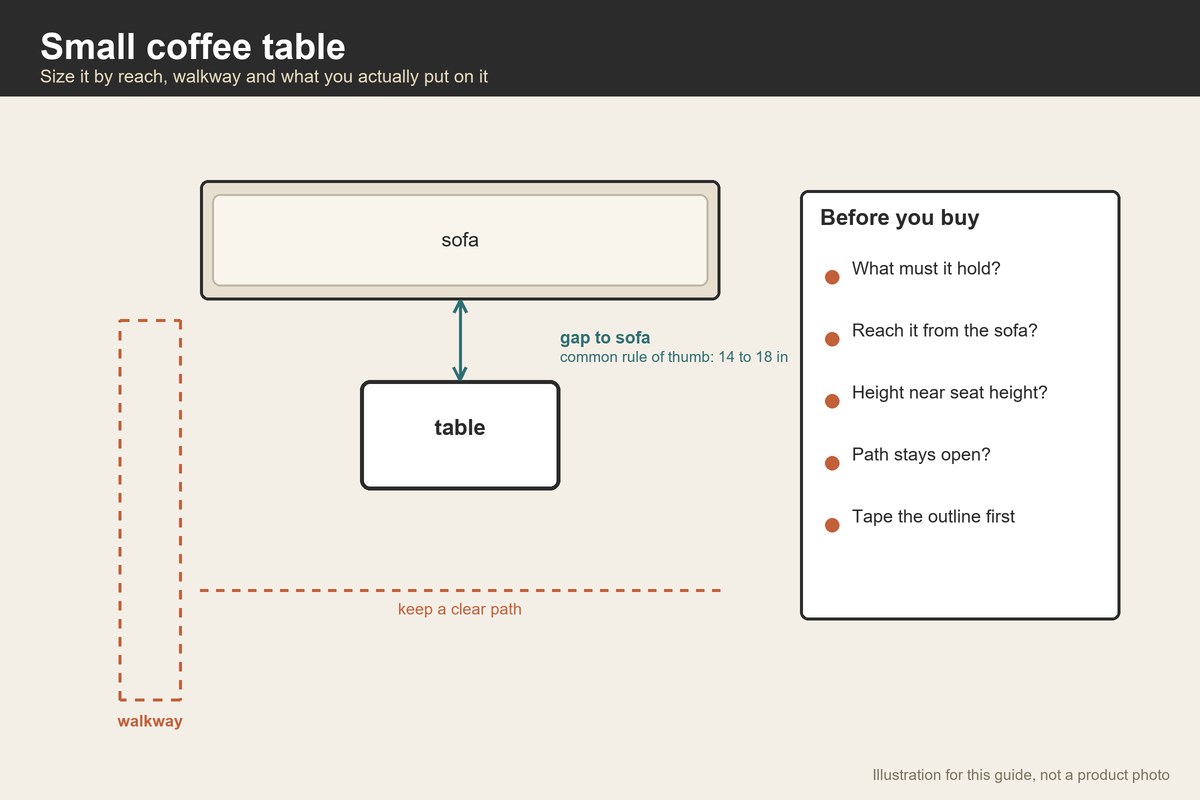
Designers often suggest keeping the table roughly 14 to 18 inches from the sofa edge, and choosing a table height close to the sofa seat height. These are common rules of thumb, not standards, and they are starting points you should test in your room. The best small coffee table is often smaller than the one you first imagine, because a table that fits on paper can still feel like an obstacle when you walk past it every day.
This guide is about sizing and use. We have not tested products, and this article does not recommend specific models.
Decide what the table must do
A coffee table can be a place for drinks, a remote and a book, or it can be the room’s main work surface, a footrest, a play area and a spot for a laptop. The more jobs it has, the more surface and stability it needs. List the jobs before measuring.
- Drinks and remote only: a small round or oval table with a modest top works.
- Laptop or meals: you need a stable, flat surface at a comfortable height, and a table that is too low can strain your back.
- Footrest: a sturdy, slightly larger table or an ottoman-style top.
- Storage: see our coffee table with storage guide for lid and drawer clearance.
If the table has one job, choose a smaller size. If it has three, consider whether a bigger table or a second piece would serve better.
Measure the gap to the sofa
Sit on the sofa and stretch your arm toward where the table will stand. The table should be reachable without leaning forward too far, yet leave space for your legs to move. The common guidance of 14 to 18 inches between the sofa edge and the table is a useful starting number. Shorter than that, and getting in and out of the sofa becomes awkward. Longer than that, and you must lean to reach a cup.
Test it with painter’s tape. Mark the sofa edge, then mark the table’s outline the chosen distance away. Sit down and try setting a cup on the taped area. Stand up and walk around it. The tape test costs nothing and takes minutes.
Keep a walking route
The most common small-room problem is a coffee table that blocks the way from the door to the window, or from the sofa to the TV. Trace your normal paths and check that the table does not sit on any of them.
The U.S. Access Board’s accessible-route guidance uses 36 inches as a minimum clear width for a path, and shorter obstructions can reduce that to 32 inches. That standard is written for accessible design in public settings, not for a home living room, but it is a helpful reference for what a comfortable route feels like. If the path beside your coffee table is much narrower than that, expect to bump into it.
If the room is very tight, look at a nesting set, a table with a lift-top, or a small side table that can move. A console table behind the sofa can hold items without occupying floor space in front.
Height and top: match the sofa
A common rule of thumb is to choose a coffee table height about equal to the sofa seat height, or a couple of inches lower. A table that is much higher than the seat makes reaching awkward. A table much lower forces you to bend. Measure the seat height of your sofa from the floor to the top of the cushion when compressed slightly, and compare it to the table’s listed height.
Remember that this is a guideline. If you use the table mainly for a laptop while sitting on the floor, or for meals, the ideal height changes.
Top material and edges matter more in a small room than people expect. Rounded corners and softer edges reduce bumps in tight spaces. A top with a lip keeps items from sliding. Glass shows fingerprints and can be hazardous around small children; a solid top is more forgiving.
Shape: round, oval, square or rectangular
A round or oval table has no corners to catch on, and it makes a narrow room feel more open. A rectangular table usually gives more usable surface per footprint and lines up with a sofa. A square table suits a square seating area. For a shape-specific discussion, see round coffee table.
If you want the most usable surface, compare the flat top area, not the overall size. A table with a large overhang or a curved edge may have less flat area than its footprint suggests.
Legs, stability and movement
A small table must be stable because it holds cups. Legs at the corners are stable; a single pedestal can tip if bumped. If you have children or pets, prefer a low center of gravity and a broad base.
Check whether the legs are attached firmly and whether the table wobbles on your floor. A felt pad under each leg protects floors.
If the table needs to move often, consider a lighter table or one with casters. Locking casters help avoid rolling when you lean on it.
A worked example
This is an illustration with invented numbers, not a product. Your living room has a sofa that is 72 inches long with a seat height of 18 inches. The distance from the sofa front to the TV stand is 60 inches. The path from the door passes on the left.
You want a table that holds two drinks and a remote, and may serve as a footrest occasionally. Using 14 to 18 inches as the gap, you plan for 16 inches from the sofa edge. The table then starts 16 inches out and, if it is 20 inches deep, ends 36 inches from the sofa. The remaining distance to the TV stand is 60 − 36 = 24 inches. That is narrower than the 32- to 36-inch route reference, so you could not walk between the table and the TV comfortably.
Try a 16-inch-deep table instead: it ends 32 inches from the sofa, leaving 60 − 32 = 28 inches. That is still tight. So the honest conclusion is that this room cannot support a walking route on the TV side with any table of this kind, and you should keep your route on the door side, or choose a very shallow table or a lift-top piece that can be pushed aside. The lesson is that the answer depends on where you actually walk, and the arithmetic takes only a minute.
It also shows why the sofa gap and the table depth must be added together. Many people measure the table alone, then find the room feels crowded. Writing the numbers in a row, sofa to table, table depth, table to next object, makes the trade-off visible before you buy.
When you might not need a coffee table
Some small rooms work better without one. A pair of small side tables, a tray table that stores away, or a wall shelf can hold drinks and the remote. If the coffee table blocks more than it helps, remove it for a week and see whether you miss it.
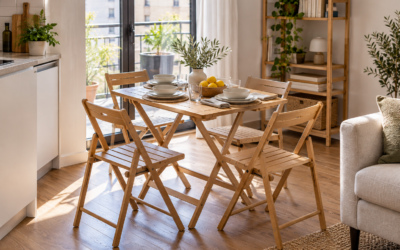
If you host rarely, a nesting set or a folding table can appear on demand. Our folding table guide covers size and storage for those.
Mistakes to avoid
- Measuring only the table. Measure the gaps around it.
- Choosing by looks alone. Test the reach and the route.
- Ignoring height. Compare with the sofa seat.
- Buying glass with small children. A solid top is more forgiving.
- Forgetting stability. Small tables are easy to bump.
- Assuming smaller is always better. A table too small becomes unusable.
Frequently asked questions
How big should a small coffee table be?
It depends on the sofa and the room. Use the 14–18 inch sofa gap as a starting point and check walking routes with tape.
What height should a coffee table be?
A common guideline is close to the sofa seat height or a couple of inches lower. It is a rule of thumb, not a standard.
Round or rectangular for a small room?
Round tables avoid corners; rectangular tables give more surface. Test both with tape.
Can I skip a coffee table?
Yes. Side tables or a tray may work better in a very tight room.
Is glass a good choice?
Glass looks light but shows marks and can be a hazard around small children. Consider your household.
Bottom line
A small coffee table is right when it leaves the reach, the route and the height comfortable. Tape it out, match the sofa height, and choose the size that suits the jobs it must do. If it blocks more than it helps, skip it.
Products worth checking
We have not tested these products. Sizes and features come from the Amazon listings, checked on September 30, 2026; where a listing does not say, we say so.
FAMIDGE 23.6-inch Round Coffee Table, Black
The listing gives 23.6 x 23.6 x 17.7 in; 5 lb. We re-opened the page on September 30, 2026 and found these figures; other details are on the product page.
- Good for: a light round accent for a compact seating group.
- Keep in mind: the text we read gives no weight capacity, and 5 lb is very light.
Furinno Andrey Coffee Table with Bin Drawer
The listing gives 18.9 x 31.5 x 15.6 in; 22.9 lb. We re-opened the page on September 30, 2026 and found these figures; other details are on the product page.
- Good for: small items you want in drawers rather than under a lid.
- Keep in mind: drawer interior dimensions are not stated in the text we read.
Vanrohe Small Round Coffee Table with Open Storage, 23.5-inch
The listing gives 23.5 x 23.5 x 18 in; 18.3 lb. We re-opened the page on September 30, 2026 and found these figures; other details are on the product page.
- Good for: a small round table that also holds a shelf of items.
- Keep in mind: the lower tier is open, so it suits tidy items only.
Sources checked
- Accessible routes guide
- FAMIDGE 23.6-inch Round Coffee Table, Black
- Furinno Andrey Coffee Table with Bin Drawer
- Vanrohe Small Round Coffee Table with Open Storage, 23.5-inch
Specifications checked on September 30, 2026. Product details and availability can change, so confirm on the product page before you buy.