As an Amazon Associate I earn from qualifying purchases. Links marked “Affiliate link” may earn us a commission at no extra cost to you. Learn more.
Quick answer
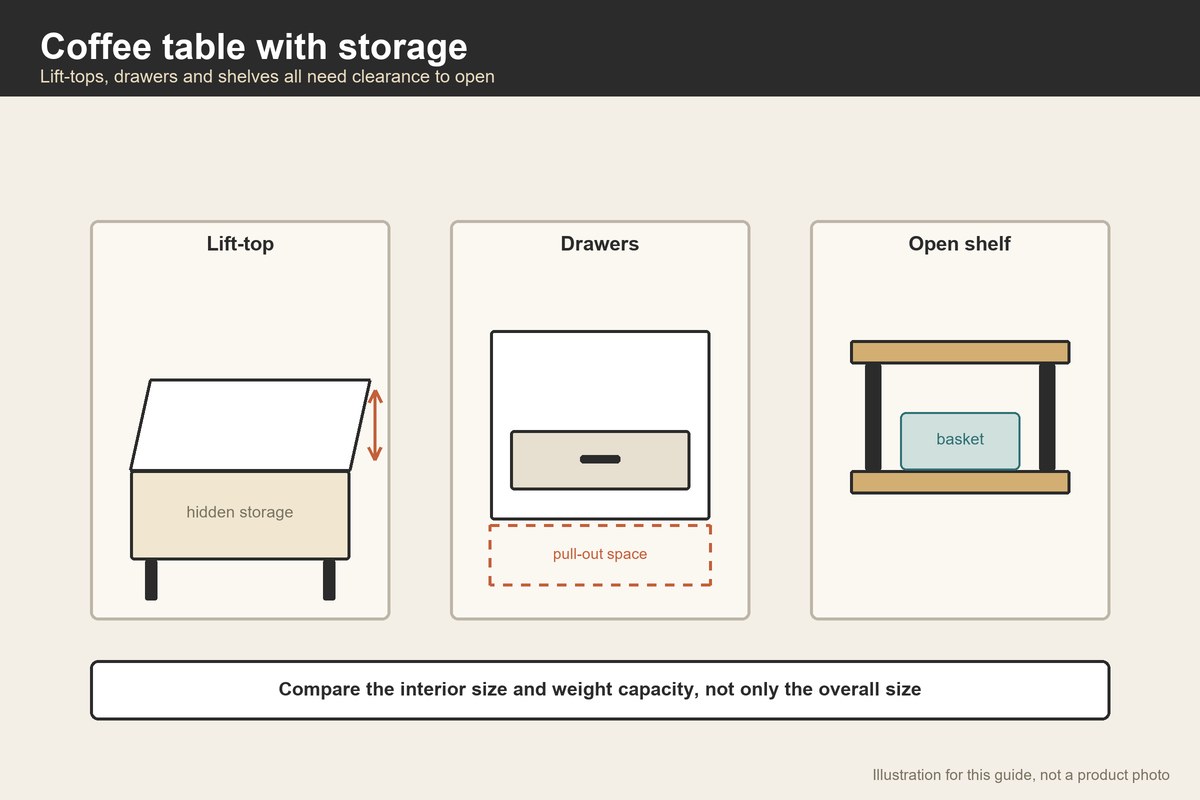
A coffee table with storage helps a small living room only if the storage opens fully where you put the table and holds the things you would otherwise leave out. The main types are lift-top tables, tables with drawers, tables with a lower shelf and tables with hidden compartments. Each needs different clearance, and each suits different items.
Before buying, list what you want to store, measure the space between the sofa and the table, and check the listing for interior dimensions rather than overall size. A lift-top needs vertical room and a lid that stays open; drawers need pull-out room at the side or end; a shelf needs no clearance but shows everything on it.
This guide is about planning and fit. We have not tested any table, and it does not recommend models.
Start with what you want to hide
Storage is only useful if it holds the right things. Common candidates are remotes, blankets, board games, magazines, chargers and kids’ toys. Group them by how often you reach for them.
Items used daily, such as remotes and coasters, should be within easy reach and fast to grab, so an open shelf or a shallow drawer works. Items used weekly, such as games and throws, can live in a lift-top or deep drawer. Items used rarely may not belong in a living-room table at all.
Measure your biggest item. A folded blanket, a board game box or a laptop is a good test. Compare its size to the listing’s interior dimensions. If the listing shows only overall dimensions, the interior is unknown because the walls, lids and frame use up part of the outside size.
The four storage types
Lift-top. The top rises and often moves forward to form a work surface. It is useful for laptops and meals, and the compartment beneath is deep. The risks are pinched fingers, a mechanism that fails and the need to clear the top before opening. Check whether the lid stays up on its own and how much clearance it needs above and in front.
Drawers. Drawers make items easy to reach and sort. They need pull-out space, which competes with the sofa gap. A drawer on the sofa side is awkward when you are seated; a drawer on the end faces the side of the room. Check whether the drawer glides on runners and whether it stops at full extension.
Lower shelf. A shelf under the top needs no clearance and holds baskets or books. It is the simplest and least expensive format, but everything is visible, so it suits tidy or decorative items.
Hidden compartments and ottoman-style lids. A cube or ottoman table has a lid that lifts off or hinges. These are large and soft-edged, good for children and footrests, and less useful as a stable work surface.
Clearance: the gap to the sofa
A coffee table is commonly placed roughly 14 to 18 inches from the sofa edge, a designer rule of thumb rather than a standard. If the table has drawers or a lift-top, that gap has to accommodate the opening as well as your legs.
Use painter’s tape. Mark the table outline. Then mark the pull-out length of the drawer, or the forward travel of a lift-top, using the listing’s figure if it gives one. If it does not, use the drawer depth as a working estimate and label it so. Sit on the sofa and imagine opening the drawer: can you do it without standing up, and can you stand up while it is open?
If the space is tight, choose a lift-top that opens toward you and a drawer that opens sideways, or a shelf-only design.
Walking routes and floor space
Storage furniture is often taller and deeper than a simple table, so it uses more floor. Check that the table does not block your path. The U.S. Access Board’s accessible-route guidance uses 36 inches as a minimum clear width, narrowing to 32 inches only at short obstructions. It is written for accessible design in public buildings, not homes, but gives a useful comfort reference. If the route beside the table is much narrower, you may be moving the table daily.
For a compact room, see our small coffee table sizing guide, and consider a console table behind the sofa for extra surface.
Weight, stability and safety
Storage tables carry more weight than open ones, both from the table itself and from the items inside. Check for a stated weight capacity on the top and inside the storage. If the listing gives none, treat it as unknown.
Lift-tops have moving parts. Look for mechanisms that hold the top open and lower it slowly. A lid that drops can pinch fingers, a real concern with children. Ask whether there are soft-close hinges or supports, and if the listing does not say, assume there are none.
Tables with drawers can tip if a drawer is pulled out fully and loaded, especially if a child leans on it. The Consumer Product Safety Commission’s Anchor It campaign focuses on tip-over hazards of furniture and TVs. While coffee tables are low, the same habit of checking stability applies where there are young children.
Materials and finish
Coffee tables are made from solid wood, veneered wood, metal, glass and composite. Glass tops show marks and can shatter, so they may not suit a home with small children. Wood tops handle scratches better and can be refinished. Composite wood is used in many storage tables, and federal formaldehyde emission standards apply to composite wood products sold in the United States. A listing may mention compliance; if it does not, ask.
Interior finish matters for items like blankets. A rough, unfinished interior can snag fabric. Check photos of the inside.
Assembly and delivery
Storage tables have more parts than simple tables. Check assembly time and tools. A lift-top mechanism is sometimes pre-installed and sometimes not.
Delivery is easier than for large furniture, but check the box size against your stairs and door, especially for a table that ships in one large piece.
A worked example
This example uses invented numbers for planning, not a real product. You have a 70-inch sofa and a 12-foot-wide living room. You want a table that stores two blankets and a board game, and you sometimes use a laptop.
A lift-top table is a good match: it holds the blankets, and the top rises for the laptop. You measure the board game box at 12 by 12 by 2.5 inches and check that the table’s interior dimensions are larger than that in both width and depth. The listing gives an interior of 30 by 14 inches and a depth of 8 inches, so the game fits with the blankets beside it.
You then check clearance. The lift-top rises and moves forward by about 8 inches, using the listing’s stated travel. With a 16-inch gap from the sofa, that leaves 8 inches between the raised top and your knees. That is cramped, so you decide to push the table to 18 inches from the sofa when using the laptop and slide it back afterward.
The example shows that the interior size and the clearance are both part of the choice.
When you may not need storage in the table
If you already own a storage bench, a cabinet or a console, a coffee table with storage may be duplication. A simple table plus a closed basket can do the same job for less. If your main issue is clutter, a change of habit or a wall shelf might address it better. A bookcase can hold games and books at a lower cost per inch of storage.
A five-minute pre-purchase checklist
Before you order, work through these steps in order. First, write down the three largest items you want inside and measure them. Second, find the listing’s interior length, width and depth, and compare them item by item. Third, tape the table outline and the open lid or drawer on the floor. Fourth, sit on the sofa and open the storage as if using it. Fifth, walk your normal route past the table with the tape in place. If any step fails, the table is the wrong size or type for the room, and it is cheaper to find out now than after delivery. If the listing lacks interior dimensions or a weight capacity, message the seller and wait for an answer instead of guessing.
Mistakes to avoid
- Using overall size as storage size. Check the interior figures.
- Ignoring the opening clearance. Tape the open shape.
- Buying a lift-top without a hold-open. It can drop.
- Overloading drawers. Respect weight limits.
- Choosing glass with small children. Consider a solid top.
- Forgetting the route. Storage tables are often bigger than they look.
Frequently asked questions
Are lift-top coffee tables good for small spaces?
They can be, because they combine a work surface and storage. They need vertical and forward clearance to lift.
How much can a storage coffee table hold?
Check the interior dimensions and weight capacity in the listing. If they are missing, treat capacity as unknown.
Drawers or lift-top?
Drawers suit small, frequent items. Lift-tops suit bulky items and laptop use. Choose by what you store.
Is a coffee table with shelves enough?
For visible, tidy items, yes. For clutter, a closed compartment hides more.
Do storage tables tip over?
They can if a loaded drawer is pulled out and weight is put on it. Check stability, especially around children.
Bottom line
A coffee table with storage helps when the type matches the items, the interior fits them and the opening clearance works in your room. Tape the open shape, compare interior dimensions and skip the storage if a simple table and a basket would do.
Products worth checking
We have not tested these products. Sizes and features come from the Amazon listings, checked on September 30, 2026; where a listing does not say, we say so.
Furinno Jensen Lift Top Coffee Table with Hidden Compartment
The listing gives 17.7 x 31.5 x 19.5 in; 37.6 lb. We re-opened the page on September 30, 2026 and found these figures; other details are on the product page.
- Good for: a couch table that doubles as a laptop or snack surface.
- Keep in mind: the page shows two different sets of dimensions (17.7 x 31.5 x 19.5 in and 19.7 x 35.4 x 18.9 in), so verify the real size and the lift-top travel.
Tangkula Farmhouse Lift Top Coffee Table with Storage
The listing gives 31.5 x 31.5 x 18.5 in; 70 lb. We re-opened the page on September 30, 2026 and found these figures; other details are on the product page.
- Good for: holding blankets or a board game in a large hidden compartment.
- Keep in mind: at 31.5 inches square and 70 lb it is a big, heavy piece for a small room; measure the lift clearance before buying.
Furinno Andrey Coffee Table with Bin Drawer
The listing gives 18.9 x 31.5 x 15.6 in; 22.9 lb. We re-opened the page on September 30, 2026 and found these figures; other details are on the product page.
- Good for: small items you want in drawers rather than under a lid.
- Keep in mind: drawer interior dimensions are not stated in the text we read.
Sources checked
- Accessible routes guide
- Anchor It
- Formaldehyde emission standards for composite wood products
- Furinno Jensen Lift Top Coffee Table with Hidden Compartment
- Tangkula Farmhouse Lift Top Coffee Table with Storage
- Furinno Andrey Coffee Table with Bin Drawer
Specifications checked on September 30, 2026. Product details and availability can change, so confirm on the product page before you buy.