As an Amazon Associate I earn from qualifying purchases. Links marked “Affiliate link” may earn us a commission at no extra cost to you. Learn more.
Quick answer
An accent chair adds seating and a bit of character to a small room, but it only helps if it is comfortable for the way you use it and small enough to leave a walkway. The numbers to compare are overall width and depth, seat height and seat depth, and the weight capacity. The listings we read on Amazon on 2026-09-30 give chairs about 26 to 30 inches wide, 28 to 35 inches deep and 22 to 33 inches high, with weights of about 15 to 40 pounds and stated capacities of 300 and 380 pounds for two of them. We have not tested any of them.
Decide the job first: a reading chair, extra seating for guests or a bedroom chair for putting on shoes. A reading chair needs support and a seat height that suits you; a bedroom chair may be more decorative.
Decide the job
Reading and relaxing needs a comfortable back, a seat depth that lets you sit upright or curl up and a place for a lamp and a small table.
Guest seating needs a seat height that is easy to get in and out of and a design that does not dominate the room.
A bedroom or entry chair may hold clothes or shoes more than people, so a smaller chair with a firm seat may be enough.
The chair you choose for one job may not suit another, so pick the main one.
Width and depth against the room
Accent chairs range from small sling chairs to wide armchairs. Measure the space you plan to put it in and add room to walk. A chair 29.9 inches wide and 30.7 inches deep, like one we read, takes about 6.4 square feet of floor (29.9 × 30.7 = 918 square inches, 918 ÷ 144 = 6.4). A narrower chair of 26.4 by 28.4 inches takes about 5.2 square feet, roughly 19 percent less.
The U.S. Access Board’s accessible-route guidance uses 36 inches as a minimum clear width for a path. That is for public accessible design, not your living room, but a similar path is comfortable. If the chair narrows the route below it, angle it or choose a slimmer one.
Seat height and depth
Seat height affects getting up. A seat about 17 to 19 inches high is common for dining chairs and comfortable for many adults. One accent chair we read lists a seat height of 21.46 inches and a seat depth of 18.12 inches, which is higher and shallower than a lounge chair and suits upright sitting. Lounge-style chairs have lower and deeper seats; a listed seat depth of 34.6 inches on one very low chair suggests a floor-style design.
If the listing does not state seat height or depth, treat them as unknown. Measure a chair you know is comfortable and compare.
Frame, cushioning and weight capacity
Frames are wood, metal or plastic. Metal frames are light; the chair we read at 15.4 pounds is easy to move. Heavier frames feel more solid. Cushion filling is usually foam, and cover materials include chenille, corduroy, velvet and faux leather. Check the listing for capacity: two of the chairs we read state 300 and 380 pounds. If a listing gives none, treat it as unknown, and do not assume a light chair is suitable for a heavy person.
Fabric matters if you have pets or children. Look for cleaning codes or removable covers. Waterproof covers are advertised on some chairs; the listing may not describe the treatment.
Arms, back and posture
Arms help you get up but take width. An armless chair saves space and slides under a table. A high back supports the head; a low back keeps the line of sight open. A swivel base is convenient in a room where you face a window and a TV. For posture, a chair with a firm lower back support can be more comfortable for long sits than a very soft one.
Placement with a sofa
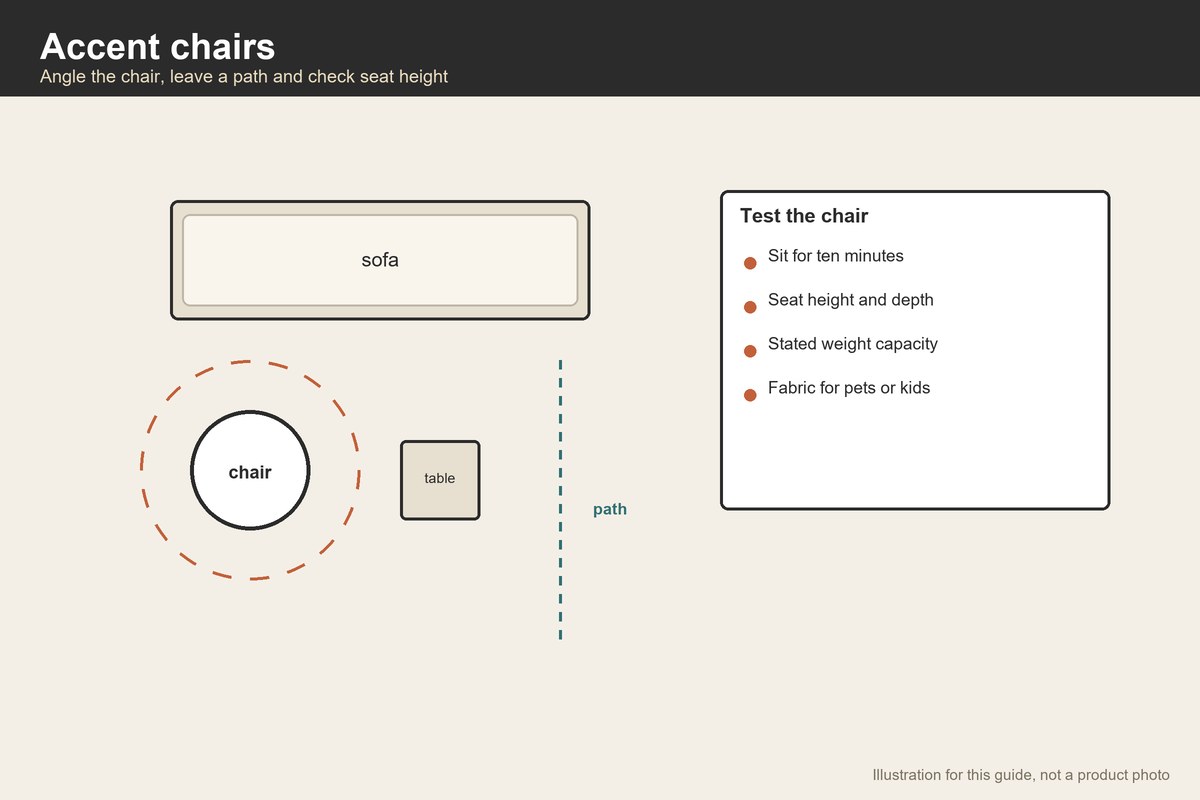
A common approach is to angle the chair toward the sofa at about 45 degrees, leaving room between them for a table. Keep the distance close enough to talk, about 4 to 8 feet is a designer’s rule of thumb, not a standard. For a loveseat and chair pairing, see loveseat.
Put a small table within reach. See side table for slide-under options and ottoman furniture for a footrest.
Safety and emissions
Check that the legs are secure and that the chair does not wobble. Keep cords away from the seat. Foam and fabrics can have a new-product odor; air the chair. Composite wood parts fall under federal formaldehyde emission rules in the United States, and a listing may state compliance. Ask if it does not.
Delivery and assembly
Accent chairs ship in boxes and need assembly of legs and back. Plan 20 to 60 minutes. Measure the box and the doorway; the chairs we read weigh 15 to 40 pounds and are easy for one person to carry.
A worked example
These are invented numbers for planning. A living room is 10 feet (120 inches) wide and 12 feet (144 inches) long. A sofa 84 inches wide sits on the 144 inch wall. You want an accent chair of 29.9 inches wide by 30.7 inches deep at the end.
Wall space: 144 − 84 = 60 inches. The chair takes 29.9 inches, leaving 30.1 inches at the side of the chair for an end table 15 inches wide and a path of 15.1 inches, which is not a path. So the chair should sit on the other side of the room or angle into the corner.
Try angling: a chair rotated 45 degrees takes a bounding width of about (29.9 + 30.7) × 0.707 = 42.8 inches, which is wider than the chair’s own width, but it fits into a corner. In a corner you lose no walkway.
Compare a 26.4 by 28.4 inch chair: 26.4 × 28.4 = 750 square inches, about 5.2 square feet versus 6.4 square feet for the larger one. In this room, either fits, but the smaller one leaves more path.
Questions to ask before you order
Ask for the seat height, seat depth and arm height if the listing does not state them. Ask whether the legs are removable and whether the chair ships partly assembled. Ask about the fabric’s cleaning code, and whether the cover is treated. Ask how much assembly is needed and whether tools are included. If a listing states a weight capacity, ask whether it applies to a single occupant or to the frame.
Testing after delivery
Sit in the chair for ten minutes and read or use your phone. Check that you can get up without pushing hard on the arms. Rock gently side to side to test for wobble. Look under the chair to see that screws are tight. Check the cushions after a week for flattening. If the chair is going in a corner, check that it can be angled so the back does not touch the wall.
Styling without clutter
An accent chair should not fight the sofa. Repeat a color or a material from the room, and keep the pattern simple. Add a small table or a floor lamp only if there is room. In a small room, one chair is usually better than two. If you want a soft look, add a throw, but keep the walkway clear.
Mistakes to avoid
- Choosing by looks. Test seat height and depth.
- Ignoring the path. Tape the footprint.
- Buying without a capacity. Look for a stated limit.
- Overlooking fabric. Pets and children change the choice.
- Skipping the table. A chair without a surface is less useful.
- Assuming light means weak. Check the weight limit.
When to skip an accent chair
If your living room is very small, a floor cushion or a bench may be enough. If you need seating for guests often, an extra dining chair that stores away may do more. For a room that needs both seating and storage, see ottoman furniture.
Related guides
See loveseat for two-seat options, rocking chair for a chair that moves and end tables for living room for the table beside it.
Frequently asked questions
How big is an accent chair?
The chairs we read are about 26 to 30 inches wide and 28 to 35 inches deep. Measure your space.
What seat height is comfortable?
Many people find about 17 to 19 inches comfortable. One chair we read is 21.46 inches, which is higher.
Should an accent chair match the sofa?
No. It should share a color or style but can differ in fabric and shape.
How much weight can an accent chair hold?
Check the listing. Two of those we read state 300 and 380 pounds.
Where should I put an accent chair?
Angled toward the sofa with a table beside it, or in a corner where it does not block the path.
Bottom line
Choose an accent chair by its job, footprint, seat height and stated capacity. Tape the floor space, check the path and skip it if a smaller seat suits the room.
Products worth checking
We have not tested these products. Sizes and features come from the Amazon listings, checked on September 30, 2026; where a listing does not say, we say so.
VINGLI Accent Chair, Chenille Upholstered Armchair, 380 LBS
The listing gives 30.7 x 29.9 x 33 in; 39.7 lb. We re-opened the page on September 30, 2026 and found these figures; other details are on the product page.
- Good for: a roomy upholstered chair with a stated capacity.
- Keep in mind: at about 30 in square it needs floor space.
Nestvala Modern Accent Chair, Upholstered Reading Sling Chair
The listing gives 28.4 x 26.4 x 30.9 in; 15.4 lb. We re-opened the page on September 30, 2026 and found these figures; other details are on the product page.
- Good for: a light, compact reading chair.
- Keep in mind: the 21.46 in seat is high and the seat is shallow, so test that it suits you.
MAXYOYO Modern Accent Chair, Metal Frame
The listing gives 34.6 x 29.5 x 21.7 in; 16.5 lb. We re-opened the page on September 30, 2026 and found these figures; other details are on the product page.
- Good for: a low, light lounge chair.
- Keep in mind: the listed 21.7 in height and 34.6 in seat depth look like a floor-style chair, so check the seat height before buying.
Sources checked
- Accessible routes guide
- Formaldehyde emission standards for composite wood products
- VINGLI Accent Chair, Chenille Upholstered Armchair, 380 LBS
- Nestvala Modern Accent Chair, Upholstered Reading Sling Chair
- MAXYOYO Modern Accent Chair, Metal Frame
Specifications checked on September 30, 2026. Product details and availability can change, so confirm on the product page before you buy.