As an Amazon Associate I earn from qualifying purchases. Links marked “Affiliate link” may earn us a commission at no extra cost to you. Learn more.
Quick answer
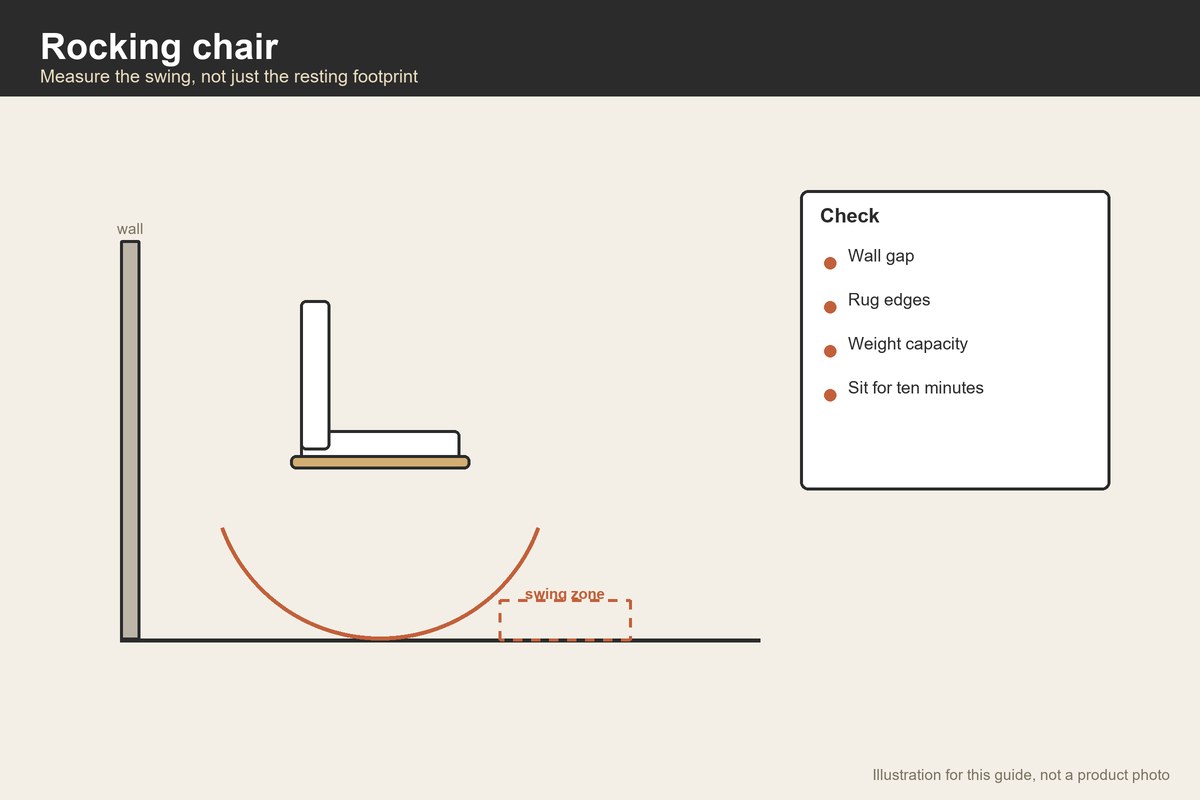
A rocking chair needs more floor than it seems, because it moves. Its footprint at rest is one number, but the space it sweeps when it rocks is larger, and it must clear the wall, a rug edge and any small table. The checks are the overall size, the weight capacity, the seat comfort and whether the base or rockers suit your floor.
The listings we read on Amazon on 2026-09-30 give a wooden indoor and outdoor rocker at about 32 by 24.5 by 44 inches, a nursery-style rocker with a footrest that states a 450 pound capacity and weighs about 37.5 pounds, and a lounge chair with an ottoman. Some listed dimensions look like shipping box sizes rather than the assembled chair, so we treat the size as unconfirmed for those. We have not tested any of them.
Because a rocking chair swings, a small room may be better served by a swivel or glider chair, which moves in a smaller space.
Rocker, glider or swivel
Traditional rocker. Two curved runners rock on the floor. It is simple and durable but sweeps forward and back, and the runners can scratch floors and catch rug edges.
Glider. The seat moves on a track or linkage, so the chair stays in one footprint. It needs less clearance behind and no runners on the floor.
Swivel rocker. Rotates and rocks. A metal base rocks in place and needs less space, though the mechanism can wear.
For a nursery, many parents prefer a glider or swivel rocker for its smooth motion and smaller footprint. For a porch or living room, a classic rocker works.
Measure the sweep, not just the chair
At rest, a rocker of 32 inches deep takes 32 inches of floor. When it rocks back it may swing 6 to 10 inches beyond its rest position, and the rockers extend forward too. These are working estimates, since the arc depends on the chair. Sit in the chair and rock it, or measure the distance from the front of the runners to the back of the runners and add the swing.
Tape the rest footprint and a second outline with 8 inches added front and back. Check that the outline clears the wall, a curtain and a table. If the chair hits the wall, it will scrape and chip the paint.
The U.S. Access Board’s accessible-route guidance uses 36 inches as a minimum clear width for a path. That is for public accessible design, not your room, but a clear path around a moving chair is a helpful comfort target.
Comfort: seat, back and arms
Sit in the chair for at least ten minutes. Look for a seat depth that lets your back reach the backrest, a back that supports your shoulders and arms at a height that suits feeding or reading. A nursery chair often has padded arms. A headrest helps for long sitting.
The listing may not give seat height or depth. If it does not, treat them as unknown. A seat height of 17 to 19 inches suits many adults; a rocker may be lower or higher.
Capacity and frame
Rocking chairs load the frame dynamically. Check the stated capacity: the nursery-style rocker we read states 450 pounds; others state none. If a listing gives none, treat it as unknown. Steel frames feel solid but can squeak; wood frames need tight joints. Rubberwood, as one listing states, is a hardwood used in furniture, and its finish and joinery matter more than the name.
Check the base. Wide runners spread weight and reduce floor marks. Rubber or felt strips on runners protect floors; some chairs include them.
Nursery use and safety
For nursing or feeding, the chair should be stable, with arms and a back that supports you. Follow safe-sleep guidance from a pediatric authority and do not let a baby sleep in a rocker or on a soft surface; this article gives no medical advice. Keep the rocker away from cords and heaters.
Rockers can catch fingers and toes under the runners. Keep pets and children clear when rocking. Check that the chair does not tip forward when you stand.
Working smoke alarms in bedrooms and near sleeping areas are recommended by the U.S. Fire Administration.
Materials, finish and emissions
Wood chairs use a stain or paint, and finishes can have an odor when new. Upholstered chairs use foam and fabric. Composite wood parts fall under federal formaldehyde emission rules in the United States, and a listing may state compliance. Ask if it does not, especially for a nursery. Air the chair before use.
Assembly and delivery
Rockers ship in a box with parts that need assembly, and a chair of about 37.5 pounds is easy to lift. Check that the assembled size matches the room. Assemble in the room, and tighten bolts after the first week.
A worked example
These are invented numbers for planning. A nursery is 9 feet by 10 feet (108 by 120 inches). A rocker at rest is 32 inches deep by 24.5 inches wide. You plan to put it in a corner with a small table beside it.
Rock zone: assume it sweeps 8 inches back and 8 inches forward, a total depth of 32 + 8 + 8 = 48 inches. Along a 120 inch wall, the chair and table take 24.5 + 16 = 40.5 inches wide, leaving 120 − 40.5 = 79.5 inches.
Clearance to the wall behind: place the chair 8 inches from the wall so it does not hit when it rocks back. Then the front of the chair at rest is 8 + 32 = 40 inches from the wall, and when rocked forward it reaches 48 inches from the wall. The room is 108 inches deep in this direction, so 108 − 48 = 60 inches remain to the far wall, comfortably above the 36 inch reference.
A glider with a fixed footprint of 30 inches deep removes the 16 inch swing, leaving 108 − 30 − 8 = 70 inches. The classic rocker works in this room, but a glider gives more room for play.
Questions to ask before you order
Ask the seller for the assembled dimensions and the resting position of the seat, and how far the chair swings. Ask about the runner or base material and whether floor protectors are included. Ask what the load limit refers to and whether the chair has been tested for repeated rocking. If the chair is for a nursery, ask whether the finish is water based and low in odor.
Testing after delivery
Sit and rock for ten minutes. Check that the chair does not tip forward when you stand. Rock gently against a taped wall line to see how far it swings. Listen for squeaks and check bolts. If the chair scrapes, add felt or rubber strips. Test the chair with a rug on the floor to see whether the runners catch.
Making the space around it work
Place a small table or a shelf within reach, but outside the swing. Keep a lamp on the side with the most light. If the chair faces a window, check for glare and cord hazards from blinds. A footrest or an ottoman can help, but keep it clear of the runners. Keep the area free of toys and cords, since a moving chair can catch them.
Mistakes to avoid
- Measuring only the resting size. Add the swing.
- Placing the chair against a wall. It will hit.
- Ignoring rug edges. Runners catch them.
- Buying by looks. Sit and rock for ten minutes.
- Skipping capacity. Look for a stated limit.
- Trusting box dimensions. Some listings show packaging sizes.
When to skip a rocker
If the room is under about 9 feet in the short dimension, a glider or a fixed armchair may fit better; see accent chairs. If you mainly want to rest your feet, see ottoman furniture. If comfort for standing is a concern, see lift chairs.
Related guides
See accent chairs, loveseat and toddler bed for a child’s room.
Frequently asked questions
How much space does a rocking chair need?
Its resting footprint plus the swing, often 6 to 10 inches at each end as a working estimate. Tape it and test.
Are gliders better than rockers?
They need less clearance and are smoother, but the mechanism can wear. Both work.
Can a rocker scratch floors?
Yes. Use felt or rubber on runners, and avoid rugs with curled edges.
How much weight can a rocking chair hold?
Check the listing. The nursery rocker we read states 450 pounds; others give none.
Is a rocking chair good for a nursery?
It can be, if it is stable and comfortable. Follow safe-sleep guidance from a pediatric authority.
Bottom line
Choose a rocking chair by measuring its swing as well as its footprint, testing comfort and checking capacity. If the room is small, a glider or fixed armchair may be better.
Products worth checking
We have not tested these products. Sizes and features come from the Amazon listings, checked on September 30, 2026; where a listing does not say, we say so.
GIANTEX Indoor and Outdoor Wood Rocking Chair, Patio Rocking Chair
The listing gives 32 x 24.5 x 44 in. We re-opened the page on September 30, 2026 and found these figures; other details are on the product page.
- Good for: a classic wood rocker.
- Keep in mind: the text we read gives no weight limit, and the runners can mark floors.
Luviyoo Nursery Rocking Chair with Footrest, 450 Lbs Capacity
The listing gives 37.5 lb; listed 450 lb maximum recommendation. We re-opened the page on September 30, 2026 and found these figures; other details are on the product page.
- Good for: a padded nursery-style rocker with a footrest.
- Keep in mind: the listed size (43.3 x 30.3 x 25.6 in) looks like packaging, so confirm the assembled size.
Welnow Lazy Chair with Ottoman, Reading Chair with Footrest
The listing gives . We re-opened the page on September 30, 2026 and found these figures; other details are on the product page.
- Good for: a reading chair with a footrest for a small space.
- Keep in mind: the listed 30 x 28 x 8 in is probably a packed size, so confirm the assembled size.
Sources checked
- Accessible routes guide
- Smoke alarm guidance
- Formaldehyde emission standards for composite wood products
- GIANTEX Indoor and Outdoor Wood Rocking Chair, Patio Rocking Chair
- Luviyoo Nursery Rocking Chair with Footrest, 450 Lbs Capacity
- Welnow Lazy Chair with Ottoman, Reading Chair with Footrest
Specifications checked on September 30, 2026. Product details and availability can change, so confirm on the product page before you buy.