As an Amazon Associate I earn from qualifying purchases. Links marked “Affiliate link” may earn us a commission at no extra cost to you. Learn more.
Quick answer
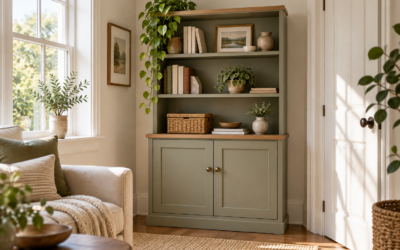
A small bookshelf is a compact unit, often three tiers and about 28 to 32 inches high, that fits beside a sofa, under a window or in a bedroom corner. It holds far fewer books than a tall bookcase, so decide first whether you want to store books or only display a few. The checks are width, depth, height, weight and the shelf thickness.
The listings we read on Amazon on 2026-10-01 include a three-tier industrial bookshelf of 11 by 16.5 by 28.5 inches, a three-tier shelf of 9.7 by 23.7 by 31.5 inches at about 19.4 pounds and a three-tier shelf of 11.4 by 23.6 by 29.5 inches at about 11 pounds. A five-cube unit of 9.4 by 19.5 by 31.5 inches weighs about 9 pounds. We have not tested any of them, and these sizes come from the listings.
At about 9 to 19 pounds these units are light, and a light unit can slide or tip. Stack weight low, and consider a strap.
Count your books
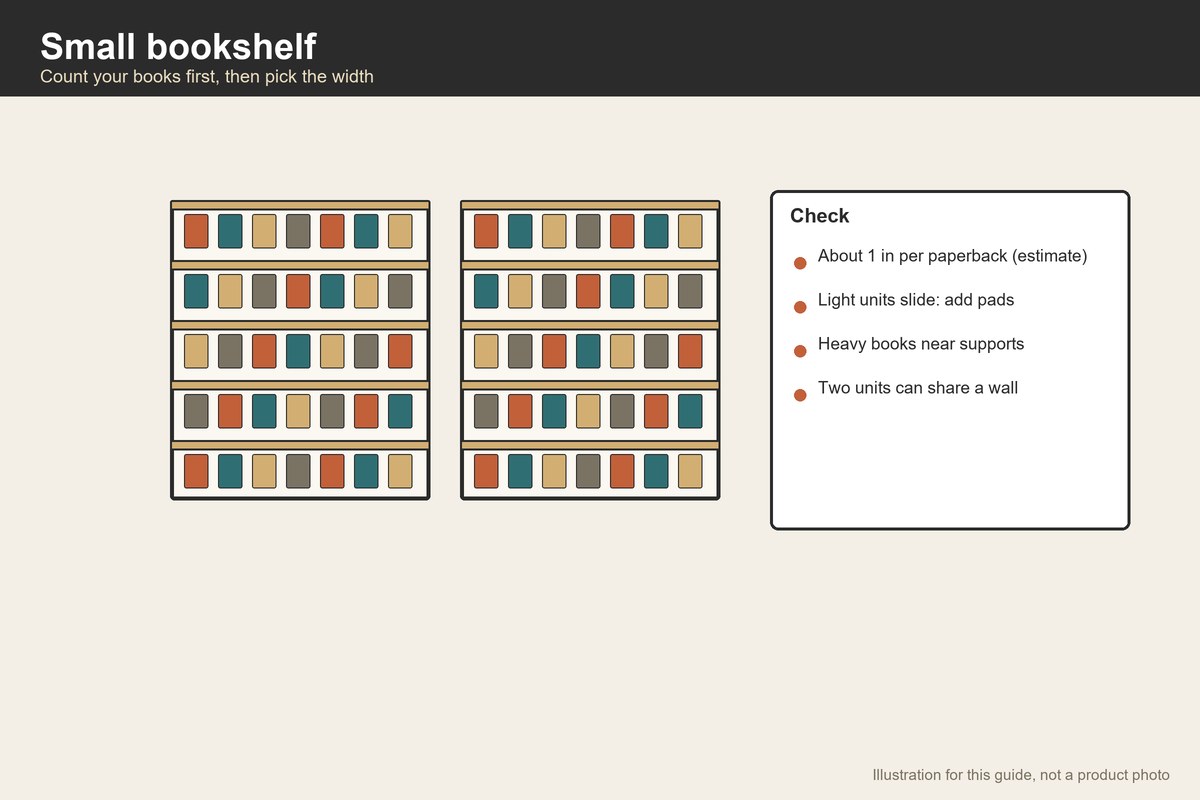
A paperback is about 1 inch thick and a hardcover about 1.5 inches, which are estimates, not standards. A 23.6 inch shelf holds about 23 paperbacks. Three shelves hold about 69. The 16.5 inch unit holds about 16 per shelf, or 48. The five-cube unit has cubes of about 9 to 10 inches wide, holding fewer books but suiting bins.
Measure your own books. If you own 200 books, a small shelf is not the answer; use a tall one or several units. If you own 40, a small shelf is enough.
Width, depth and height
Width sets capacity per shelf: 16.5 inches versus 23.7 inches is a difference of 7.2 inches, about 44 percent more length (7.2 ÷ 16.5). Depth of 9.4 to 11.4 inches suits standard books and small baskets. Height of 28.5 to 31.5 inches is below a typical table top, so you can put a lamp on top.
A low shelf can also serve as a plant stand, a bench shelf or a nightstand. See nightstands for bedside use and end tables for a living room.
Shelf thickness and sagging
The units we read list shelf thickness of about 0.5 inches in some cases. A 23.6 inch span with a row of hardcovers can bow. Put heavy books at the ends near the supports, and avoid loading the center. A back panel or cross brace helps. If a listing gives a per-shelf limit, follow it; if it does not, treat it as unknown.
Material and finish
The units we read use metal frames with engineered wood shelves, or metal tubes. Metal frames are slim and light. Federal rules limit formaldehyde emissions from composite wood products sold in the United States, and listings may state compliance. Ask if it does not.
Stability and safety
A low shelf is less of a hazard than a tall one, but a child can still pull it over, and a light unit can slide on a smooth floor. The Consumer Product Safety Commission’s Anchor It campaign explains why furniture should be anchored where children live. Use a small strap or brackets if there are toddlers. Add felt or rubber pads to stop sliding.
Where it fits
Small shelves suit gaps beside a bed or a sofa, under a window sill and in a hallway. The U.S. Access Board uses 36 inches as a minimum clear width for a route. That is public accessible-design guidance, not a home rule, but a useful yardstick. A shelf 9.7 inches deep in a 42 inch hall leaves 32.3 inches.
Styling and use
Use the top for a lamp, a plant or a tray. Put heavier books on the bottom shelf. Keep a few gaps for breathing room. If you use baskets, choose ones that fit the shelf depth. A small shelf is a good place for books you read daily.
Delivery and assembly
Small shelves ship in boxes of about 9 to 20 pounds, which one person can carry. Assemble on the floor, tighten the fasteners and check the squareness by measuring both diagonals. Retighten after a month.
A worked example
These are invented numbers for planning. You have 90 paperbacks and 10 hardcovers. You consider the 23.6 inch wide three-tier unit and the 16.5 inch wide unit.
Shelf length needed: 90 × 1 + 10 × 1.5 = 105 inches. The 23.6 inch unit has 3 × 23.6 = 70.8 inches of shelf, so it holds about 67 percent of your books (70.8 ÷ 105). The 16.5 inch unit has 3 × 16.5 = 49.5 inches, or 47 percent.
You would need 105 ÷ 70.8 = 1.5, so two of the wider units. Two units side by side take 47.2 inches of wall. On a bedroom wall of 8 feet (96 inches), that leaves 96 − 47.2 = 48.8 inches.
Weight: two units at 19.4 pounds weigh 38.8 pounds empty. Add 105 inches of books at about 0.7 pounds per inch (an assumption), 73.5 pounds. The total is about 112 pounds, far more than the units themselves, so spread the load.
Questions to ask before you order
Ask the seller for the shelf thickness, the per-shelf limit and whether the shelves are adjustable. Ask whether the unit has a back panel and an anchor kit. Ask whether the dimensions are of the assembled unit. If the listing shows several sizes, confirm that the photos match.
A quick decision path
If you have fewer than about 60 books, choose a small shelf. If you have more, choose a taller unit. If the spot is beside a bed, choose a height near the mattress; see nightstands. Decide the spot first.
Care and long-term wear
Wipe the shelves, tighten the fasteners every few months and check that the unit still sits level. Replace missing pads. If a shelf bows, move the heavy books to the ends or the bottom. Keep the unit away from heaters and damp walls.
Real-life scenarios
A small shelf beside a bed holds the book you are reading, a lamp and a water glass. In a hallway, it can hold keys and mail. In a nursery, it can hold picture books. In a studio, two small shelves side by side can act as a room divider. Think about the job before you choose the height.
The day it arrives
Unpack in the room where it will live, check each part against the list and look for dents, chips or scratches before you sign for it. Take photos of any damage and keep the packaging until you are sure about the fit. Assemble on a blanket to protect the finish, and keep the instructions and spare hardware in a labeled bag.
Budget without prices
We leave prices out because Amazon changes them often. When you compare, think about the total cost: the item, delivery or help to carry it, floor protection, and anything you must buy to go with it. A cheaper piece that does not fit the room costs more than a slightly dearer one that does. Check the return policy before ordering, since bulky items can be hard to send back.
Choosing between shapes
A tube-and-shelf design is light and open. A board design is heavier and steadier. A cube design holds bins and baskets. If you want to store books, choose shelves; if you want to store small items, choose cubes. If you want to decorate, choose open shelves. Pick the shape that suits what you will put on it.
Using more than one
Two small shelves can be stacked on a wall, placed side by side or used on both sides of a bed. Fasten them together or to the wall if you stack them. Keep heavy items on the lower unit. Using two small units gives flexibility: you can move one to another room later.
Mistakes to avoid
- Overloading the middle. Put weight near supports.
- Ignoring weight. Light units slide.
- Buying by looks. Count your books.
- Skipping pads. Protect floors.
- Forgetting children. Anchor if needed.
When to skip a small shelf
If you have many books, use a tall bookcase; see bookcase bookshelf. For a corner, see corner bookshelf.
Related guides
See white bookshelf, kids bookshelf and ladder shelf.
Frequently asked questions
How many books fit on a small bookshelf?
A 23.6 inch three-tier unit holds about 69 paperbacks at roughly 1 inch each.
How tall is a small bookshelf?
The ones we read are about 28.5 to 31.5 inches high.
Are small bookshelves stable?
They are light, so use pads or a strap.
Can I use one as a nightstand?
Yes, if the height suits.
Do I need to assemble it?
Yes, usually in under an hour.
Bottom line
A small bookshelf suits a few dozen books and a narrow spot. Count your books, check shelf thickness and stability, and choose a taller unit if your collection is larger.
Products worth checking
We have not tested these products. Sizes and features come from the Amazon listings, checked on September 30, 2026; where a listing does not say, we say so.
HOOBRO Bookshelf, 3-Tier Industrial Bookcase, Small
The listing gives 11 x 16.5 x 28.5 in; 3 tiers. We re-opened the page on September 30, 2026 and found these figures; other details are on the product page.
- Good for: a very narrow three-tier shelf.
- Keep in mind: 16.5 in wide holds few books, and the text we read gives no weight.
Furinno PASIR Book Shelf, 3-Tier Bookshelf
The listing gives 9.7 x 23.7 x 31.5 in; 19.4 lb. We re-opened the page on September 30, 2026 and found these figures; other details are on the product page.
- Good for: a wider three-tier unit.
- Keep in mind: another field lists 9.49 x 22.72 x 31.5 in, so plan with the smaller.
Furinno Turn-N-Tube Book Shelf, 3-Tier Bookshelf
The listing gives 11.4 x 23.6 x 29.5 in; 11 lb. We re-opened the page on September 30, 2026 and found these figures; other details are on the product page.
- Good for: a light tube-and-shelf unit.
- Keep in mind: at 11 lb it can slide, so add pads.
Sources checked
- Formaldehyde emission standards for composite wood products
- Anchor It
- Accessible routes guide
- HOOBRO Bookshelf, 3-Tier Industrial Bookcase, Small
- Furinno PASIR Book Shelf, 3-Tier Bookshelf
- Furinno Turn-N-Tube Book Shelf, 3-Tier Bookshelf
Specifications checked on September 30, 2026. Product details and availability can change, so confirm on the product page before you buy.