As an Amazon Associate I earn from qualifying purchases. Links marked “Affiliate link” may earn us a commission at no extra cost to you. Learn more.
Quick answer
A ladder shelf leans against a wall, with shelves that get shallower toward the top. It uses less floor than a straight bookcase of the same height at the top but more at the bottom. The numbers that matter are the floor depth at the base, the height and the weight. The listings we read on Amazon on 2026-09-30 give a four-tier unit of 13.6 inches deep, 22 inches wide and 54.1 inches high at about 18.7 pounds, a five-tier unit of 14 by 24.8 by 70.1 inches at about 30.8 pounds and a solid-wood five-shelf unit of 16 by 24.75 by 72 inches at about 23 pounds. We have not tested any of them.
Ladder shelves lean on the wall, so they rely on it. Anchor them to a stud; the Consumer Product Safety Commission’s Anchor It campaign explains why anchoring matters where children live.
If you prefer a straight case, see bookcase bookshelf. For a corner, see corner bookshelf.
How a ladder shelf works
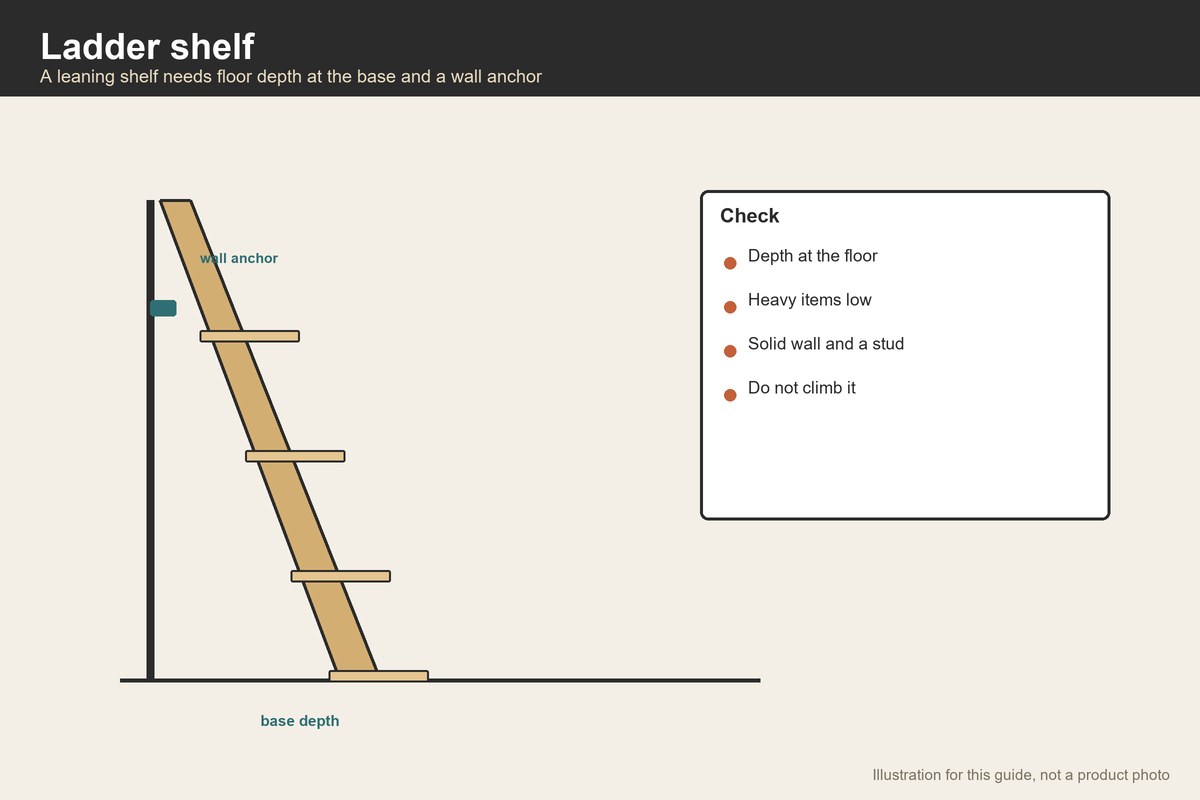
Two side rails slope back toward the wall, and shelves bridge them. The bottom shelf is the deepest, and each shelf above is shallower. The lean angle depends on the model. The frame transfers part of the load to the wall, which is why a ladder shelf should sit flat against a solid wall.
The slope means that the top of the shelf is closer to the wall than the base. A shelf 14 inches deep at the floor might be 7 or 8 inches deep at the top; the listing may not give each shelf’s depth, so treat that as unknown.
Floor depth against a straight case
A straight bookcase of 9.4 inches depth, like those in bookcase bookshelf, takes 9.4 inches of floor. A ladder shelf of 14 inches takes 14 inches at the base, so about 4.6 inches more (14 − 9.4), or 49 percent more floor depth. On the other hand, the ladder shelf’s top is closer to the wall, and the sloped profile can feel lighter in a room.
Check the route. The U.S. Access Board uses 36 inches as a minimum clear width for a route, and 32 inches at short obstructions. That is public accessible-design guidance, not a home rule, but it is a helpful yardstick. A ladder shelf in a hallway narrows it by its base depth.
Shelf count and capacity
The four-tier unit has four shelves at 22 inches wide, about 88 inches of shelf length. The five-tier units have five shelves at about 24.8 inches wide, about 124 inches. The shelves get shallower, so top shelves suit small items.
A rough capacity estimate: a 24.8 inch shelf holds about 24 paperbacks at 1 inch each. But the narrow top shelves cannot hold a row of books flat if they are only 6 or 7 inches deep, so reserve them for decor.
Weight and stability
The units we read weigh about 18.7 to 30.8 pounds. A light unit is easy to move but easy to tip forward if loaded at the top. Put heavy books on the bottom shelves. Do not climb a ladder shelf, despite its name. Anchor it, as the Anchor It campaign advises. Check that the wall is solid. A leaning shelf on a thin drywall wall can leave marks and may not be safe without a stud anchor.
Materials
The four-tier unit we read is particleboard with metal. The five-tier Amazon Basics unit lists a solid rubberwood frame in its title. The solid-wood unit lists 100 percent solid wood. Solid wood is repairable and heavier; particleboard is lighter and cheaper. Federal rules limit formaldehyde emissions from composite wood products sold in the United States, and listings may state compliance. Ask if it does not.
Assembly and delivery
Ladder shelves ship flat. A 30.8 pound box is a one-person lift; assembling a 72 inch unit is easier with two. Assemble flat on the floor, then stand it against the wall, and anchor it before loading.
A worked example
These are invented room numbers for planning. A hallway is 42 inches wide. You consider the 14 inch deep, 24.8 inch wide five-tier unit and a straight bookcase 9.4 inches deep.
Ladder: 42 − 14 = 28 inches of path remain at the base. Straight: 42 − 9.4 = 32.6 inches. Neither reaches 36 inches, but the straight case leaves 4.6 inches more.
At shoulder height, the ladder shelf is shallower. If the shelf slopes evenly from 14 inches at the floor to about 6 inches at the top (an assumption), at half height (35 inches) its depth is about 10 inches, and the path at that height is 42 − 10 = 32 inches. A person’s shoulders at about 17 inches wide pass more easily than the base.
Wall use: a 24.8 inch unit on a 96 inch wall leaves 96 − 24.8 = 71.2 inches. Two units side by side take 49.6 inches, leaving 46.4 inches for a door.
Capacity: each unit has about 124 inches of shelf length. Two units give 248 inches, enough for about 248 paperbacks at 1 inch each. That is our estimate.
Questions to ask before you order
Ask the seller for the depth of each shelf, the weight limit per shelf, the lean angle and the anchor kit. Ask whether the unit stands without a wall. Ask how many boxes it ships in. If the listing shows several finishes, confirm that the dimensions match.
A quick decision path
If you have a wall with a stud and a bit of floor, a ladder shelf adds a light, sloped look. If you need deep shelves for large books, choose a straight bookcase. If children are around, anchor it and keep heavy items low.
Styling and loading a ladder shelf
A ladder shelf looks best with a mix of heights. Put the heaviest items on the bottom, small decor in the middle and light items at the top. Keep books in short stacks on the shallow upper shelves. If you use baskets, choose sizes that fit the shelf depth. Avoid placing a heavy plant on the top. Keep the shelf away from heat vents.
Wall and floor conditions
A ladder shelf rests its upper rails on the wall, so the wall surface matters. A baseboard can hold the shelf away from the wall at the bottom and change the lean, so some people trim the bottom feet or choose a unit with a gap for it. Check that the floor is level. If the shelf rocks, shim it. If the wall has a chair rail, check that the rails clear it. Anchor to a stud, and check the anchor after a month.
The day it arrives
Unpack and assemble on the floor. Stand the shelf against the wall, check the lean and mark the stud for the anchor. Fix the anchor before you load. Add heavy items to the bottom shelf first, and check the stability. Re-check after a week.
Budget without prices
We leave prices out. A solid-wood ladder shelf usually costs more than a particleboard one, but it can be repaired and refinished. If you plan to move often, a lighter unit is easier to carry; if you plan to stay, solid wood may last longer.
A short loading guide
Start with the bottom shelf, which is deepest and strongest. Place the heaviest books flat or in a short row there. Move up and use lighter items. Leave the top shelf for small decor. Step back and look at the unit from the side: if the load is concentrated near the front edge, shift it toward the wall. Check the anchor strap and the rails once a month.
Cleaning and care
Dust the shelves with a dry cloth. Wipe solid wood with a barely damp cloth and dry it right away. Avoid sprays that leave a film. If the shelf has a metal frame, check the joints for rust in a humid room. Re-tighten bolts after the first month.
Mistakes to avoid
- Skipping the anchor. Leaning units can slide.
- Loading the top. Keep weight low.
- Ignoring base depth. It takes more floor than it seems.
- Climbing it. It is not a ladder.
- Assuming all shelves are deep. Top shelves are shallow.
When to skip a ladder shelf
If your wall is thin or you cannot anchor it, choose a different shelf. If you need a lot of capacity, a straight bookcase gives more per floor inch. For wall-mounted options, see best floating shelves for a home office.
Related guides
See bookcase bookshelf, corner bookshelf and best small bookcases with doors.
Frequently asked questions
How much floor does a ladder shelf take?
The ones we read are about 13.6 to 16 inches deep at the base.
Do ladder shelves need anchoring?
Yes. They lean on the wall and can slide or tip.
Can I put a heavy load on top?
No. Keep heavy items low.
Are ladder shelves good for books?
Lower shelves can be; upper shelves are shallow.
Can I use one on a thin wall?
Only if it can be anchored safely.
Bottom line
A ladder shelf is a light way to add storage, but it takes more base floor than a straight bookcase and needs a solid wall and an anchor. Measure the path, keep heavy items low and choose a straight case for deep books.
Products worth checking
We have not tested these products. Sizes and features come from the Amazon listings, checked on September 30, 2026; where a listing does not say, we say so.
VASAGLE Ladder Shelf, Bookcase Book Shelf, 4-Tier, 22 In
The listing gives 13.6 x 22 x 54.1 in (D x W x H); 18.7 lb. We re-opened the page on September 30, 2026 and found these figures; other details are on the product page.
- Good for: a short ladder shelf for a small wall.
- Keep in mind: the page lists several variants with other shelf counts.
Amazon Basics 5-Tier Ladder Bookshelf Storage Organizer, Solid Rubberwood Frame
The listing gives 14.02 x 24.84 x 70.07 in; 30.8 lb. We re-opened the page on September 30, 2026 and found these figures; other details are on the product page.
- Good for: a tall five-shelf ladder with a solid frame.
- Keep in mind: it takes 14 in of floor at the base.
Casual Home 100% Solid Wood 5-Shelf Ladder Bookcase, 72 inch
The listing gives 16 x 24.75 x 72 in; 23 lb. We re-opened the page on September 30, 2026 and found these figures; other details are on the product page.
- Good for: a solid-wood ladder shelf.
- Keep in mind: it is 16 in deep at the base, the deepest of the three.
Sources checked
- Anchor It
- Accessible routes guide
- Formaldehyde emission standards for composite wood products
- VASAGLE Ladder Shelf, Bookcase Book Shelf, 4-Tier, 22 In
- Amazon Basics 5-Tier Ladder Bookshelf Storage Organizer, Solid Rubberwood Frame
- Casual Home 100% Solid Wood 5-Shelf Ladder Bookcase, 72 inch
Specifications checked on September 30, 2026. Product details and availability can change, so confirm on the product page before you buy.