As an Amazon Associate I earn from qualifying purchases. Links marked “Affiliate link” may earn us a commission at no extra cost to you. Learn more.
Quick answer
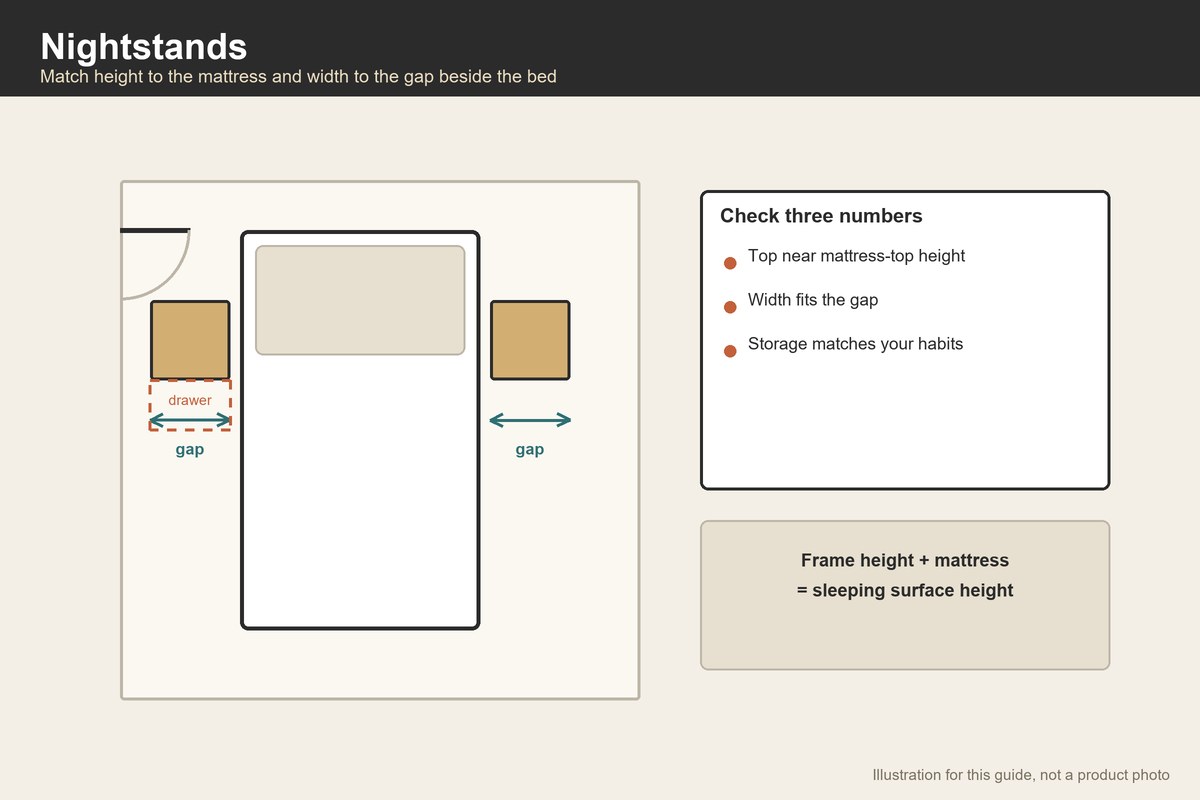
A nightstand is right when three numbers line up: its top sits within a few inches of the top of your mattress, its width fits in the gap beside the bed with room left to walk, and its storage matches what you actually reach for at night. In a small bedroom the width and depth matter most, because a nightstand that is a few inches too wide can leave you sidestepping the bed.
Start by measuring the top of your mattress from the floor, then the gap between the bed and the nearest wall or door. The nightstands we read about on Amazon on 2026-09-30 are narrow, roughly 13 to 16 inches wide and 11 to 12 inches deep, and about 21 to 23 inches high. Those numbers come from the listings, not from our own measurements, and we have not tested any of them.
If you do not need a drawer, a slim open-shelf table or a wall shelf can free even more floor. This guide is about fit, not a ranking.
Match the height to the mattress
A nightstand is used mostly while you are lying down, so its top should be reachable without lifting your shoulder. A common rule of thumb is to keep the top within a few inches of the top of the mattress. This is a design habit, not a standard, and it matters less if you use the table mostly for a lamp.
Measure from the floor to the top of your mattress, not to the top of the frame. Frame height and mattress thickness add together. For example, a frame that is 14 inches high with a 10 inch mattress puts the sleeping surface at 24 inches, so a table around 21 to 23 inches high sits a little below it, which is fine for reaching. If the same frame holds a 12 inch mattress, the surface is 26 inches and a 21 inch table starts to feel low.
If you are shopping for a platform bed, see how frame height changes the total in platform bed frame. A low floor bed may call for a low stool or shelf instead of a standard table.
Measure the gap and the walking route
The width of the nightstand comes out of the space between the bed and the wall. Measure the free floor on each side. In a 10 foot (120 inch) wide room with a queen bed about 60 inches wide, the two sides share 60 inches, or 30 inches each. A nightstand that is 15.7 inches wide leaves 30 − 15.7 = 14.3 inches beside it, which is tight for walking but fine if you enter from the foot of the bed.
The U.S. Access Board uses 36 inches as a minimum clear width for a route and allows 32 inches at short obstructions. That guidance is written for accessible design in public buildings and is not a rule for your bedroom, but it is a helpful reference for a comfortable path. If a nightstand would leave a route much narrower than that, choose a slimmer one or use a wall-mounted shelf on that side.
Do not forget the door and closet swing. Open every door with the bed and the nightstand in place, using tape on the floor if you are still shopping.
Drawers, shelves or both
Storage type decides how often you can use the table without getting up.
Open shelves hold a book, a glass and a charger in view. They need no clearance to open, which suits a tight gap. The trade-off is that everything on them is visible and dust settles.
A drawer hides clutter and holds items such as medication, glasses or a journal. A drawer needs pull-out space in front of the table, so measure how far it opens. Small drawers on lightweight tables can also feel flimsy if the runners are thin, and the listing may not describe them.
A cabinet with a door works if the door swing does not hit the bed frame.
Whatever you choose, check the listed weight limit. The listings we read give limits such as 60 pounds for a plastic three-tier table and 35 pounds for a two-drawer table, but many do not state one. If a listing gives none, treat the capacity as unknown, and keep heavy items off the top.
Power, cords and lighting
Most people charge a phone and use a lamp at the bedside. A nightstand with a built-in outlet strip or USB ports can reduce cord clutter, but you still need a wall outlet close enough, and the cord should not stretch across the walking route. Route cords along the baseboard, and keep them away from the bed frame where they can be pinched.
Do not cover heaters or chargers with fabric or paper. Fire safety guidance from the U.S. Fire Administration recommends working smoke alarms in bedrooms and outside sleeping areas. A tidy nightstand top is part of that habit, since a lamp or a charger is easier to check when the surface is clear.
Stability and tip-over
Tall narrow tables can tip, especially when a drawer is pulled out and loaded. The Consumer Product Safety Commission’s Anchor It campaign explains why anchoring furniture matters where children live. A low nightstand is less of a hazard than a tall chest, but a wall strap on a light table is inexpensive insurance if small children visit.
Check the feet. A table on a thick rug can wobble, and one with a narrow base is easier to knock over in the dark.
Materials and emissions
Many small nightstands use particleboard or MDF with a veneer. Federal rules limit formaldehyde emissions from composite wood products sold in the United States, and a listing may state compliance. If it does not, ask before buying, especially for a piece next to your pillow. Metal and solid wood tables avoid the question, but weigh more and cost more.
Compare three listing types
The listings we read on 2026-09-30 fall into three types. A plastic three-tier table is light at about 6.2 pounds and easy to move, with open shelves and a stated 60 pound limit. A metal-and-particleboard table with a charging station is about 10.98 pounds and gives you outlets. A two-drawer wooden-top table is about 7.88 pounds and has a stated 35 pound limit. None of these is “best”; each solves a different problem. If you want more storage without more width, compare a taller narrow table with a wider low one, and note that the chest option in chest of drawers gives far more capacity.
A worked example
This example uses invented room numbers, not a measured room. A bedroom is 9 feet wide (108 inches), with a full bed of 54 inches centered on the long wall. The two sides share 108 − 54 = 54 inches, or 27 inches each.
You want a table with a drawer. Option A is 15.7 inches wide and 11.8 inches deep, and its drawer pulls out about 9 inches toward the foot of the bed. Beside the bed it leaves 27 − 15.7 = 11.3 inches, which is enough for the drawer to open along the side only if nothing else stands there. If the door swings across that 11.3 inch strip, the drawer and the door compete for the same floor.
Option B is 13.4 inches wide with open shelves. It leaves 27 − 13.4 = 13.6 inches and needs no pull-out space. The lesson is that the narrower open table wins in this room even though it holds less. If you need the drawer, put the wider table on the side away from the door.
Questions to ask before you order
Listings leave gaps, so send the seller a short message if a detail matters. Ask for the drawer interior size if you plan to store anything larger than a phone charger. Ask how the outlet or charging strip is wired and whether it has a switch. Ask whether the top has a raised edge, since a lip keeps a glass from sliding. Ask about the finish, because a glossy top shows rings and a matte top hides them. If the answers are vague, treat that as information and choose a table whose listing states what you need.
How to test the table after delivery
Assemble it in the bedroom and put it in place before you tighten every bolt, so you can adjust it to the floor. Push gently on each corner to check for wobble, and add felt pads if the floor is uneven. Put your usual load on it, such as a lamp, a glass and a book, and check that it feels steady. Open the drawer fully and check that it stops before it falls out. Sleep with it for a week before you throw away the packaging, because a table that annoys you at night is easier to return early.
Mistakes to avoid
- Buying by photo. Read the listed width, depth and height, not the styling.
- Ignoring mattress thickness. Height is measured to the sleeping surface.
- Forgetting the door swing. Tape the outline and open the door.
- Loading a light table. Check the weight limit.
- Trailing cords. Plan the outlet and route first.
- Two matching tables by default. One side may suit a wall shelf better.
Who should skip a nightstand
If your bed is pushed against two walls, you cannot use a nightstand on those sides. A wall-mounted shelf, a headboard with a ledge or a small stool may fit better. If you already own a small dresser, using it as a nightstand may give more storage than a new table.
Related guides
For bigger storage see chest of drawers, and for a table that also suits a living room, see end tables for living room. If your bed needs storage of its own, compare bed frame with storage.
Frequently asked questions
How tall should a nightstand be?
A common rule of thumb is that its top sits within a few inches of the top of the mattress. Measure to the mattress surface, not the frame.
How wide should a nightstand be in a small room?
Subtract the bed width from the room width and split the remainder. Leave enough for a comfortable path; the Access Board reference is 36 inches, but that is a public-building standard.
Are drawers better than open shelves?
Drawers hide clutter but need pull-out space. Open shelves need none but show everything.
Do I need two nightstands?
No. A single table, a shelf or a wall light can work if the room is tight.
Should I anchor a nightstand?
It is a good habit if young children are around, especially for taller pieces.
Bottom line
Choose a nightstand from three numbers: the mattress-surface height, the gap beside the bed and the storage you actually use. Tape the outline, open the drawer and the door, and pick the narrower option if the room is tight.
Products worth checking
We have not tested these products. Sizes and features come from the Amazon listings, checked on September 30, 2026; where a listing does not say, we say so.
Furinno JUST Toolless 3-Tier Night Stand, Open Storage, Americano
The listing gives 11.5 x 13.4 x 22.8 in (D x W x H); 6.2 lb. We re-opened the page on September 30, 2026 and found these figures; other details are on the product page.
- Good for: a very narrow open-shelf bedside table for a tight gap.
- Keep in mind: it is a plastic frame with open shelves only, so there is no drawer to hide clutter.
SUPERJARE Nightstand with Charging Station, USB-C Port
The listing gives 11.8 x 15.7 x 23.4 in; 10.98 lb. We re-opened the page on September 30, 2026 and found these figures; other details are on the product page.
- Good for: a bedside table with built-in charging.
- Keep in mind: it still needs a wall outlet nearby, and another field on the page lists the sides in a different order, so confirm the height before planning.
WLIVE Night Stand, Small Dresser with 2 Drawers and Wooden Top
The listing gives 11.8 x 15.7 x 20.9 in; 7.88 lb. We re-opened the page on September 30, 2026 and found these figures; other details are on the product page.
- Good for: two small drawers in a narrow footprint.
- Keep in mind: the 35 lb limit is low, and at 20.9 in it may sit below a tall mattress top.
Sources checked
- Accessible routes guide
- Smoke alarm guidance
- Anchor It
- Formaldehyde emission standards for composite wood products
- Furinno JUST Toolless 3-Tier Night Stand, Open Storage, Americano
- SUPERJARE Nightstand with Charging Station, USB-C Port
- WLIVE Night Stand, Small Dresser with 2 Drawers and Wooden Top
Specifications checked on September 30, 2026. Product details and availability can change, so confirm on the product page before you buy.