As an Amazon Associate I earn from qualifying purchases. Links marked “Affiliate link” may earn us a commission at no extra cost to you. Learn more.
Quick answer
A platform bed frame has a built-in flat support surface, made of slats or a solid deck, so the mattress rests directly on the frame without a box spring. That makes the bed lower, simpler and usually easier to assemble than a traditional frame with a separate foundation. It suits small bedrooms, modern styles and foam or hybrid mattresses.
The choice comes down to four checks: whether the support surface suits your mattress, how tall the finished bed will be, how the headboard and footboard affect the room, and whether the frame will get through your door and be assembled in the room. Slat spacing is the technical detail most people miss. A mattress warranty may require slats to be no more than a certain distance apart, and a wide gap can cause a foam mattress to sag.
This is a planning guide. We have not tested any frame. Product picks require separate verification, and we do not quote prices or ratings.
What a platform frame does
A traditional bed uses a frame that holds a box spring or foundation, and the mattress sits on top. A platform frame replaces the box spring with a supportive deck. The deck can be a set of wood or metal slats, a solid panel, or a metal grid.
Fewer parts is one advantage. You do not buy a separate foundation, and the assembled bed sits lower to the floor. A platform frame with no box spring can also leave the room looking more open, because the sleeping surface is closer to the ground.
The trade-off is that the deck must do the work of the foundation. If the deck is poorly supported, the mattress may sag or wear early. So the support system is the first thing to check.
Slats, gaps and the mattress warranty
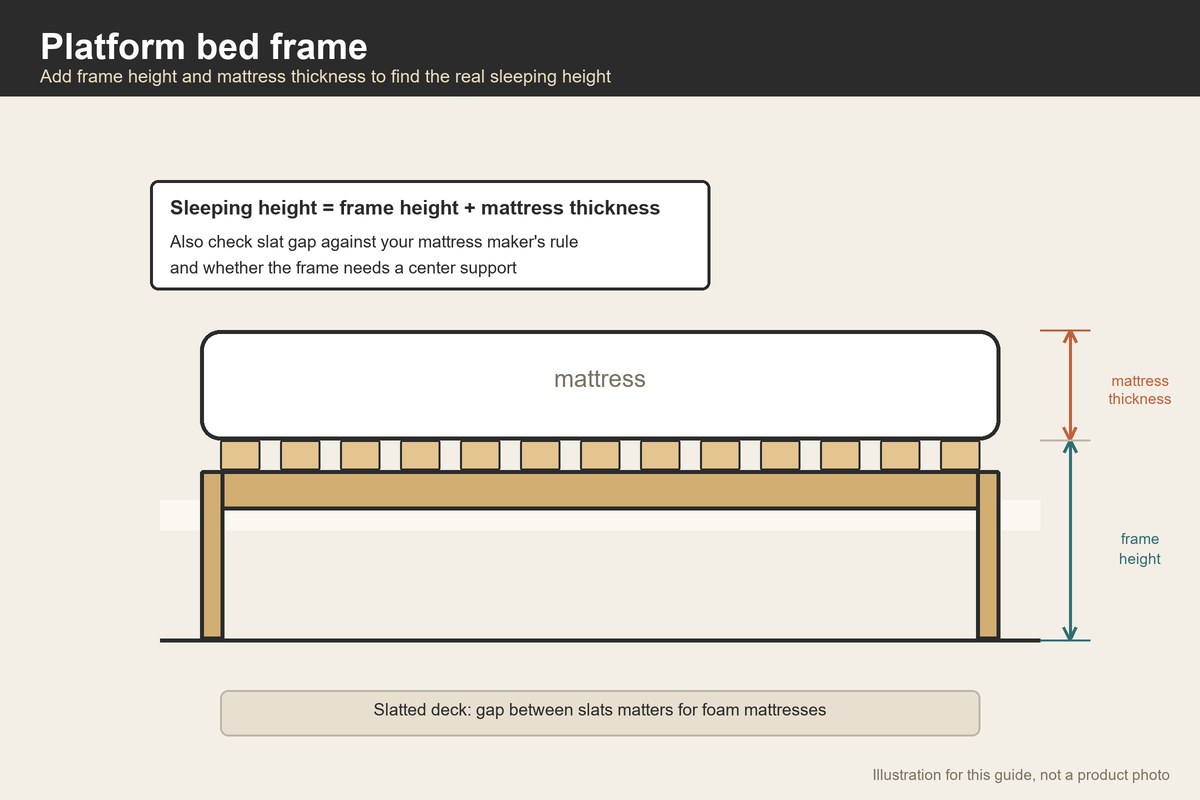
Slatted platforms are the most common. The gaps between slats matter. If the gap is too wide, a foam or hybrid mattress can sink between slats, wearing the foam and voiding warranty coverage in some cases. Many mattress makers publish a maximum slat gap in their warranty or care documentation; check your mattress maker’s rules, not a general number. If the listing for the frame states slat spacing, compare it. If it does not, ask.
A solid deck has no gaps but can trap moisture beneath the mattress. Ventilation matters, especially in humid climates. Some solid decks include air holes. Check the listing for ventilation and consider whether you can use a breathable mattress protector.
Metal grid platforms are supportive but can transmit the pattern to a thin mattress. Check that your mattress is thick enough or that a thin liner is allowed.
Height: measure the finished bed, not the frame
Platform frames come in low, mid and tall profiles. The finished sleeping height equals the frame’s platform height plus the mattress thickness. Both numbers appear in listings, but not always together. To find your comfortable height, measure your current bed from the floor to the top of the mattress and compare.
A very low bed can be harder to get out of for someone with stiff knees or hips. A tall bed can feel awkward for a shorter person or for a child. Think about who uses the bed and whether the height fits them.
Under-bed clearance follows the same logic. A platform frame with legs may leave room for bins; a frame that sits directly on the floor leaves none. If under-bed storage matters, see our guide to a bed frame with storage.
Mattress sizes are standardized in the United States: a twin is about 38 by 75 inches, a full about 54 by 75, a queen about 60 by 80 and a king about 76 by 80. Platform frames vary in how much they extend beyond the mattress, so check overall length and width, not only the size name.
Headboards, footboards and the room
Many platform frames are sold without a headboard. Others have a low headboard built in or offer an add-on. A fixed headboard may add width and depth. A footboard adds length and can block the path at the end of the bed.
Sketch the layout. In a small bedroom, a platform frame without a footboard leaves the most walking room at the foot. If the frame is against a wall on one side, you will need to make the bed from the other side or reach across. Consider whether both sides need access.
Use the U.S. Access Board’s accessible-route guidance as a reference for comfortable circulation: it uses 36 inches as a minimum clear width for a path, though that standard is for accessible design in public settings and not a rule for your home. If your route around the bed is narrower, expect to squeeze by.
Materials and weight
Platform frames come in wood, metal and upholstered versions.
Wood is sturdy and traditional, but heavy. See our solid wood bed frame guide for how to check what “solid” means.
Metal is lighter and often less expensive. Check the welds and bolts in photos, and note that metal frames can squeak if the hardware loosens. Retighten after the first weeks.
Upholstered frames look soft and quiet, but fabric can stain, and the interior structure may be composite wood. Composite parts are covered by federal formaldehyde emission standards in the United States, and a listing may state compliance. If it does not, ask.
Whatever the material, look for a stated weight capacity. If the listing gives none, treat it as unknown. Two sleepers and a heavy mattress add up.
Assembly and delivery
Platform frames often ship flat in one or two boxes. That is convenient, but the boxes can be heavy. Measure your stairs and hallway before ordering. Check whether the frame needs tools and how many people the instructions recommend.
Also check that the frame can be assembled inside the bedroom. Some frames need to be assembled and then carried; a frame that cannot pass a doorway once built must be put together in the room.
A worked example
This example uses invented numbers for planning, not a real product. You have a 9-by-10-foot bedroom with a queen mattress that is 12 inches thick. You are choosing between a low frame with a platform height of 7 inches and a mid frame with a platform height of 14 inches.
The finished height is 7 + 12 = 19 inches for the low frame and 14 + 12 = 26 inches for the mid frame. If your knees prefer a seat height nearer 18 to 20 inches, the low frame suits you; if you want under-bed storage, only the mid frame has room. The right answer depends on the person and the room, not on a universal number.
You also check slat spacing against the mattress warranty. The low frame has slats with a gap wider than your mattress maker allows, so you would need a bunkie board or a different frame.
Noise, mattress feel and long-term care
Slats and hardware can produce noise as the mattress moves. Wood-on-wood contact and loose bolts are the usual causes. A strip of felt where slats meet the rails, and a check of bolts after the first few weeks, prevents most squeaks. A solid deck is generally quieter, but ventilation then matters more.
A platform can also change how a mattress feels. A firm deck under a soft foam mattress can feel firmer than a box spring would, while a slatted deck with wide gaps can feel uneven. If you notice a change, compare the slat gap to your mattress maker’s guidance before blaming the mattress.
When to skip a platform frame
If you already own a good frame and a foundation in working condition, replacing them may not improve anything. If your mattress is an old innerspring that was built to sit on a box spring, a platform’s slats may not support it as designed; check the mattress maker’s rules.
If you want a bed that adjusts, see the adjustable bed frame guide, because that has different requirements. If floor space is the biggest problem, a desk-and-bed layout or a daybed may serve the room better than any fixed bed.
Mistakes to avoid
- Ignoring the slat gap. Match your mattress warranty.
- Forgetting the mattress thickness. The finished height adds both.
- Choosing a footboard you don’t need. It takes room at the foot.
- Skipping the weight capacity. Add up sleepers and mattress.
- Not planning delivery. Measure boxes against stairs.
- Assuming no box spring means no support. The deck is the foundation.
Frequently asked questions
Do I need a box spring with a platform bed?
Usually not; the platform replaces it. Follow the frame and mattress makers’ instructions.
What slat spacing is right?
Follow your mattress maker’s rule. If none is stated, ask the maker or the frame seller.
Are platform beds good for small bedrooms?
They can be, because they sit low and often have a simple shape. The room’s layout still decides.
Can I use an innerspring mattress on a platform bed?
Check the mattress maker’s documentation. Some are designed for slats; others assume a foundation.
Can platform beds squeak?
Yes, if hardware loosens. Retighten bolts and check contact points.
Bottom line
Choose a platform bed frame by verifying the support surface against your mattress, adding frame and mattress height, checking the headboard and footboard against the room, and planning delivery. If a listing does not state slat spacing or weight capacity, ask before buying.
Products worth checking
We have not tested these products. Sizes and features come from the Amazon listings, checked on September 30, 2026; where a listing does not say, we say so.
Amazon Basics Foldable Metal Platform Bed Frame, 14-inch, Queen
The listing gives 80 x 60 x 14 in; 45.6 lb. We re-opened the page on September 30, 2026 and found these figures; other details are on the product page.
- Good for: a light, tool-free platform frame with open space underneath.
- Keep in mind: it is a bare metal frame with no headboard, and deck spacing is not something we could read from the text, so check it against your mattress maker.
LIFEMENT Queen Bed Frame, Signature Wood Platform
The listing gives 80.5 x 60 x 12.1 in; 52 lb. We re-opened the page on September 30, 2026 and found these figures; other details are on the product page.
- Good for: a wood platform frame at a low height with a reinforced center support.
- Keep in mind: it is low, so add your mattress thickness to the 12.1 inches to see the sleeping height.
Bestier Queen Bed Frame with Storage Headboard and LED, Upholstered
The listing gives 83.46 x 60.51 x 39.37 in; 74.9 lb. We re-opened the page on September 30, 2026 and found these figures; other details are on the product page.
- Good for: an upholstered platform frame that includes a headboard with storage.
- Keep in mind: the material list mixes engineered wood and solid wood terms, so ask which parts are which if that matters to you.
Sources checked
- Mattress size chart
- Accessible routes guide
- Formaldehyde emission standards for composite wood products
- Amazon Basics Foldable Metal Platform Bed Frame, 14-inch, Queen
- LIFEMENT Queen Bed Frame, Signature Wood Platform
- Bestier Queen Bed Frame with Storage Headboard and LED, Upholstered
Specifications checked on September 30, 2026. Product details and availability can change, so confirm on the product page before you buy.