As an Amazon Associate I earn from qualifying purchases. Links marked “Affiliate link” may earn us a commission at no extra cost to you. Learn more.
Quick answer
An adjustable bed frame is a base whose head and foot sections raise and lower, usually by an electric motor and a remote. It suits people who read, work or watch TV in bed, who want to elevate their legs, or who have a health reason to change position. It is not a drop-in replacement for a normal frame. Three things can make it a poor purchase: a mattress that does not bend, a headboard or wall that blocks the movement, and a power or delivery setup you had not planned for.
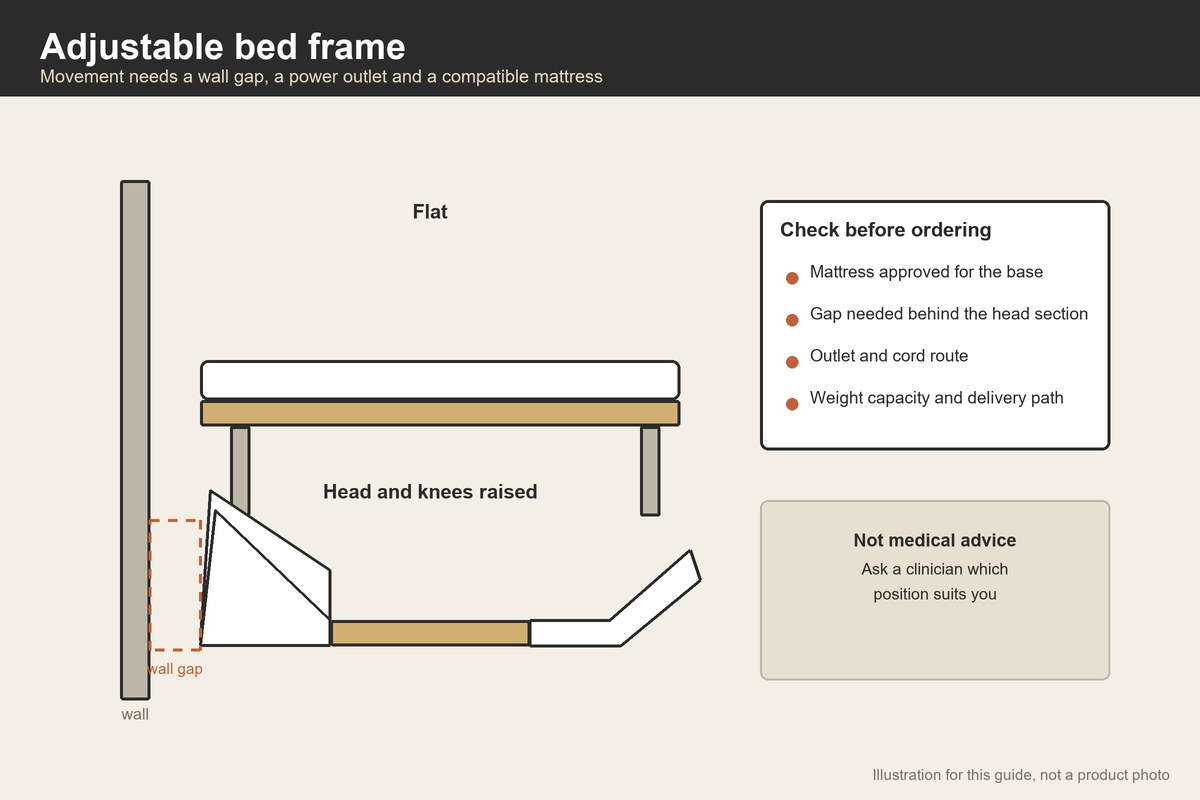
Before you compare models, confirm the mattress you plan to use is approved for an adjustable base, measure the wall gap the frame needs, and find out how the base ships and what it weighs. If a listing does not state a mattress-compatibility rule, weight capacity or power requirement, treat that as unverified and ask.
This guide is about planning fit. We have not tested any base, and it does not give medical advice. If you want an adjustable base for a health reason, ask your clinician what position and support are appropriate.
Know what you are buying
An adjustable bed frame is different from an adjustable bed. A frame or base is the moving platform; you add a mattress on top. Some products are sold as a complete bed with mattress; others are sold as the base only. Read the listing carefully to see which one you are looking at, because the mattress can be a large part of the total cost and of the comfort.
Most adjustable bases have a head section, a foot section and sometimes a center section that stays flat. Extra features vary by model: remote control, preset positions, massage, under-bed lights, USB ports, wall-hugging movement, and a wireless remote. These are convenience features. For most people the deciding factors are the basics: does it fit the room, does it work with the mattress and can it be delivered and set up.
Mattress compatibility is the first check
A standard mattress is built to lie flat. On an adjustable base it must bend at the hips and knees repeatedly. Some mattress types flex easily and some do not.
Foam and hybrid mattresses with a flexible core are commonly sold as adjustable-friendly. Traditional innerspring mattresses with a rigid coil unit may not bend well and can be damaged or void a warranty. Manufacturers state their own compatibility rules, so the safe route is to read the mattress maker’s documentation, not to assume.
Also check the mattress size. Adjustable bases come in standard U.S. mattress sizes, including twin XL, full, queen and split versions. A twin is about 38 by 75 inches, a full about 54 by 75, a queen about 60 by 80 and a king about 76 by 80. Some bases in queen and king sizes are built as two halves so each sleeper can set their own position. A split base needs split-compatible bedding or a mattress that stays put across the gap.
Mattress thickness is the third point. A very thick mattress may not follow the base’s angle well, and the listing may state a maximum thickness. If it does not, ask the seller.
Measure the wall gap and headboard
Many adjustable frames move the head section up and back. On a flat frame, the mattress top stays under the headboard. On an adjustable frame, raising the head can push the mattress into the wall or headboard unless the base is a “wall-hugger” design that slides forward as it lifts. The listing should say which type it is.
To plan the layout, measure from the wall to the front edge of the bed you will use. Add whatever gap the manufacturer specifies. If the listing gives no figure, ask before you buy rather than guessing.
A headboard adds a second problem. A fixed headboard bolted to a standard frame often does not work with an adjustable base, because the head section moves and the headboard does not. Many adjustable bases accept a bracket-mounted headboard or use their own. Check what the model supports.
Plan the power, cords and remote
Most adjustable bases plug into a wall outlet. Check where the outlet is relative to the bed and how long the cable is. A cord stretched across a walkway is a trip hazard. If the outlet is on the far side of the room, plan a cable route along the wall or a protected path, and keep power cords out of the area where feet, pets or small children move.
Also ask what happens during a power failure. Some bases have a battery backup to lower the bed; many do not, and the listing may not say. If you rely on the base for mobility or safety, this matters and you should ask.
Motors make noise. Listings sometimes state a decibel rating; if none is stated, do not assume the base is silent.
Weight, frame strength and floor clearance
A base with two motors, a steel frame and a mattress is heavy. The listing should state the product weight and a maximum load or weight capacity. If it states neither, treat that as an open question. Two sleepers plus a heavy mattress can approach the capacity of some models, so add up the actual load, including the mattress weight if the listing gives it.
Under-bed clearance also matters. Adjustable bases usually sit on legs or a low frame. A low profile leaves no space for storage bins. A taller one leaves room but raises the sleeping surface. Measure the height you need from the floor to the top of the mattress so getting in and out of bed stays comfortable.
Legs and floor: a heavy base can dent soft flooring. Consider glides or pads, and confirm the legs are adjustable if your floor is uneven.
Delivery and setup
Adjustable bases are bulky and heavy and often ship as a single large box or as several. Check the delivered dimensions against your stairs, hallway, and door widths. A frame that cannot pass a turn in a stairwell will not reach the bedroom.
Setup usually involves attaching legs, connecting the motor and remote, and placing the mattress. Some frames need two people. If you are alone, check whether the frame can be assembled in the bedroom in parts.
Returns are also harder. A used adjustable base is hard to repack, and some sellers have restocking fees or no returns on bulky items. Read the return policy before ordering, as it affects your risk.
Use and safety habits
Keep hands, pets and small objects clear of the moving joints. Before you lower or raise the bed, look to see that nothing is caught, and do not let children play on or under it. Follow the manufacturer’s weight limits and instructions.
If someone in the household has limited mobility, think about the remote’s location and how it is used. A remote that falls behind the bed can be hard to reach.
Fire safety guidance applies in bedrooms: keep smoke alarms working and keep exits clear. A power cord under bedding or under the mattress is a fire and wear risk; route it so it is not pinched or covered.
A worked planning example
This is an illustration with made-up numbers for planning, not measured data. Suppose a bedroom is 10 ft by 12 ft, with a queen bed centered on the 10 ft (120 inches) wall, and you want to read with the head raised. A queen mattress is about 60 by 80 inches.
Step one: the mattress. Your current innerspring mattress may not be adjustable-friendly, so you check the maker’s documentation. If it is not approved, the true cost of the base includes a new mattress.
Step two: the wall gap. If the listing asks for a gap of 6 inches behind the head of the bed and your current bed sits 3 inches from the wall, you must pull the bed forward 3 inches, which shrinks the walkway at the foot by the same 3 inches. On the 12 ft (144 inches) room length, an 80 inches bed plus the 6 inches gap leaves 144 − 86 = 58 inches, still above the 36 inches route reference.
Step three: power. The outlet sits on the wrong side of the bed, so you plan a cord path along the baseboard rather than across the floor.
Step four: delivery. The box is long and heavy, so you measure the stair turn against the listed size.
If all four pass, an adjustable base is reasonable. If two fail, a wedge pillow or a bed lift may meet your need at lower cost and complexity.
Alternatives to consider
You may not need a full adjustable base. A foam bed wedge or a set of bed risers can raise the head or feet without a motor. They do not offer the same range of positions, but they are simple, light and cheap to swap. For a reading spot, a supportive chair can give the seated posture without changing your main bed; see solid wood bed frame if you are also replacing the frame.
If your primary problem is a small room, an adjustable base does not help with space; a platform bed frame or a bed frame with storage may fit the room better.
Mistakes to avoid
- Assuming your current mattress will work. Check the mattress maker’s rules.
- Ignoring the wall gap. Check the movement type and measure.
- Overlooking the power plan. Plan the outlet and cord route.
- Skipping the delivery check. Measure stairs and doors.
- Buying on features. Massage and lights matter less than fit and compatibility.
- Forgetting the return policy. Bulky items may be hard or costly to return.
Frequently asked questions
Can I put any mattress on an adjustable bed frame?
No. The mattress needs to bend without damage. Check the mattress maker’s documentation. Foam and flexible hybrid mattresses are more commonly approved than rigid innerspring types.
Do I need a special headboard?
Often yes. A fixed headboard may not move with the base. Check whether the model supports a bracket or its own headboard.
Will an adjustable base work in a small bedroom?
It can, if the wall gap and delivery route work. A wall-hugger design needs less gap. Measure before you buy.
Are adjustable bases quiet?
Not always. If the listing gives no noise rating, do not assume silence.
Is an adjustable base a medical device?
Do not assume so. If you need one for a health reason, talk to a clinician about what you need.
Bottom line
An adjustable bed frame works when the mattress is approved, the wall gap and cord path are planned and the frame can be delivered. Verify those first, ignore extras until they pass, and consider a wedge or riser if you only need a simple change in position.
Products worth checking
We have not tested these products. Sizes and features come from the Amazon listings, checked on September 30, 2026; where a listing does not say, we say so.
Best Choice Products Ergonomic Queen Adjustable Bed Frame with Massage and Wireless Remote
The listing gives 80 x 59 x 14.25 in; 137 lb. We re-opened the page on September 30, 2026 and found these figures; other details are on the product page.
- Good for: a first adjustable base with preset positions, separate head and foot incline and bedside USB.
- Keep in mind: the listing names foam, gel, latex and hybrid mattresses as compatible; confirm your own mattress maker allows an adjustable base, and check the cord length and wall gap yourself.
SIBEDS Black Linen Adjustable Bed Frame, Queen, with Headboard
The listing gives 85.43 x 64.96 x 47.24 in; 122.6 lb. We re-opened the page on September 30, 2026 and found these figures; other details are on the product page.
- Good for: someone who wants an upholstered frame with a headboard and an adjustable head section in one piece.
- Keep in mind: one bullet says the head is cranked up and another says a quiet motor, so confirm how it is powered and which mattress types it accepts before buying.
Sources checked
- Mattress size chart
- Smoke alarm guidance
- Best Choice Products Ergonomic Queen Adjustable Bed Frame with Massage and Wireless Remote
- SIBEDS Black Linen Adjustable Bed Frame, Queen, with Headboard
Specifications checked on September 30, 2026. Product details and availability can change, so confirm on the product page before you buy.