As an Amazon Associate I earn from qualifying purchases. Links marked “Affiliate link” may earn us a commission at no extra cost to you. Learn more.
Quick answer
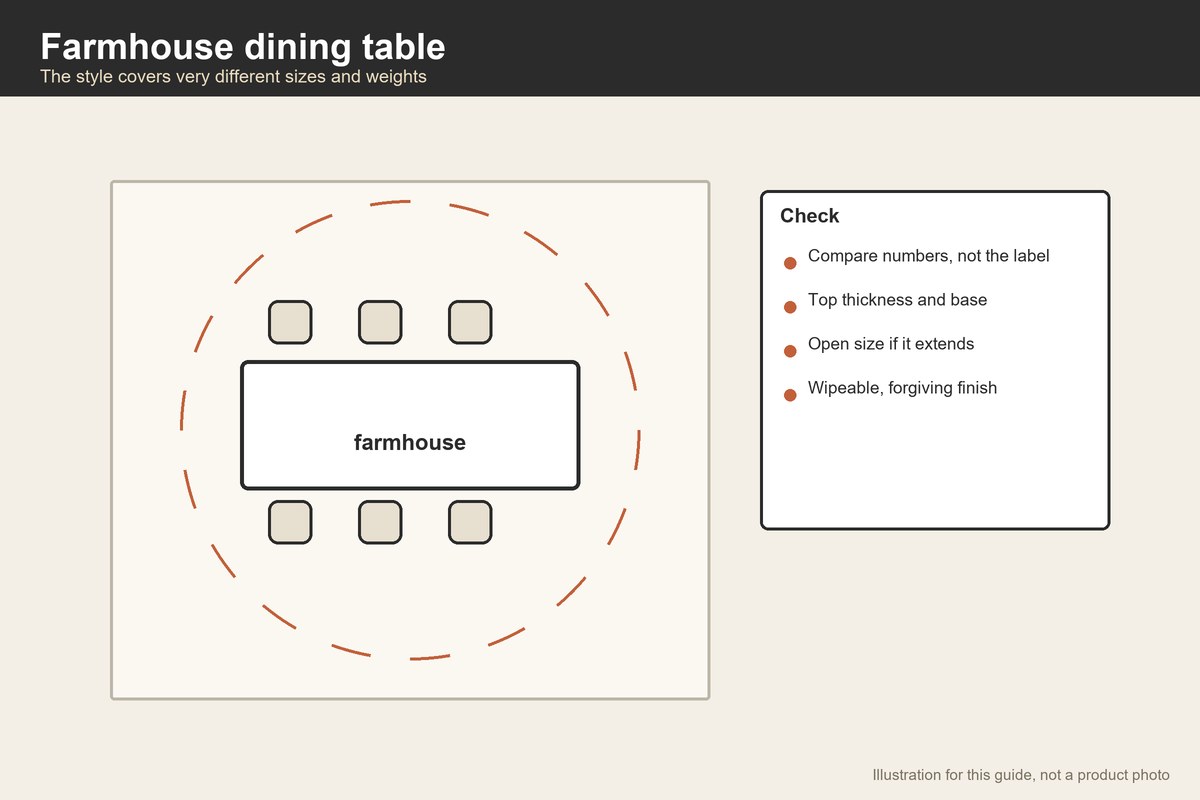
“Farmhouse” is a style, not a size or a material. It usually means a plain, sturdy look with a thick top, chunky legs or a trestle base and a rustic finish. In listings it is applied to everything from a 31.5 inch round table to an extendable table of over 7 feet, so judge each table by its numbers: size, weight, top thickness and base.
The listings we read on Amazon on 2026-10-01 include a rectangular extendable table that is 34.6 inches deep, listed at 86.6 inches long in the dimensions field and 70 to 110 inches in the title, at about 94 pounds, a 31.5 inch round farmhouse table at 30 inches high and about 25.4 pounds, and another 31.5 inch round farmhouse table with a storage shelf at 29.5 inches high and about 20 pounds. We have not tested any of them, and these sizes come from the listings.
If you want a family table that gets daily use, check finish and top thickness more than the look.
Style cues and what they mean in practice
Thick top and chunky legs. They look sturdy and add weight. The listings we read give top thicknesses on some tables but not others; ask the seller. A thick top resists warping if it is real wood and hides fasteners.
Trestle or X-leg bases. Trestle bases can block the end chairs. X-shaped bases suit small tables and leave knee room if the crossing is low.
Distressed or rustic finishes. They hide small scratches and dents, which suits families, but they can also be a printed pattern, not real wear. Check photos of the edge.
Bench seating. Farmhouse tables often pair with benches, which seat more in less space; see breakfast nook dining set.
Sizes across the style
The same style covers very different sizes. The small round tables we read are 31.5 inches across, about 779 square inches of top (π × 15.75²), and weigh about 20 to 25 pounds, so they suit a nook for two. The large rectangular table is 86.6 by 34.6 inches, about 2,996 square inches of top, and weighs about 94 pounds, so it suits a dining room for six to eight.
The large table’s extended length of 110 inches is about 27 percent longer than 86.6 inches ((110 − 86.6) ÷ 86.6). At the usual planning estimate of about 24 inches of edge per person, a rule of thumb, 110 inches on both long sides gives about 9 seats plus the ends, which is more than the room may hold.
Weight and moving
The weights we read span about 20 to 94 pounds. A heavy farmhouse table is stable but hard to move. If you rent or move often, a small round table of 20 to 25 pounds is easier. A table of 94 pounds needs two or three people.
Top material and finish
The tables we read use engineered wood with metal or wood bases. A printed wood-grain top wipes clean but cannot be sanded. Federal rules limit formaldehyde emissions from composite wood products sold in the United States, and listings may state compliance. Ask if it does not. If you want real wood, see solid wood dining room table.
Height and chairs
The tables we read are 29.5 to 30.3 inches high. The U.S. Access Board’s accessible-design standard places dining surfaces between 28 and 34 inches high, which shows the general range that suits seated use. Check that chairs and benches match; see dining chairs.
Room fit
The U.S. Access Board uses 36 inches as a minimum clear width for a route. That is public accessible-design guidance, not a home rule, but a useful yardstick for the space behind seated people. Add about 20 inches for a chair pulled out. A large farmhouse table needs a large room.
Care in a busy household
Wipe spills quickly, use placemats under hot dishes and put felt pads under centerpieces. Tighten bolts on a trestle or X base every few months. If the table extends, keep the slides clean. For a table with a printed top, avoid abrasive pads.
A worked example
These are invented room numbers for planning. A dining room is 12 feet by 14 feet (144 by 168 inches). You consider the extendable table closed (86.6 × 34.6 inches) and open (110 inches long).
Closed: length margin (168 − 86.6) ÷ 2 = 40.7 inches at each end; width margin (144 − 34.6) ÷ 2 = 54.7 inches at each side. Subtract a chair at 20 inches: 54.7 − 20 = 34.7 inches behind the side chairs and 40.7 − 20 = 20.7 behind end chairs.
Open: length margin (168 − 110) ÷ 2 = 29 inches at each end. That is below 36 inches, so the ends are tight, and an end chair at 20 inches leaves only 9 inches.
Now the small round table (31.5 inches) in the same room leaves (144 − 31.5) ÷ 2 = 56.25 inches to each wall. It is far more comfortable but seats only two to four.
The big table suits this room closed and not open; the small one leaves the room almost empty. Choose by how often you host.
Questions to ask before you order
Ask the seller for the top thickness, the base type, the weight and the finish. Ask whether the benches or chairs are included. If the table extends, ask how the leaf stores. If the listing shows several finishes, confirm that the dimensions match.
A quick decision path
If you host often, choose the extendable table and check the room when open. If you have a nook, choose a small round table. If you have children, choose a wipeable top with a forgiving finish. Decide the room first, then the style.
Care and long-term wear
Rustic finishes hide small marks but not spills that soak in. Wipe up liquids at once, avoid harsh cleaners and use felt pads under centerpieces. Tighten trestle and leg bolts after a month and again each season, since the weight of a big table loosens joints. If benches are used, check their legs and seat hardware too.
Real-life scenarios
A farmhouse table in a busy household becomes a homework desk, a craft table and a dinner table. That is a case for a wipeable top and a forgiving finish. In a rental, a heavy table is harder to move, so choose size carefully. If you want the look without the bulk, a small round farmhouse table in a corner gives the style at a fraction of the footprint.
The day it arrives
Unpack in the room where it will live, check each part against the list and look for dents, chips or scratches before you sign for it. Take photos of any damage and keep the packaging until you are sure about the fit. Assemble on a blanket to protect the finish, and keep the instructions and spare hardware in a labeled bag.
Budget without prices
We leave prices out because Amazon changes them often. When you compare, think about the total cost: the item, delivery or help to carry it, floor protection, and anything you must buy to go with it. A cheaper piece that does not fit the room costs more than a slightly dearer one that does. Check the return policy before ordering, since bulky items can be hard to send back.
Common questions we hear
Shoppers ask whether a farmhouse table has to be real wood, whether it is too big for a small room and whether a bench is comfortable. No to the first, not if you pick a small round one, and yes for short meals but add a cushion for long ones. They also ask whether a distressed finish is a printed look; check the edge photos. These answers come from how such tables are built and sold, not from tests of the products listed here.
Mistakes to avoid
- Buying the style, not the size. Compare numbers.
- Ignoring trestle bases. They can block end chairs.
- Forgetting the open size. Measure it.
- Assuming rustic means wood. Check the material.
- Skipping pads. Protect the finish.
When to skip it
If your room is modern and small, a simpler table may suit better. For a tiny kitchen, see kitchenette table. For a larger option, see dining table extendable.
Related guides
See oval dining table, rectangle dining room table and round dining set for 4.
Frequently asked questions
What is a farmhouse dining table?
A style with a sturdy, rustic look. Sizes and materials vary.
Are farmhouse tables real wood?
Some are; many are engineered wood with a wood-look finish. Check the listing.
How big are farmhouse tables?
The ones we read range from 31.5 inches across to over 7 feet long.
Are they heavy?
Small ones are about 20 to 25 pounds; the large one we read is about 94 pounds.
Do they suit small rooms?
Small round ones can.
Bottom line
A farmhouse dining table is a look, so judge it by size, weight, top thickness and base. Measure the room with chairs pulled out and choose a small round table for a nook and a large extendable table only for a large room.
Products worth checking
We have not tested these products. Sizes and features come from the Amazon listings, checked on September 30, 2026; where a listing does not say, we say so.
jiteentarou Extendable Dining Table for 6 8 People, Rectangular Farmhouse
The listing gives 34.6 x 86.6 x 30.3 in (D x W x H); 94 lb. We re-opened the page on September 30, 2026 and found these figures; other details are on the product page.
- Good for: a large extendable farmhouse table.
- Keep in mind: the title says 70 to 110 in while the dimensions field says 86.6 in, so confirm the closed length.
MECHYIN 31.5 inch Round Dining Table for 2 4, Farmhouse Kitchen Table
The listing gives 31.5 x 31.5 x 30 in; 25.4 lb. We re-opened the page on September 30, 2026 and found these figures; other details are on the product page.
- Good for: a small round farmhouse table for a nook.
- Keep in mind: at 31.5 in it is tight for four.
MAHANCRIS 31.5 inch Round Dining Table for 2-4, Farmhouse with Storage Shelf
The listing gives 31.5 x 31.5 x 29.5 in; 20 lb. We re-opened the page on September 30, 2026 and found these figures; other details are on the product page.
- Good for: a light round table with a shelf.
- Keep in mind: the shelf takes leg room, and the weight is only 20 lb.
Sources checked
- Formaldehyde emission standards for composite wood products
- ADA Standards
- Accessible routes guide
- jiteentarou Extendable Dining Table for 6 8 People, Rectangular Farmhouse
- MECHYIN 31.5 inch Round Dining Table for 2 4, Farmhouse Kitchen Table
- MAHANCRIS 31.5 inch Round Dining Table for 2-4, Farmhouse with Storage Shelf
Specifications checked on September 30, 2026. Product details and availability can change, so confirm on the product page before you buy.