As an Amazon Associate I earn from qualifying purchases. Links marked “Affiliate link” may earn us a commission at no extra cost to you. Learn more.
Quick answer
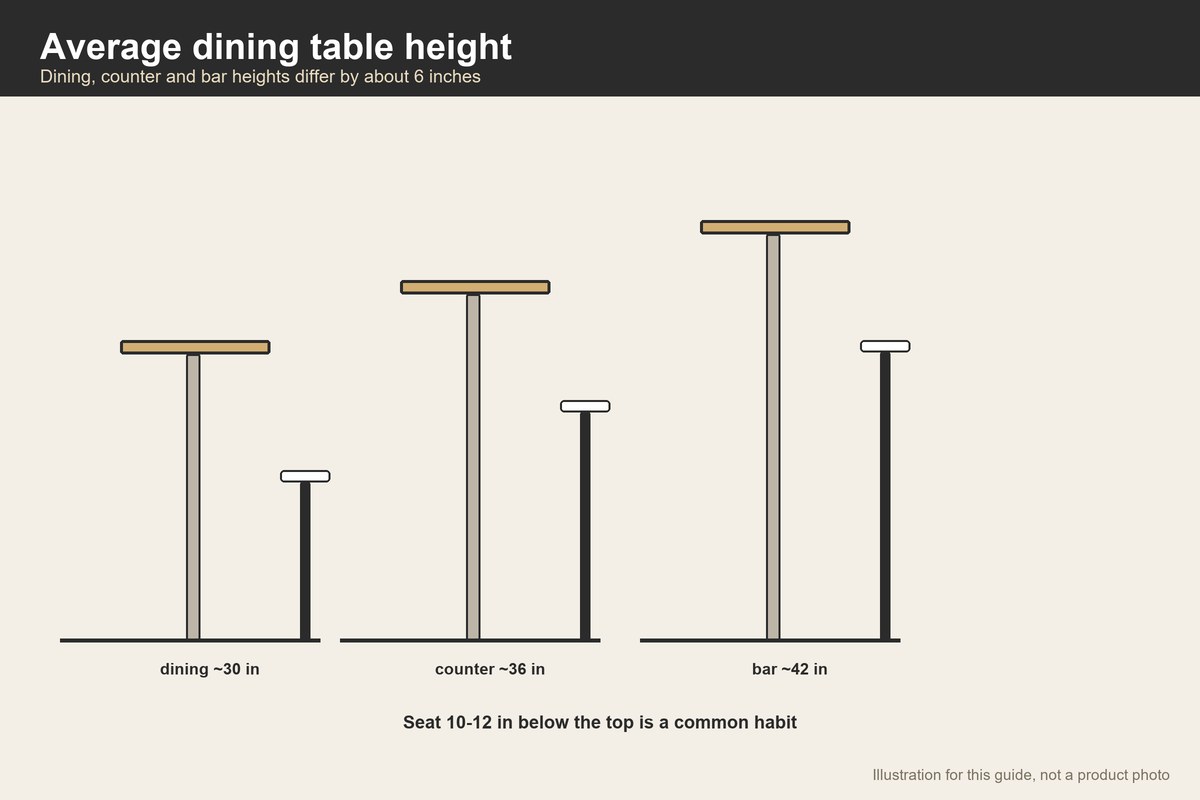
Most dining tables are about 29.5 to 30 inches high. The tables we read on Amazon on 2026-09-30 show that spread: 29.5, 29.53, 29.9, 29.92 and 30 inches for dining tables, 36 inches for a counter-height table and 42 inches for a bar table. Those are listing figures, not an official standard, so check any table you buy. Chairs for a table of about 30 inches typically have seats of about 17 to 19 inches; the metal chair we read lists a 17 inch seat.
The only published reference we opened is accessibility guidance. The U.S. Access Board’s technical standard for accessible dining surfaces gives a height range of 28 to 34 inches for tables, with space for knees underneath. That standard covers public accessible design, not a private home, but it shows the range that suits seated use. A 36 inch counter table and a 42 inch bar table sit above it.
If you are matching chairs, see dining chairs. If you want a tall table, see bar height bar table.
The three common heights
Standard or dining height. About 29.5 to 30 inches in the listings we read. Chairs with seats of 17 to 19 inches suit it. This is the height for long meals, homework and laptops.
Counter height. About 36 inches, matching many kitchen counters. The counter table we read is 30 inches deep and 48 inches wide, rectangular. Stools or tall chairs with seats of about 24 to 26 inches suit it, a rule of thumb.
Bar height. About 40 to 42 inches. The pub table we read is 42 inches. Stools with seats about 28 to 30 inches suit it.
The names are used loosely. Always compare the number, not the label.
The gap between seat and top
A common habit is to leave about 10 to 12 inches between the seat and the underside of the tabletop, or about 12 inches from seat to top surface. This is a rule of thumb, not a standard, and it depends on your legs and the apron thickness.
Work through it: a table of 30 inches with a 1 inch top and a 3 inch apron has an underside at 26 inches. A chair seat of 17 inches leaves 26 − 17 = 9 inches under the apron, and 30 − 17 = 13 inches from seat to top. A chair seat of 19 inches leaves 26 − 19 = 7 inches under the apron, which is tight for large thighs.
Legroom
Tables with wide aprons or drawers cut legroom. Check the listing photos of the base. The government accessible-design standard calls for knee clearance under dining surfaces; the specific figures are in its text, and we do not quote them here. For a home, sit at the table and check that your knees clear the apron and the legs.
Height of children’s seats
Children often need a booster or a footrest. A child’s feet dangling at a 30 inch table tire quickly. A footrest or a lower child chair helps.
Adjustable-height tables
Some small tables adjust. The pub tables we read range from 27 to 35.4 inches and 28.9 to 37.4 inches. They suit changing uses, but the lock must hold, and the stool or chair must match the setting you choose.
Ceilings, rugs and other effects
A thick rug raises the floor by a fraction of an inch and can change the feel of chairs. Floor pads on chair legs add height as well. Small differences like these rarely matter, but they add up if your chair is borderline.
Materials and emissions
Tables at standard height use wood, engineered wood or metal. Federal rules limit formaldehyde emissions from composite wood products sold in the United States, and listings may state compliance. Ask if it does not.
A worked example
These are invented numbers for planning. You consider a dining table that is 29.92 inches high with a 1 inch top and a 3 inch apron, and the metal chair with a 17 inch seat from the listings.
Seat to top: 29.92 − 17 = 12.92 inches. Seat to apron underside: 29.92 − 1 − 3 − 17 = 8.92 inches. Both fit the habits above.
Now consider the 36 inch counter table with a 1 inch top and a 3.5 inch apron. Underside: 36 − 1 − 3.5 = 31.5 inches. A seat of 24 inches leaves 31.5 − 24 = 7.5 inches under the apron, and 36 − 24 = 12 inches seat to top. So the counter table needs stools whose seats are about 24 inches, which is 7 inches higher than the dining chair seat.
Finally the 42 inch table: a 30 inch seat gives 12 inches seat to top. The difference between the three tables is 36 − 29.92 = 6.08 inches and 42 − 36 = 6 inches, so each step is about 6 inches.
Questions to ask before you order
Ask the seller for the underside height of the apron, the top thickness and the knee clearance. Ask whether the legs are adjustable, and whether chairs are included and what their seat height is. If the listing shows several sizes, confirm that the height matches the size you choose.
A quick decision path
If you eat at the table daily, choose standard height. If the table is part of a kitchen counter run, consider counter height. If you want a perch for short sittings, choose bar height. If anyone has trouble with high seats, choose standard.
Why the numbers vary
Tables are made in a range of heights because chairs, floors and users differ. A seller’s “standard” may differ from another’s by half an inch. A rug under the table and pads under the legs also change the effective height. When you compare, look at the listed height and subtract rounding: a table listed at 29.92 inches and one listed at 30 inches are the same table for practical purposes.
Seat height and legroom in practice
The best test is to sit at the table. Rest your forearms on the top: if your shoulders rise, the table is too high or the chair too low. Put your hand flat on your thigh: if it hits the apron, the table is too low or too thick. A footrest or a cushion can adjust a chair by an inch or two. If you share a table with children, a booster seat can bring them up to the same level as adults.
The day you test it
Put a chair at the table, sit with your feet flat and rest your forearms on the top. Check whether your shoulders rise, whether your knees touch the apron and whether your feet reach the floor. Try the other chairs in the household, since a table that works for you may not suit a child or a taller guest. Adjust with cushions, footrests or pads, and note the effect.
Budget without prices
We leave prices out. Matching height is cheaper than replacing a table: a different set of chairs or a footrest costs less than a new table. Measure first, and buy the part that does not fit.
Checking a table you already own
Measure from the floor to the top surface with a tape, then to the underside of the apron. Write both numbers down. Measure the seat height of your chairs the same way, from the floor to the top of the seat with no cushion compressed. Subtract to get the seat to top and seat to apron gaps. If the first is much more than about 13 inches or the second is under about 7 inches, expect discomfort; these are habits, not limits. A thin cushion or a footrest can correct a small gap. For a larger gap, change the chair or the table.
Common height questions
People ask whether a table can be cut down. Cutting legs is possible on solid wood but risky on engineered wood, and it cannot be undone. People also ask whether risers can raise a low table; they can, if they are rated for the weight and sit squarely. If you are unsure, keep the table and change the chairs, which is the cheaper and safer fix.
Mistakes to avoid
- Matching by name. Use the number.
- Ignoring the apron. It cuts legroom.
- Mixing dining chairs with counter tables. Heights will not work.
- Forgetting children. Add a footrest or booster.
- Trusting adjustable locks. Test them.
When height does not matter
For a short snack at a perch, height matters less. For a laptop or homework, the standard height is best. See table ergonomics for posture checks.
Related guides
See rectangle dining room table, kitchen table and chairs for 4 and small kitchen table and chairs.
Frequently asked questions
What is the standard dining table height?
The dining tables we read are about 29.5 to 30 inches high.
What is counter height?
About 36 inches in the listing we read.
What is bar height?
About 42 inches in the table we read.
How tall should dining chairs be?
About 17 to 19 inches for a 30 inch table. Check the listed seat height.
Is there an official standard?
The Access Board’s accessible-design standard gives 28 to 34 inches for accessible dining surfaces; it does not apply to private homes.
Bottom line
The usual dining table height is about 30 inches, with counter tables near 36 inches and bar tables near 42 inches. Match the chair seat height and check legroom before you buy.
Products worth checking
We have not tested these products. Sizes and features come from the Amazon listings, checked on September 30, 2026; where a listing does not say, we say so.
East West Furniture YAT-OAK-H Yarmouth Rectangle Counter Height Dining Table
The listing gives 30 x 48 x 36 in (D x W x H); 44 lb. We re-opened the page on September 30, 2026 and found these figures; other details are on the product page.
- Good for: a counter-height (36 in) table for tall stools.
- Keep in mind: it needs stools with seats about 24 in high.
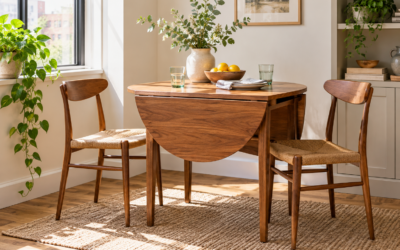
VASAGLE Folding Dining Table, Drop Leaf Extendable Table
The listing gives 30.7 x 47.2 x 30 in open; 38.6 lb. We re-opened the page on September 30, 2026 and found these figures; other details are on the product page.
- Good for: a standard-height (30 in) folding table.
- Keep in mind: the page also lists a smaller closed size, so confirm both.
Amazon Basics Metal Dining Chairs, Stackable
The listing gives 20.1 x 17.1 x 33.5 in; seat height 17 in. We re-opened the page on September 30, 2026 and found these figures; other details are on the product page.
- Good for: a chair with a stated 17 in seat height for a 30 in table.
- Keep in mind: it is firm without a cushion.
Sources checked
- ADA Standards
- Formaldehyde emission standards for composite wood products
- East West Furniture YAT-OAK-H Yarmouth Rectangle Counter Height Dining Table
- VASAGLE Folding Dining Table, Drop Leaf Extendable Table
- Amazon Basics Metal Dining Chairs, Stackable
Specifications checked on September 30, 2026. Product details and availability can change, so confirm on the product page before you buy.