As an Amazon Associate I earn from qualifying purchases. Links marked “Affiliate link” may earn us a commission at no extra cost to you. Learn more.
Quick answer
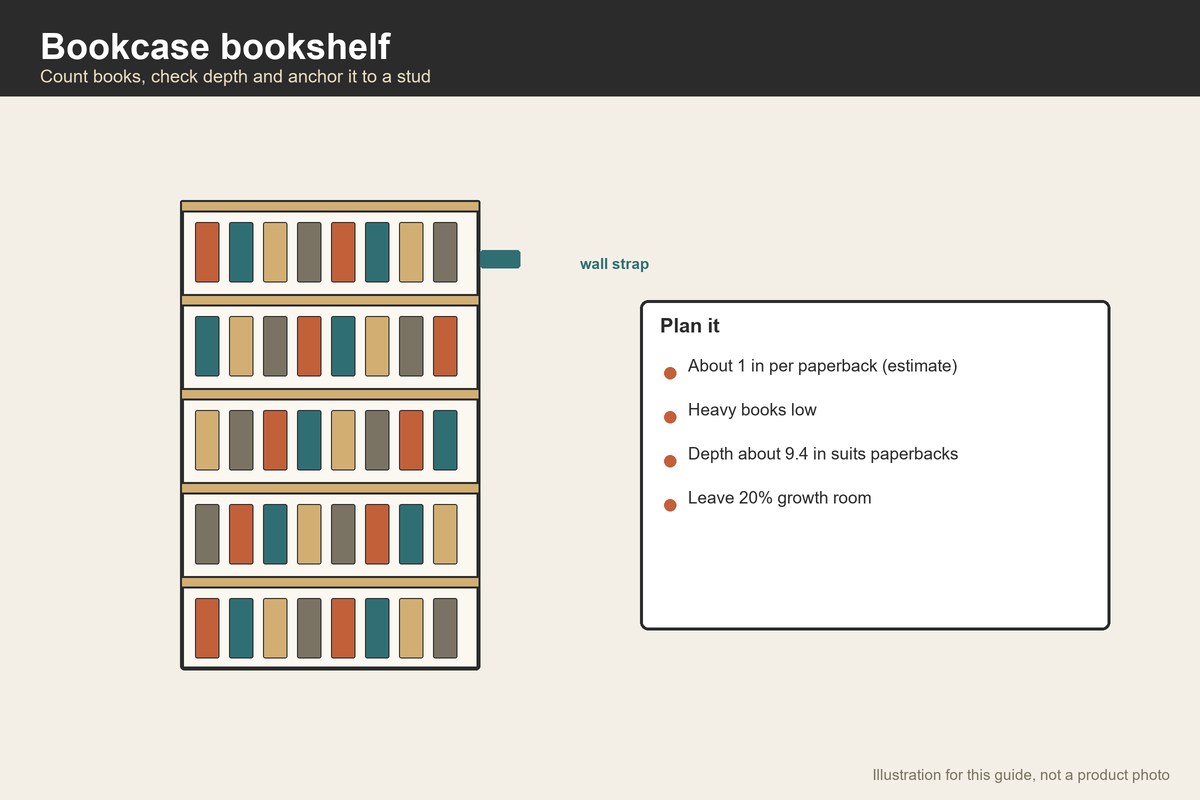
A bookcase bookshelf works when it is sized from your books, not from the wall. Count your books, measure the tallest, and choose a width, height and depth that hold them with room to grow. Then anchor it to the wall. The Consumer Product Safety Commission’s Anchor It campaign explains why furniture should be anchored where children live.
The listings we read on Amazon on 2026-09-30 give a five-tier bookshelf that is 23.6 inches wide, 9.4 inches deep and 52.5 inches high, about 36.7 pounds; a narrow five-tier unit of 15.78 by 9.4 by 52 inches, about 22 pounds; and a taller five-tier unit of 24.76 by 9.49 by 71.18 inches, about 19.8 pounds. We have not tested any of them. All three are shallow, about 9.4 inches, which suits paperbacks and standard hardcovers but not oversized art books.
The lighter the unit, the more it needs anchoring. The tall 19.8 pound unit is a tip-over risk if it is not fastened.
Count the books first
Estimate capacity with simple arithmetic. A shelf 23.6 inches wide holds about 23 paperbacks at roughly 1 inch each, which is our estimate, not a listed figure. With five shelves, that is about 5 × 23 = 115 paperbacks. Hardcovers are thicker, so perhaps 15 per shelf, or about 75 on five shelves. Measure a sample stack of your own books to refine the estimate.
Leave growth room. A common habit is to fill a shelf to about 80 percent, so you can add books without rearranging. On a 23.6 inch shelf that is about 18.9 inches of books.
Width, depth and height
Width. A narrow 15.78 inch unit fits a hallway or a gap between furniture but holds fewer books per shelf. A 23.6 to 24.8 inch unit is a standard single-column size.
Depth. About 9.4 inches suits paperbacks and most novels. A deeper unit of 12 inches or more suits large books and baskets, but the listings we read are shallow.
Height. A 52 inch unit is waist-to-chest height for many adults and looks lighter in a room. A 71 inch unit holds more but dominates a wall and needs anchoring.
Shelf spacing and adjustability
Standard books are about 9 to 12 inches tall. A five-tier unit of 52 inches has shelf spacing of roughly 10 inches if the shelves are evenly spaced (52 ÷ 5 = 10.4). That is a calculation on the overall height, not a stated spacing, so check the listing. The taller unit of 71 inches with adjustable shelves lets you change heights for large books. Adjustable shelves rest on pins; check the pin size and the stated load limit. If a listing gives none, treat it as unknown.
Load and material
The units we read are engineered wood (particleboard and MDF). A shelf that is 23.6 inches wide and about 0.6 inch thick may sag under a heavy row of books over time. A rule of thumb is to place the heaviest books on the lowest shelves and avoid spans wider than about 30 inches for thin shelves; treat that as advice, not a rating. Federal rules limit formaldehyde emissions from composite wood products sold in the United States, and listings may state compliance. Ask if it does not.
Tip-over safety
Most bookcase accidents are avoidable with anchors. Fasten the top of the bookcase to a wall stud with the strap or bracket from the kit. Place heavier items low, and keep the unit off a thick carpet that tilts it back. Anchor It recommends anchoring furniture and TVs; use the method that suits your wall and follow the instructions.
Floor space and route
A bookcase 9.4 inches deep takes little floor. The U.S. Access Board uses 36 inches as a minimum clear width for a route, and 32 inches at short obstructions. That guidance is for accessible design in public buildings, not a home rule, but it is a useful yardstick. A shallow bookcase in a hallway leaves most of the width.
Assembly and delivery
Bookcases ship flat. A 36.7 pound box is a one-person lift; a tall unit is easier with two people for standing it upright. Assemble it in the room and stand it against the wall before loading. Retighten screws after a month.
A worked example
These are invented room and book numbers. You own 140 paperbacks and 30 hardcovers. Paperbacks at about 1 inch take 140 inches; hardcovers at about 1.5 inches take 45 inches. Total: 185 inches of shelf, plus 20 percent growth: 185 × 1.2 = 222 inches.
A 23.6 inch shelf holds 23.6 inches of books, so you need 222 ÷ 23.6 = 9.4 shelves, about 10. Two five-tier units of 23.6 inches give 10 shelves and 236 inches. A single 71 inch unit with five shelves of 24.76 inches gives 124 inches, so two tall units would cover 248 inches.
Wall space: two 23.6 inch units side by side take 47.2 inches; two 24.76 inch units take 49.52 inches. On a 9 foot (108 inch) wall, 108 − 49.52 = 58.48 inches remain for a door or a window.
Weight check: if the 140 paperbacks average about 0.7 pounds each, they weigh about 98 pounds; that average is an assumption. Spread over 10 shelves, that is under 10 pounds a shelf from the paperbacks, but the hardcovers add more. The lightest unit, at about 19.8 pounds, is far lighter than its load, which is another reason to anchor it.
Questions to ask before you order
Ask the seller for the shelf thickness, the weight limit per shelf, the pin size and whether the anchor kit is included. Ask how many boxes it ships in. If the listing shows several finishes, confirm that the dimensions match the one you choose.
A quick decision path
If you have few books, choose the narrow 15.78 inch unit. If you have many, choose two tall units. If you have large books, look for deeper shelves. Decide your book count first, then compare only the units that fit.
Styling and loading a bookcase
A bookcase looks better when the loads are balanced. Put the heaviest books on the lowest shelves, mix horizontal stacks with vertical rows and leave some gaps. Keep fragile items away from the edges. In a room with children, keep heavier objects off the top shelf. If a shelf bows after a few weeks, redistribute the books or add a support under the middle. This is general advice, not a claim from the listings.
Wall, floor and room conditions
Check the floor before you place a tall bookcase. A thick rug or an uneven floor tilts the unit back, which can put more strain on the anchor. Shim the front feet if the unit leans. Keep the bookcase away from radiators and sunny windows, since heat and light can warp or fade engineered wood. If the wall is plaster or masonry, use the correct anchors; the kit may include only drywall hardware, so check.
The day it arrives
Unpack the shelves and count the pins, screws and cams. Assemble the frame on the floor, check that it is square by measuring both diagonals and tighten the fasteners. Stand it against the wall with a helper and fix the anchor before you fill it. If a shelf bows when empty, check that it is seated correctly.
Budget without prices
We leave prices out. A larger number of cheap units can cost more in the end than one sturdy tall unit, but only if you will use the height. Count books first, then decide how many units you need and whether the wall can take them.
Mistakes to avoid
- Skipping the anchor. Tall light cases tip.
- Overloading a wide shelf. Put heavy books low.
- Ignoring depth. Large books need more than about 9 inches.
- Buying by height alone. Count shelf length.
- Forgetting growth. Plan for 20 percent more.
When to skip a bookcase
If you own few books, a wall shelf or a cube organizer may serve better; see best cube storage organizers for small rooms. For closed storage see best small bookcases with doors.
Related guides
See best floating shelves for a home office, corner bookshelf and ladder shelf.
Frequently asked questions
How many books fit on a shelf?
About 1 inch per paperback is a rough estimate. Measure your own books.
How deep should a bookcase be?
About 9.4 inches suits paperbacks and standard books; large books need more.
Do I need to anchor a bookcase?
Yes, especially a tall, light one, and especially with children around.
Can shelves sag?
Yes, if they are thin and loaded. Put heavy books low and check the load limit.
What is the difference between a bookcase and a bookshelf?
The terms overlap. Check dimensions and shelf count in the listing.
Bottom line
Size a bookcase from your book count, then check width, depth and height. Anchor it to a wall stud, place heavy books low and choose the narrowest unit that holds what you own with room to grow.
Products worth checking
We have not tested these products. Sizes and features come from the Amazon listings, checked on September 30, 2026; where a listing does not say, we say so.
VASAGLE 5-Tier Bookshelf, Storage Organizer
The listing gives 9.4 x 23.6 x 52.5 in (D x W x H); 36.7 lb. We re-opened the page on September 30, 2026 and found these figures; other details are on the product page.
- Good for: a sturdy mid-height bookcase.
- Keep in mind: at 52.5 in high it holds fewer books than a tall unit, and the text we read gives no shelf load limit.
Furinno LUDER Book Shelf, 5-Tier Bookshelf with Open Shelves
The listing gives 9.4 x 15.78 x 52 in; 22 lb. We re-opened the page on September 30, 2026 and found these figures; other details are on the product page.
- Good for: a narrow bookcase for a gap.
- Keep in mind: it is light, so anchor it.
Furinno Jaya 5-Tier Book Shelf with Adjustable Shelves
The listing gives 9.49 x 24.76 x 71.18 in; 19.8 lb. We re-opened the page on September 30, 2026 and found these figures; other details are on the product page.
- Good for: a tall bookcase with adjustable shelves.
- Keep in mind: 19.8 lb at 71 in tall is a tip-over risk without anchoring.
Sources checked
- Anchor It
- Formaldehyde emission standards for composite wood products
- Accessible routes guide
- VASAGLE 5-Tier Bookshelf, Storage Organizer
- Furinno LUDER Book Shelf, 5-Tier Bookshelf with Open Shelves
- Furinno Jaya 5-Tier Book Shelf with Adjustable Shelves
Specifications checked on September 30, 2026. Product details and availability can change, so confirm on the product page before you buy.