As an Amazon Associate I earn from qualifying purchases. Links marked “Affiliate link” may earn us a commission at no extra cost to you. Learn more.
Quick answer
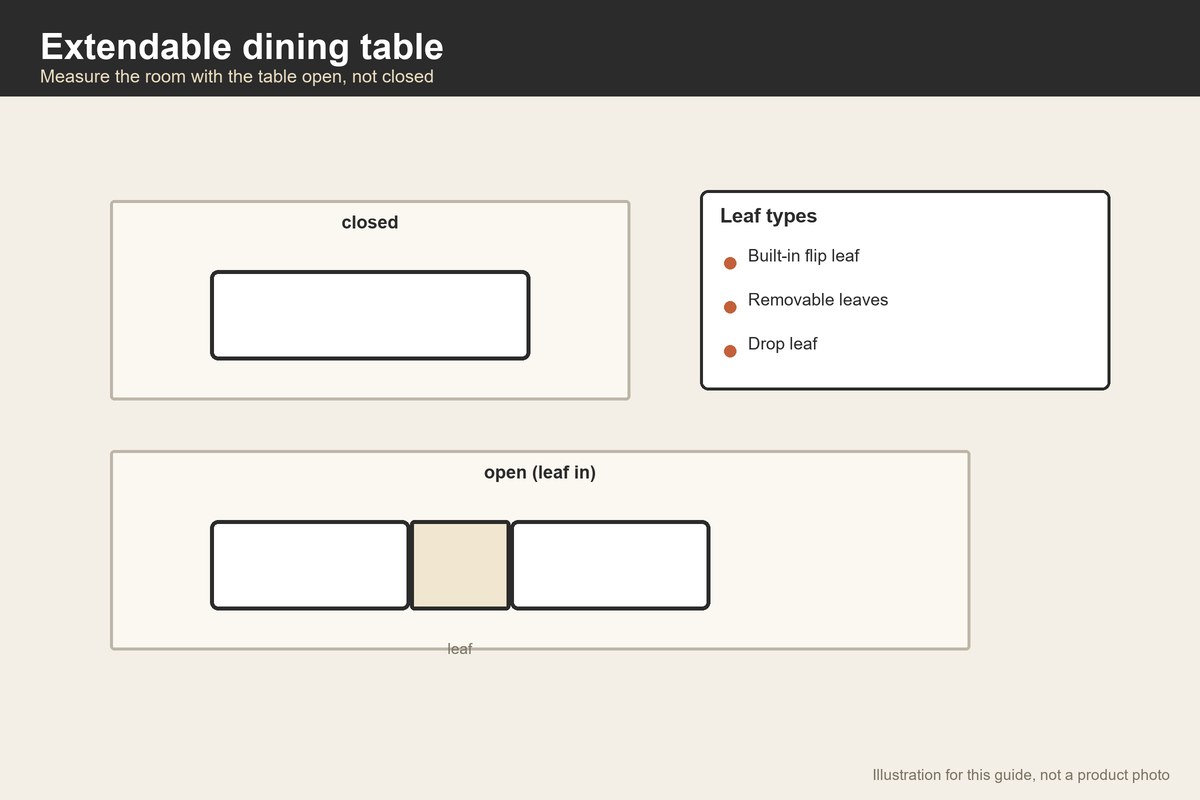
An extendable dining table is a table with a leaf, a flip-out section or a slide mechanism that makes it longer for guests. It pays off in a small room that hosts only sometimes, because you keep the floor space most days. The checks are the closed size, the open size, how the leaf works and how much room you need around the table in each state.
The listings we read on Amazon on 2026-09-30 show three designs. An oval table extends from 55 to about 70.8 inches with a built-in flip leaf and weighs about 83 pounds. A small solid-wood square table expands from 23.6 to 47.2 inches and weighs about 52 pounds. An oval table with removable leaves goes from 35.4 to 47.2 inches and weighs about 73.2 pounds. We have not tested any of them, and the open and closed sizes come from the listings.
Measure the room with the table open, since that is when it is tightest.
Three leaf types
Built-in flip leaf. A section folds out from under the top and locks in place. There is no storage problem because the leaf stays in the table. It adds weight and complexity: the oval table we read weighs about 83 pounds. Check that the locks are firm, since a leaf that sags is a nuisance.
Removable leaves. Loose boards drop in between the two halves. The table with removable leaves we opened lists hidden storage, but the leaves must be stored when not in use, and the seams may show. Check that the boards line up and that the table has pins to keep them in place.
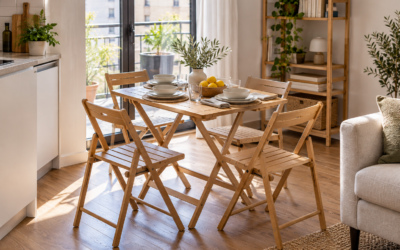
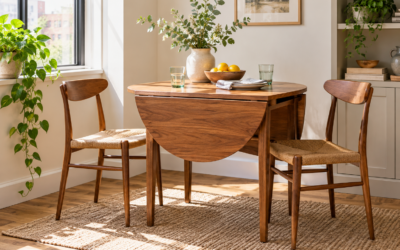
Drop leaf or fold-out. A side folds down and is held up by a bracket. It is simple and saves floor, but the brackets take leg room when the table is open. See dinette sets for small spaces for drop-leaf layouts.
Choose the type by how often you extend. If you extend every week, a built-in flip leaf is convenient. If you extend twice a year, removable leaves are fine.
Closed size, open size and the extra you gain
Compare the gain, not only the open size. The oval 55 to 70.8 inch table adds 70.8 − 55 = 15.8 inches, about 29 percent more length. The square table that expands from 23.6 to 47.2 inches doubles its length (47.2 ÷ 23.6 = 2), a bigger gain in a tiny footprint. The 35.4 to 47.2 inch table adds 11.8 inches, about 33 percent.
At an estimate of about 24 inches of edge per person, which is a rule of thumb rather than a standard, each extra 24 inches of length seats about two more people if they sit on both long sides. So the 15.8 inch gain adds roughly one seat, and the doubling of the small table adds roughly two.
Weight and moving
Extendable tables are heavy because of the mechanism. The listings we read give 52 to 83 pounds. A heavy table is stable but hard to move, and you should not drag it, since the legs and the slides can bend. If you have to move it often, choose the lightest.
Room needed in each state
The U.S. Access Board uses 36 inches as a minimum clear width for a route. That is guidance for accessible design in public buildings, not a home rule, but it is a helpful yardstick for the path behind a seated person. Add about 20 inches for a chair pulled out. Leave space at the ends for end chairs.
Height and chairs
The tables we read are about 29.5 to 30 inches high. The Access Board’s accessible-design standard places dining surfaces between 28 and 34 inches high, which shows the general range that suits seated use. Match the chairs to the height; see dining chairs.
Materials
The small table lists rubberwood, which is a hardwood used in furniture. The oval tables list engineered wood in the titles we opened. Federal rules limit formaldehyde emissions from composite wood products sold in the United States, and listings may state compliance. Ask if it does not. Rubberwood can be refinished.
Delivery and assembly
Extendable tables ship in heavy boxes, and the mechanism needs careful assembly. Plan for two people. Test the extension before you throw away the packaging, and keep the hardware.
A worked example
These are invented room numbers for planning. A dining room is 10 feet by 12 feet (120 by 144 inches). Use the oval table: 55 inches closed, 70.87 inches open, 31.5 inches wide.
Closed: length margin 144 − 55 = 89 inches, or 44.5 inches per end; width margin 120 − 31.5 = 88.5 inches, or 44.25 inches per side. Both are above 36 inches, so the room is comfortable.
Open: length margin 144 − 70.87 = 73.13 inches, or 36.57 inches per end. That is just above 36 inches, so the ends are fine but tight with chairs pulled out. Floor area rises from 55 × 31.5 = 1,732.5 square inches to 70.87 × 31.5 = 2,232.4 square inches, an increase of about 29 percent.
Now try the square table at 47.2 inches open and 31.5 inches deep. Length margin 144 − 47.2 = 96.8 inches; it leaves plenty of room. When closed at 23.6 inches long, the table is a small square that suits two.
The oval table suits six to eight when open but nearly fills this room; the small table suits two to four and leaves space. Choose by the largest group you host.
Questions to ask before you order
Ask the seller for the closed and open dimensions, the leaf thickness, the mechanism type and the locking method. Ask whether the leaf can be stored inside and how much it weighs. Ask about the apron height to check legroom. If the listing shows several finishes, ask whether the dimensions are identical.
A quick decision path
If you host six or more a few times a year, choose removable leaves. If you host weekly, choose a built-in flip leaf. If the room is tiny, choose the table that doubles in length. If the room is large, a fixed table may be simpler.
Hosting with a leaf table
An extendable table is only as good as the routine. Decide where the leaf lives, who puts it in and how long it takes. Practice once before the first big meal, so you know whether it needs two people. Keep a small cloth or pad to protect the surface when you slide halves apart. If the leaf is stored inside the table, check that the cover and the lock do not catch your fingers. The gain in seats is real, but the setup time is part of the cost.
Care and long-term wear
Slides, locks and leaf pins are the parts that wear. Wipe the slides with a dry cloth and keep crumbs out of the track. Do not lean on a leaf that is not locked. Tighten bolts after the first month. If a table has a gap between halves when closed, check that the pins are seated. Rubberwood can be refinished; engineered wood cannot be sanded as deeply, so protect the top from heat and water from the start.
The day it arrives
Unpack the table in the room and check the leaf, the slides and the hardware against the list. Test the extension at once: open it fully, close it and lock it. If a part is missing or the leaf binds, tell the seller before you discard the box. Place felt on the slide ends if the instructions allow, and keep the extra hardware in a labeled bag.
Budget without prices
We leave prices out. Compare total cost: a table with a built-in leaf is convenient but heavy and may cost more to ship; removable leaves need a storage place. If you rarely extend, a fixed table plus a folding table for guests may cost less and use less space.
Mistakes to avoid
- Measuring closed only. Check the open size against the room.
- Ignoring weight. Heavy tables are hard to move.
- Forgetting leaf storage. Removable leaves need a place.
- Overlooking leg room. Brackets and aprons can block knees.
- Skipping the lock check. A sagging leaf is annoying.
When to skip an extendable table
If you host rarely, buy a fixed table and borrow extra seating. If you host often, a larger fixed table may serve better. For tiny kitchens, see small kitchen table and chairs.
Related guides
See rectangle dining room table, round dining set for 4 and kitchen table and chairs for 4.
Frequently asked questions
How much longer does an extendable table get?
The ones we read add about 12 to 24 inches. Check the listing for the exact open length.
Are extendable tables sturdy?
They can be, but the mechanism adds weak points. Check the locks and the legs.
How much room do I need when it is open?
About 36 inches from the table edge to walls as a planning figure, plus chair pull-out.
Are removable leaves better?
They are simple and stable but need storage. Flip leaves stay in the table.
How many people sit at an extended table?
A common estimate is about 24 inches of edge per person.
Bottom line
Choose an extendable dining table by the open size and the room left when it is open, then by leaf type. Measure both states, check the locks and pick the lightest table that seats your largest group.
Products worth checking
We have not tested these products. Sizes and features come from the Amazon listings, checked on September 30, 2026; where a listing does not say, we say so.
55-70.8 inch Extendable Oval Dining Table for 4-8 with Built-in Flip Leaf
The listing gives 55 in closed to 70.87 in open, 31.5 in wide, 29.53 in high; 83 lb. We re-opened the page on September 30, 2026 and found these figures; other details are on the product page.
- Good for: a table that grows by about 16 in with a built-in leaf.
- Keep in mind: at 83 lb it is heavy, and the listing does not describe the lock.
DONGMUWUJEE Solid Wood Small Dining Table for 2-6, 23.6 inch to 47.2 inch Expandable
The listing gives 23.6 in closed to 47.2 in open; 31.5 x 47.2 x 29.5 in (D x W x H). We re-opened the page on September 30, 2026 and found these figures; other details are on the product page.
- Good for: a small table that doubles in length.
- Keep in mind: the page lists several extension sizes (up to 70.8 in) across variants.
Gutmotto Extendable Dining Table, 35.4-47.2 inch, Small Kitchen
The listing gives 35.4 x 35.4 x 30 in closed (D x W x H); 73.2 lb. We re-opened the page on September 30, 2026 and found these figures; other details are on the product page.
- Good for: a compact oval with hidden storage.
- Keep in mind: removable leaves need a storage spot, and it is heavy for its size.
Sources checked
- Accessible routes guide
- ADA Standards
- Formaldehyde emission standards for composite wood products
- 55-70.8 inch Extendable Oval Dining Table for 4-8 with Built-in Flip Leaf
- DONGMUWUJEE Solid Wood Small Dining Table for 2-6, 23.6 inch to 47.2 inch Expandable
- Gutmotto Extendable Dining Table, 35.4-47.2 inch, Small Kitchen
Specifications checked on September 30, 2026. Product details and availability can change, so confirm on the product page before you buy.