As an Amazon Associate I earn from qualifying purchases. Links marked “Affiliate link” may earn us a commission at no extra cost to you. Learn more.
Quick answer
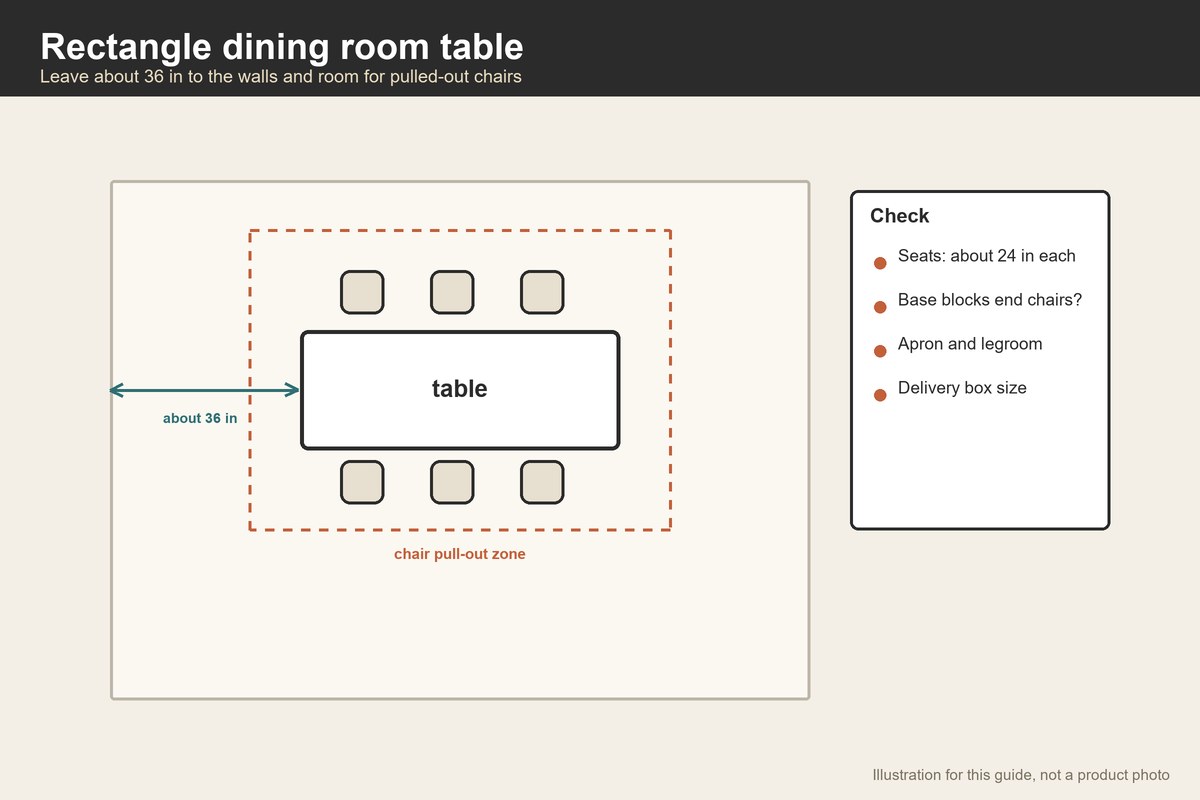
A rectangle dining room table fits a room when its length leaves about 36 inches to the wall at each end and its width leaves the same on each side, so chairs can be pulled out and people can pass. That 36 inch figure is a widely used planning habit, not a code: the U.S. Access Board uses 36 inches as a minimum clear width for a route, which is a helpful yardstick for the space behind a seated person.
For seating, a common planning estimate is about 24 inches of table edge per person, which is a rule of thumb rather than a standard. On that estimate, a 63 inch table seats two people per long side plus one at each end, or six in total. The listings we read on Amazon on 2026-09-30 give a 63 inch rectangular table at 29.5 inches deep and 29.9 inches high, a 55 inch table with a storage shelf, and a 47 inch foldable table at 31.5 inches deep. We have not tested any of them.
Decide the number of seats first, then measure the room, then compare tables.
Choose the seat count
Most households eat with two to four people on an ordinary day and six when guests come. A rectangle is good at the second case because people sit along both long sides. Write down how many people sit most days and how many on busy days, then choose a table for the most common case and a way to stretch for the rest; see dining table extendable if you want a table that grows.
Use the edge arithmetic to check. Two long sides at 63 inches give 126 inches of edge, and 126 ÷ 24 is about 5.25, so five seats on the long sides only. The two ends add a seat each if the chairs fit, so six to seven in practice. The 47 inch table gives 94 inches of long-side edge, 94 ÷ 24 is about 3.9, so four seats.
Length and width
Length decides seats. Width decides comfort and how much you can set out. The tables we read are 29.5 to 31.5 inches deep. That is on the narrow side for serving dishes down the middle. A table about 36 inches wide is more comfortable for shared plates, but it needs more floor, and the listings we read do not offer one.
Do not forget leg room. Legs at the corners suit chairs at the ends. A trestle or a center base can block the end chairs. Check the listing photos of the base.
Height and chairs
The tables we read are about 29.5 to 30 inches high. Dining chairs often have seats of about 17 to 19 inches. The Access Board’s accessible-design standard places dining surfaces between 28 and 34 inches high, which shows the general range that suits seated use, though it does not apply to a private home. Match the chair to the table; see dining chairs.
Storage, leaves and folding
Some tables add features. The 55 inch table we read has a storage shelf. The 47 inch one folds and rotates, and weighs about 41.8 pounds. Folding tables save floor when closed but have moving parts; check the locks and the hinge strength. A shelf under the top takes leg room, so check the space under it.
Materials and weight
The tables we read use particleboard with a metal frame, weighing about 42 to 45 pounds. Particleboard is light and inexpensive, and it chips at edges and swells if wet. Federal rules limit formaldehyde emissions from composite wood products sold in the United States, and listings may state compliance. Ask if the listing does not. A heavy table is stable but hard to move; a light one may wobble. Check for adjustable feet.
Delivery and assembly
A 63 inch tabletop arrives in a long box. Measure stairs, turns and the doorway. Allow an hour to assemble and ask a second person to hold the top. Level the table on your floor, and retighten the legs after a week.
A worked example
These are invented room numbers for planning. A dining room is 11 feet by 13 feet (132 by 156 inches). You consider the 63 by 29.5 inch table centered in the room.
Length: 156 − 63 = 93 inches, or 46.5 inches at each end. That is above the 36 inch planning figure, so end chairs can be pulled out.
Width: 132 − 29.5 = 102.5 inches, or 51.25 inches at each side. Subtract a chair pulled out 20 inches: 51.25 − 20 = 31.25 inches behind the chair, slightly below 36, so a person passing behind a seated guest squeezes by.
Move the table to one side to make a wider path: put it 36 inches from one wall. Then the other side has 102.5 − 36 = 66.5 inches, and 66.5 − 20 = 46.5 inches behind the chair. One side is a path, and the other is a wall seat.
For the 47 by 31.5 inch table: length 156 − 47 = 109 inches; width 132 − 31.5 = 100.5 inches. The room is comfortable, and you could add a bench on one side.
Questions to ask before you order
Ask the seller for the leg spacing, the apron height, the top thickness and the weight capacity. Ask whether the top is heat resistant, and whether the legs have adjustable feet. Ask how many boxes the table ships in and how heavy the heaviest box is. If a listing shows several sizes, confirm that the dimensions belong to the size you choose.
A quick decision path
If your room is under about 10 feet wide, choose the 47 inch table or a folding model. If you host six often, choose the 63 inch table and check the length. If you need storage, consider a table with a shelf, but check leg room. If you rarely host, buy for daily use and borrow extra chairs.
Lighting, rugs and the table’s surroundings
A rectangle sets up a long axis, so place a pendant or a row of lights along it, not at the center of the room. A rug should extend beyond the table by about the chair pull-out distance, around 20 inches, or the chair legs will catch on the edge. If you use a table runner, keep it narrower than the table so plates still sit on the wood. These are layout habits, not rules, and they only matter once the table has passed the room-fit checks above.
Caring for the top
Particleboard tops with a laminate surface wipe clean with a damp cloth. Avoid soaking the edges, since water that reaches the core makes it swell. Use trivets under hot dishes and placemats under wet glasses. Retighten the legs after the first month and every few months after that, since a rectangular table with long aprons can rack slightly over time. If a leg wobbles, check the bolts before you shim the foot.
Hosting and flexibility
If you host often, think about how guests will use the table. Seat children at the ends and adults along the sides to save space, or add a bench on one long side so that three people can share the length of two chairs. A bench tucks under when not in use. If you have a spare folding table, you can place it at one end for a buffet. None of this changes the buying checks, but it explains why a table that is slightly longer than you need for daily meals can still be the better choice.
Budget without prices
We leave prices out because Amazon changes them often. When you compare, think about total cost: the table, chairs if needed, a rug, delivery help and any floor protection. A table that arrives in a 63 inch box may need two people and a van. Treat the cost of getting it into the room as part of the price.
The day it arrives
Unpack in the room, check each part against the list and look for dents or chips before you sign for it. Assemble on a blanket so the top is not scratched, attach the legs, then turn the table over with a helper. Level it on the floor and add pads. Keep the box until you are sure the table fits and does not wobble.
Mistakes to avoid
- Buying by seat count alone. Check length, width and the room.
- Ignoring chair pull-out. Add about 20 inches per side.
- Forgetting the base. A center base can block end chairs.
- Trusting one listed size. Confirm that the dimensions match the size you choose.
- Skipping delivery. Measure the route.
When to skip a rectangle
If your room is nearly square, a round table may use the floor better; see round dining set for 4. If the room doubles as a living area, a drop-leaf table is easier to move.
Related guides
See kitchen table and chairs for 4, dinette sets for small spaces and average dining table height.
Frequently asked questions
How big is a rectangle dining table for six?
A common estimate is about 24 inches of edge per person, so about 60 to 72 inches long. The listing we read at 63 inches fits six at the estimate.
How much space do I need around it?
About 36 inches from the table edge to a wall is a common planning figure, and more where people walk behind chairs.
What height is standard?
The tables we read are about 29.5 to 30 inches high.
Is a narrow table a problem?
At about 30 inches deep, serving dishes are cramped. Use a runner and smaller platters.
Do rectangle tables seat more than round ones?
For the same footprint, a rectangle seats more people along the edge, but a round table is easier to walk around.
Bottom line
Choose a rectangle dining room table by seat count, then check the room: about 36 inches to walls, chair pull-out and the route. Compare the listed length, depth and height, and confirm the base does not block end chairs.
Products worth checking
We have not tested these products. Sizes and features come from the Amazon listings, checked on September 30, 2026; where a listing does not say, we say so.
YATINEY 63 inch Dining Table for 6-8 People, Modern Large Kitchen Table
The listing gives 29.5 x 63 x 29.9 in (D x W x H); 42.2 lb. We re-opened the page on September 30, 2026 and found these figures; other details are on the product page.
- Good for: a 63 in rectangular table for six.
- Keep in mind: another field lists 63 x 63 x 29.9 in, which looks like a typo, so plan with 29.5 in deep.
55 inch Dining Table for 4-6, Rectangle Kitchen Table with Storage Shelf
The listing gives 55.12 x 29.5 x 29.92 in (L x W x H); 45 lb. We re-opened the page on September 30, 2026 and found these figures; other details are on the product page.
- Good for: a mid-size table with a shelf underneath.
- Keep in mind: the shelf takes leg room, and the page also lists 29.5 in for both depth and width.
Rukulin 47 inch Wooden Foldable Kitchen Table, Rotating Table for 4-6 People
The listing gives 47 x 31.5 x 30 in; 41.8 lb. We re-opened the page on September 30, 2026 and found these figures; other details are on the product page.
- Good for: a smaller table that folds away.
- Keep in mind: the folding mechanism adds moving parts, and the text we read gives no weight limit.
Sources checked
- Accessible routes guide
- ADA Standards
- Formaldehyde emission standards for composite wood products
- YATINEY 63 inch Dining Table for 6-8 People, Modern Large Kitchen Table
- 55 inch Dining Table for 4-6, Rectangle Kitchen Table with Storage Shelf
- Rukulin 47 inch Wooden Foldable Kitchen Table, Rotating Table for 4-6 People
Specifications checked on September 30, 2026. Product details and availability can change, so confirm on the product page before you buy.