As an Amazon Associate I earn from qualifying purchases. Links marked “Affiliate link” may earn us a commission at no extra cost to you. Learn more.
Quick answer
A lift chair is a power recliner whose seat tilts forward and up to help a person stand. It suits someone who finds standing up from a low seat hard, but it needs floor space to recline and an outlet, and it is not a medical device you should choose without advice. Ask a clinician or therapist which features are appropriate; this article gives no medical advice.
The numbers that matter are the seat width and height, the weight capacity, the number of motors, the room needed behind and in front, and the power cord. The listings we read on Amazon on 2026-09-30 give lift recliners with stated capacities of 350 and 400 pounds, weights of about 101 to 112 pounds and one assembled size of 29.53 by 36.23 by 42.52 inches. Some list dimensions that look like shipping sizes, so we treat those as unconfirmed. We have not tested any of them.
If you only need a comfortable chair for a small room, an accent chair or a rocker may serve better.
One motor or two
Single motor. One motor moves the back and the footrest together. It is simpler and less costly. The back and footrest move as one, so you cannot recline without raising the legs.
Dual motor. Two motors move the back and the footrest independently. It gives more positions, including a flat-ish position for lying down, and is often heavier. A listing we read describes a dual motor lift recliner at about 101 pounds.
Decide whether you need independent control. If the user wants to sit upright with legs raised, a dual motor helps.
Size and fit for the person
Measure the person, not just the room. Compare the following with the listing, if it states them.
Seat width and depth. The seat should fit the hips and the thighs. A seat that is too deep makes the knees uncomfortable; a seat that is too narrow presses on the hips.
Seat height. A higher seat helps standing; a lower seat is easier to sit onto.
Back height. Taller backs and headrests suit taller people.
Weight capacity. The listings we read state 350 and 400 pounds; others give none. If a listing gives none, treat it as unknown, and choose a chair with a capacity above the person’s weight with a margin.
If the listing offers size variants, such as regular and medium-wide, pick the one that matches the user.
The lift itself
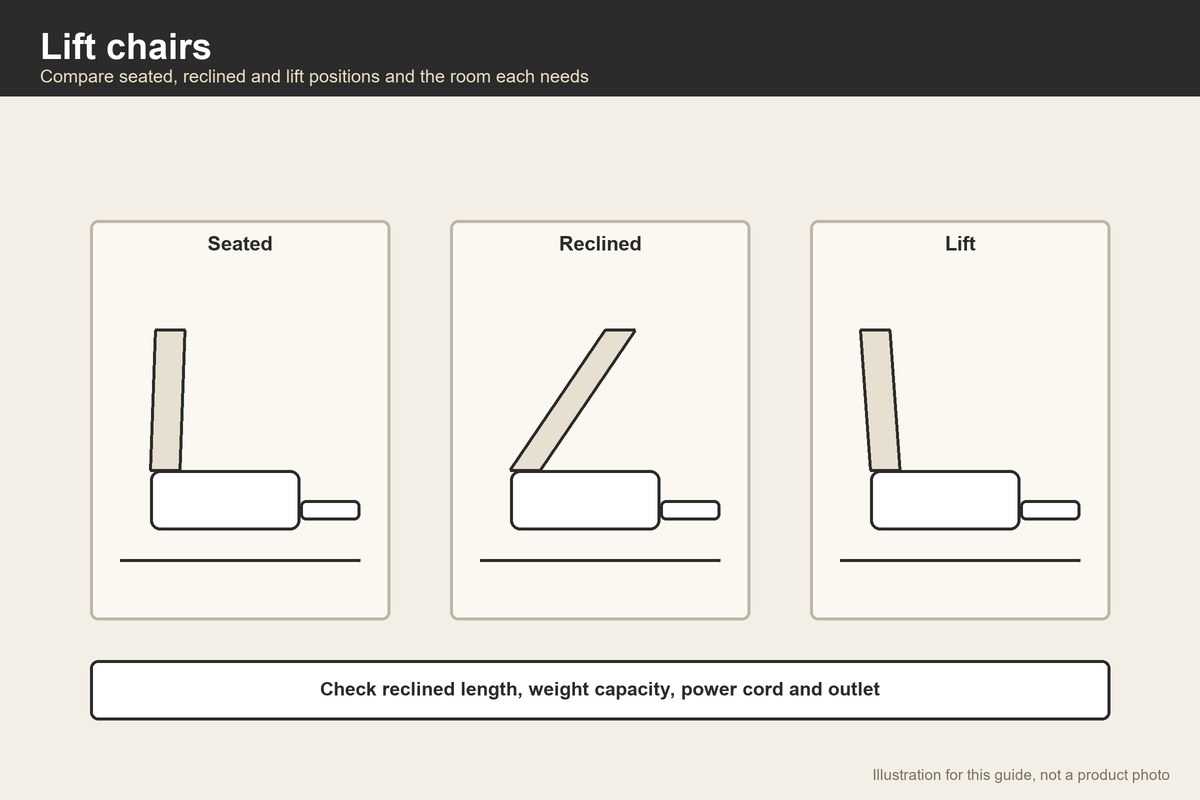
The lift moves the seat up and forward, so the chair needs floor space in front. Read how far the chair moves and where the footrest goes. Listings often give a fully reclined length, which is more than the resting depth. If a listing does not state it, treat it as unknown.
Test with the user. Some lift chairs tilt sharply; others move gently. A person with balance problems needs a gentle motion and a stable place to grab. Ask a therapist about a suitable design.
Room clearance for recline
The recline needs room behind the chair unless it is a wall-hugger design that slides forward as the back reclines. The listing should say. A standard recliner can need 12 to 24 inches behind, though this varies, and we could not verify a figure from the listings, so measure the chair’s stated reclined dimensions.
The U.S. Access Board’s accessible-route guidance uses 36 inches as a minimum clear width for a path, and a 60 inch turning circle for wheelchair use. That standard is for public accessible design, not a home, but if the user uses a walker or wheelchair, a wide clear path to the chair is important. Keep the area around the chair clear of rugs and cords.
Power, cords and safety
Lift chairs plug into a wall outlet. Check where the outlet is and how long the cord is, and keep the cord out of walking routes. Some chairs include a battery backup that lowers the chair in a power failure; if a listing does not say, treat it as absent. Do not use extension cords unless the maker allows it.
The hand control should be within reach. Keep children and pets clear of the moving parts. Heat and massage features, which the listings we read include, add electrical parts; follow the instructions and do not use them on skin that cannot feel heat.
Working smoke alarms and clear exits are recommended by the U.S. Fire Administration.
Upholstery and care
Faux leather wipes clean but can crack. Fabric is softer but stains. Look for washable covers. A lift chair that will be used many hours a day needs breathable upholstery. The listing may not describe stitching or foam density, so treat those as unknown.
Delivery and assembly
A lift chair weighs about 100 pounds or more, so the delivery box is heavy. Check the box size against your door and stairs, and ask about white-glove delivery, which the listing may not describe. Assembly usually attaches the back and connects the control. Two people help.
A worked example
These are invented numbers for planning. A living room is 11 feet by 12 feet (132 by 144 inches). You consider a lift chair with an assembled size of 29.53 inches deep, 36.23 inches wide and 42.52 inches high, and a fully reclined length of 60 inches (an assumption, since the listing does not state it).
Placement: the chair sits against the 144 inch wall. Reclined, it extends 60 inches into the room, leaving 132 − 60 = 72 inches to the opposite wall, above the 36 inch reference and well above what a walker needs.
Beside the chair: a wall space of 144 − 36.23 = 107.77 inches remains, enough for an end table 15 inches wide with 92.77 inches spare.
If the chair were a standard recliner needing 18 inches behind it, it would sit 18 inches from the wall and take 29.53 + 18 = 47.53 inches of depth at rest. Compare the wall-hugger design that needs less: this example shows why the design matters. If the room were 9 feet wide (108 inches), 108 − 60 = 48 inches would remain, still above 36, but the walker route beside the chair would be tight.
Questions to ask before you order
Ask the seller for the seat width, seat depth, seat height and the fully reclined length. Ask whether the chair has a battery backup, how long the cord is and whether the cord is detachable. Ask whether the warranty covers the motor and the frame, and how service is handled. Ask about delivery options, including in-home setup. Ask whether the hand control has a lock. If someone else will use the chair, ask them to try a similar model before you order.
Setting up safely
Place the chair on a hard, level floor, with clear space in front. Keep the cord along the wall, and do not run it under a rug. Test the lift with an assistant standing by, and check that the motion is smooth. Do not let children or pets play near the moving parts. Keep the hand control within reach and out of the way of pets. Follow the maker’s instructions about weight limits and cleaning.
Involving the user and a professional
The person who will use the chair should test the seat height, the lift speed and the ease of using the control. A physical or occupational therapist can advise on positions and features. If the chair is for someone with limited mobility, check that they can reach the control and that the path to the chair is clear. Ask about a trial period or a return policy for a heavy item, since returns are costly.
Mistakes to avoid
- Choosing without the person. Compare seat size and height to their body.
- Ignoring recline space. Check the reclined length.
- Skipping the outlet plan. Plan the cord.
- Trusting a missing capacity. Look for a stated limit.
- Buying by features. Heat and massage are extras.
- Ignoring delivery. A 100 pound box needs help.
When to skip a lift chair
If the person can stand from a firm chair with a higher seat, a regular armchair with firm cushions may be enough. If they need regular help standing, discuss with a clinician before buying. For a comfortable non-powered chair, see rocking chair or accent chairs.
Related guides
See accent chairs, ottoman furniture and loveseat.
Frequently asked questions
What is a lift chair?
A power recliner whose seat tilts up and forward to help you stand.
One motor or two?
A single motor moves the back and footrest together; two motors move them separately.
How much space does it need?
More than its resting footprint. Check the reclined length and whether it hugs the wall.
What weight can it hold?
Check the listing. Two we read state 350 and 400 pounds.
Is a lift chair a medical device?
Do not assume so. Ask a clinician which features suit the user.
Bottom line
Choose a lift chair by matching seat size and capacity to the person, checking the reclined length and planning the outlet. Get advice from a clinician if it is for a health need, and skip it if a firm armchair does the job.
Products worth checking
We have not tested these products. Sizes and features come from the Amazon listings, checked on September 30, 2026; where a listing does not say, we say so.
MCombo Power Lift Recliner Chair, Leather R7289
The listing gives listed 350 lb maximum recommendation. We re-opened the page on September 30, 2026 and found these figures; other details are on the product page.
- Good for: a power lift recliner with a stated capacity.
- Keep in mind: the page offers size variants (for example medium-wide), and we did not read a fully reclined length.
GarveeHome Power Lift Recliner Chair, Heat and Massage
The listing gives 112 lb; listed 400 lb maximum recommendation. We re-opened the page on September 30, 2026 and found these figures; other details are on the product page.
- Good for: a heavy-duty lift chair with heat and massage.
- Keep in mind: the listed 29 x 25 x 20 in looks like packaging, and heat and massage add electrical parts.
Leyu and Hafort Dual Motor Power Lift Recliner Chair
The listing gives 29.53 x 36.23 x 42.52 in; 101.2 lb. We re-opened the page on September 30, 2026 and found these figures; other details are on the product page.
- Good for: a dual-motor chair with independent back and footrest.
- Keep in mind: the text we read does not state a weight capacity or a reclined length.
Sources checked
- Accessible routes guide
- Smoke alarm guidance
- MCombo Power Lift Recliner Chair, Leather R7289
- GarveeHome Power Lift Recliner Chair, Heat and Massage
- Leyu and Hafort Dual Motor Power Lift Recliner Chair
Specifications checked on September 30, 2026. Product details and availability can change, so confirm on the product page before you buy.