As an Amazon Associate I earn from qualifying purchases. Links marked “Affiliate link” may earn us a commission at no extra cost to you. Learn more.
Quick answer
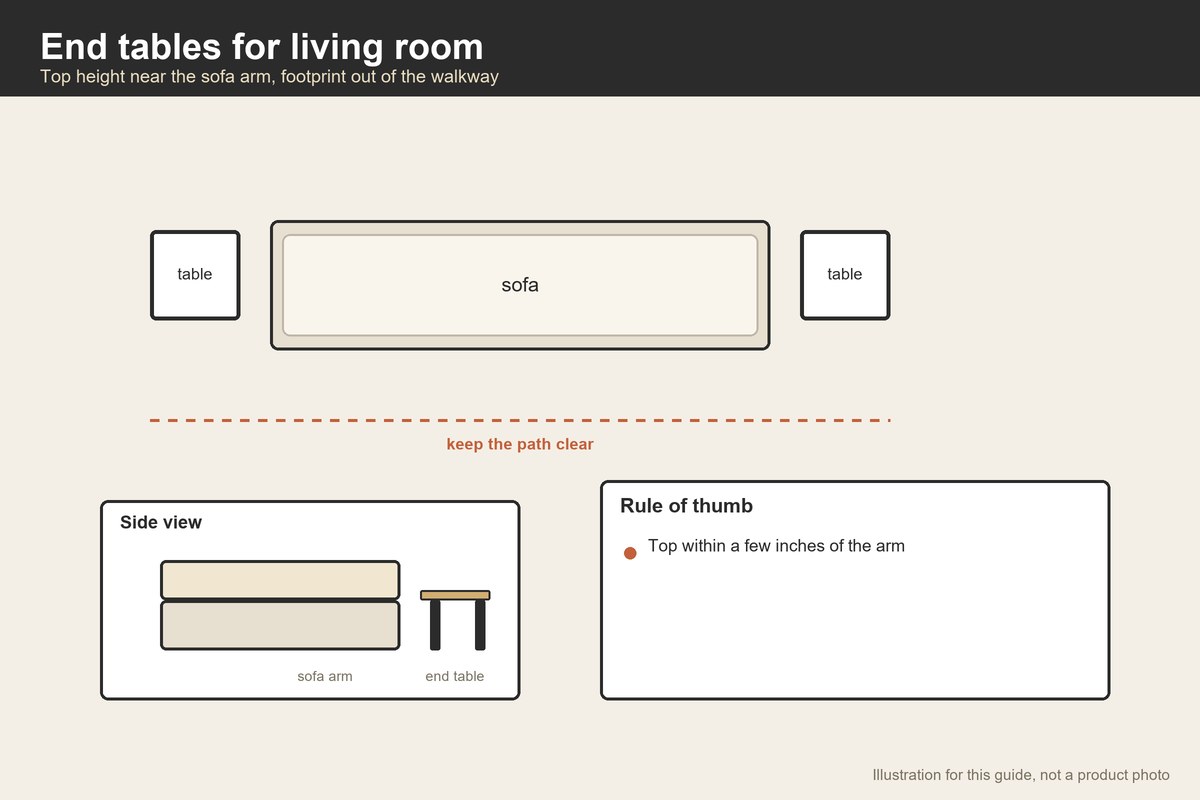
An end table works beside a sofa when its top is close to the height of the sofa arm, its footprint stays out of the walking route and its surface is large enough for what you set on it. In a small living room, most people need only a lamp, a drink and a remote, which fit on a top of about 11 by 15 inches. The listings we read on Amazon on 2026-09-30 give end tables that are about 11 inches deep, 15 to 20 inches wide and 15 to 22 inches high, with weights of about 6 to 14 pounds each. We have not tested any of them.
Measure your sofa arm, tape the table footprint on the floor and check that you can still reach it from a seated position. If space is very tight, a C-shaped table that slides under the sofa may work better than a regular end table; see side table.
Match the arm height
A common rule of thumb is to choose an end table whose top is within a few inches of the sofa arm, either slightly below or slightly above. That makes it easy to set a cup down without stretching. This is a design habit, not a standard.
Measure from the floor to the top of the sofa arm. If the arm is 24 inches high, tables of 21 to 26 inches are reasonable. A 15 inch table beside a 24 inch arm forces you to bend, and a very high table blocks the arm’s line. The lower tables we read, at about 15 inches, suit a floor sofa or a low chair, while the taller ones at about 22 inches suit a standard sofa.
Footprint and the walkway
End tables are narrow, but a depth of 11 inches matters in a tight room. Measure from the end of the sofa to the wall or the next piece, and subtract the table width. If the gap is 24 inches and the table is 15 inches wide, 9 inches remain, which is not a walking path but may be enough for a lamp cord.
The U.S. Access Board’s accessible-route guidance uses 36 inches as a minimum clear width for a path, narrowing to 32 inches at short obstructions. It is written for accessible design in public settings, not for your living room, but it is a good reference for comfort. If an end table narrows a main route below that, move it or choose a slimmer one.
Storage, shelves and drawers
Small end tables come in a few forms.
Open shelves hold a basket or a book and need no clearance. They are lighter and cheaper but show everything.
A drawer hides remotes and chargers. It needs pull-out space in front of the table, so tape the travel.
A closed cabinet hides more but adds weight and cost.
A nesting or round table offers a small surface that you can move.
The tables we read state weight limits of about 50 pounds for one open-shelf model; many others do not state a limit. If a listing gives none, treat it as unknown, and avoid putting a heavy lamp or a large plant on a lightweight table.
Lamps, cords and charging
A table lamp needs an outlet, and a cord across a walking route is a trip hazard. Check where the nearest outlet is before you decide where the table goes. Some end tables have built-in charging outlets or USB ports; they cut clutter but still need a wall plug. The set of two tables with charging stations we read weighs about 13.8 pounds total, with a listed height of 21.7 inches.
Keep lamp shades away from the bulb, and do not cover chargers with fabric. The U.S. Fire Administration recommends working smoke alarms in living areas and outside sleeping areas.
Stability
Tall narrow tables can tip. A light table with a small base is easy to knock over with a bag or a pet. Choose a wide base, and place the heaviest item low. Anchoring is rarely needed for a small table, but it is worth considering if small children live in the home; see the Consumer Product Safety Commission’s Anchor It campaign.
Materials and emissions
Most small end tables use engineered wood with a metal frame. Federal rules limit formaldehyde emissions from composite wood products sold in the United States, and a listing may state compliance. Ask if it does not. Metal and solid wood tables avoid the question but cost more.
Pairs, singles and mixed sets
Two matching tables give a balanced look but take twice the floor. A single table beside the seat you use most may be enough. For a sectional, one table at the end or in the corner is often enough. A mixed pair, one table and one floor lamp, is a good compromise in a tight room. If your living room also includes a coffee table, check that the tables do not crowd it; see small coffee table for the gap to the sofa.
A worked example
These are invented numbers for planning. A living room is 11 feet (132 inches) wide, with a 72 inch sofa centered on one wall. The space on each side is (132 − 72) ÷ 2 = 30 inches.
An end table of 15 inches wide leaves 30 − 15 = 15 inches beside it, which is enough for a lamp cord but not a walking path. A table of 19.69 inches wide, like a wider set we read, leaves 30 − 19.69 = 10.31 inches. If the door opens onto that side, the wider table blocks it.
Height: the sofa arm is 24 inches high. A 15.16 inch table is 8.84 inches below the arm, which is low; a 21.7 inch table is 2.3 inches below the arm, which is easier to reach. In this room, the taller, narrower table fits better than the wide low one.
Styles and how they change the fit
A round table has no corners, which helps in tight rooms, but it wastes some of the footprint. A square table fits a corner. A tray-top table has a lip that keeps cups from sliding. A table with a lower shelf gives storage but has a narrower base. Match the style to what you will put on top: a tall lamp needs a stable base, and a plant needs a wider top than a drink.
Questions to ask before you order
Ask the seller for the top thickness and edge type, since thin tops can chip. Ask whether the legs have adjustable feet and whether the table comes with anti-tip hardware. Ask whether a listed pair is sold as one purchase or two separate tables. If charging ports are included, ask how many outlets and USB ports there are and whether there is a switch or surge protection.
Setting the table up
Place the table where you would normally put a drink, and try it for a week before you buy a matching second one. Check that the lamp cord reaches the outlet without crossing a walkway. Move the table 6 inches in each direction to see how your reach changes. A small change in position often fixes an annoying gap. If you use a laptop or tablet, check that the table is stable enough for it.
Mistakes to avoid
- Ignoring arm height. A table that is too low forces you to bend.
- Choosing by looks. Check the listed width, depth and height.
- Blocking the path. Tape the footprint.
- Overloading a light table. Look for a weight limit.
- Forgetting outlets. Plan the cord route.
- Buying pairs by default. One table may be enough.
When to skip an end table
If the sofa is against a wall on one side, you cannot use a table there. A wall shelf, a floor lamp or a tray table may serve better. If you use your laptop on the sofa, a C-shaped table is often more useful than an end table.
Related guides
See side table for slide-under designs, small coffee table for the front of the sofa and nightstands for bedside versions.
Frequently asked questions
How tall should an end table be?
A common rule of thumb is a top within a few inches of the sofa arm. Measure your sofa.
How wide should an end table be?
Subtract the sofa length from the wall space, split the remainder, and leave a path. Narrow tables of 11 to 16 inches suit small rooms.
Should end tables match the coffee table?
No. They should sit at a similar height and finish family, but they need not match.
Do I need two end tables?
Not always. A single table or a lamp on the floor may work.
Are end tables with charging ports worth it?
They reduce clutter but still need an outlet. Plan the cord route.
Bottom line
Choose end tables by arm height, footprint and use. Tape the outline, plan the cord route and pick the narrower option if the path beside the sofa is tight.
Products worth checking
We have not tested these products. Sizes and features come from the Amazon listings, checked on September 30, 2026; where a listing does not say, we say so.
VASAGLE Side Tables Set of 2, Small End Table
The listing gives 11.81 x 19.69 x 15.16 in; 12.76 lb (set). We re-opened the page on September 30, 2026 and found these figures; other details are on the product page.
- Good for: two low tables for a pair of chairs or a bed.
- Keep in mind: at 15.16 in the top sits low beside most sofa arms.
HOOBRO End Table, Small Side Table, 2-Layer Storage Shelves
The listing gives 11 x 15 x 19.7 in; 6.2 lb. We re-opened the page on September 30, 2026 and found these figures; other details are on the product page.
- Good for: a slim table with two shelves.
- Keep in mind: it is light, so it moves easily and can tip if knocked.
HOOBRO Side Table with Charging Station, Set of 2 End Tables
The listing gives 11 x 15 x 21.7 in; 13.8 lb (set). We re-opened the page on September 30, 2026 and found these figures; other details are on the product page.
- Good for: a pair with USB charging beside a sofa.
- Keep in mind: the charging still needs a wall outlet, and the text we read gives no weight limit.
Sources checked
- Accessible routes guide
- Smoke alarm guidance
- Anchor It
- Formaldehyde emission standards for composite wood products
- VASAGLE Side Tables Set of 2, Small End Table
- HOOBRO End Table, Small Side Table, 2-Layer Storage Shelves
- HOOBRO Side Table with Charging Station, Set of 2 End Tables
Specifications checked on September 30, 2026. Product details and availability can change, so confirm on the product page before you buy.