As an Amazon Associate I earn from qualifying purchases. Links marked “Affiliate link” may earn us a commission at no extra cost to you. Learn more.
Quick answer
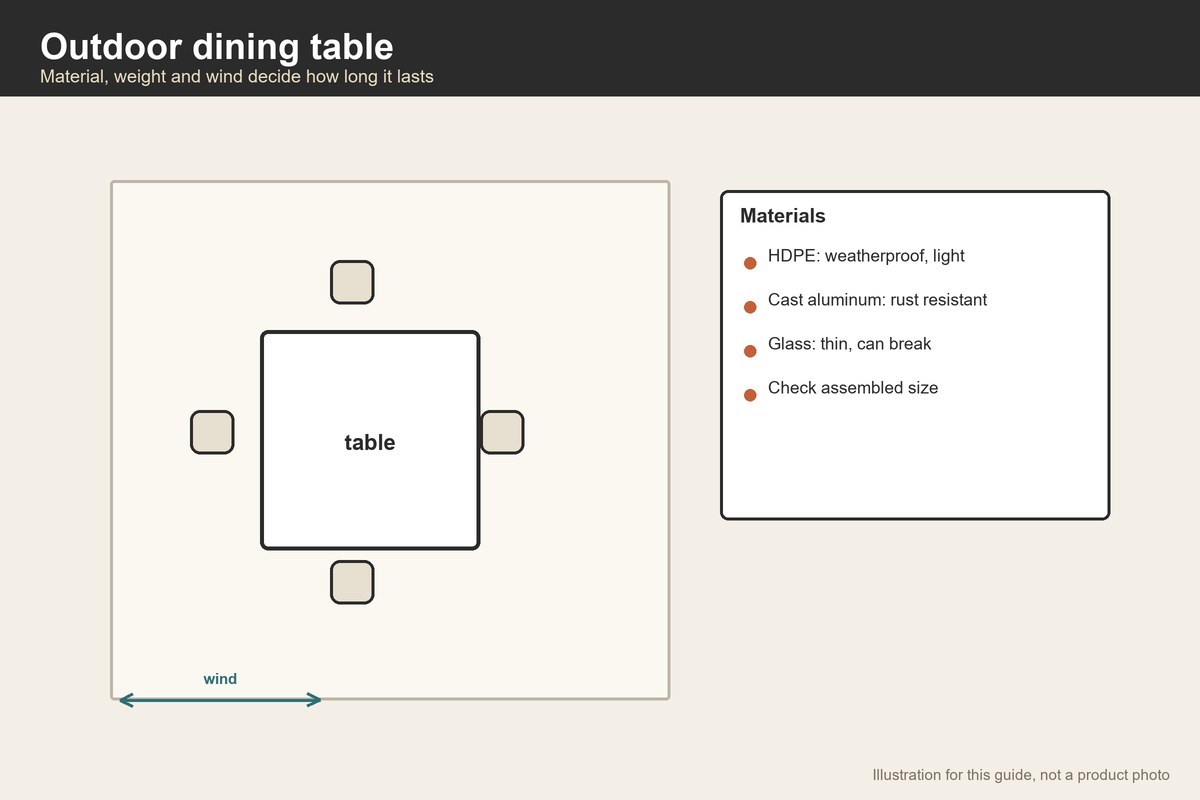
An outdoor dining table must survive weather, fit your space and stay put in wind. The three checks are material, size and weight. The listings we read on Amazon on 2026-09-30 show three materials: an HDPE wood-grain square table of 35.4 inches across and 29.1 inches high at about 28.4 pounds, a cast aluminum round bistro table of 29.53 inches across at about 18 pounds and a round glass-top table of 31.5 inches across and 28.3 inches high at about 25.3 pounds. We have not tested any of them.
Heavier tables resist wind better, but a heavy table is harder to move and store. If you live above the ground floor, check your building’s rules about balcony furniture and weight.
If your patio is tiny, a bistro set may be enough; see bistro table and chairs. If you also want chairs, see POLYWOOD outdoor furniture for one brand’s lumber.
Materials
HDPE or plastic lumber. HDPE (high-density polyethylene) is a plastic that does not rot and does not need staining. The square table we read lists a galvanized metal frame and a wood-grain HDPE top. Plastic can get hot in strong sun, and dark colors run warmer.
Cast aluminum. Rust-resistant and heavy for its size, cast aluminum suits bistro sets. The round table we read lists a top thickness of 2.36 inches and a weight of about 18 pounds, light for its size.
Glass top. A tempered glass top looks light and wipes clean, but the 5 millimeter glass we read is thin, and glass can break from impact. Glass shows water spots and gets hot in the sun.
Wood and metal. Teak and treated wood last but need care; steel can rust if the finish chips. We opened no wood tables for this guide.
Size and seats
A 35.4 inch square table seats four, one per side, with about 35 inches of edge each. A 29.53 inch round table has a circumference of about 92.8 inches (π × 29.53), or 3.9 people at 24 inches each, so it seats two comfortably and four tightly. A 31.5 inch round has a circumference of about 99 inches, or 4.1 people. These use a rule-of-thumb estimate of about 24 inches per person.
Square tables have corners, which are good for tucking against a rail. Round tables suit conversation and are easier to walk around.
Weight and wind
Light tables move in gusts. The tables we read weigh about 18 to 28 pounds. A table with a heavy base, or a glass top that adds weight, is steadier. If you add an umbrella, the table must be able to hold it; the listings we opened do not state an umbrella hole or a stand rating, so treat it as unknown. Never leave an open umbrella on a light table in wind.
Chairs also move. Stackable chairs can be stored in strong wind. Keep items off the tabletop when you leave.
Care and storage
Rinse HDPE and aluminum with water and mild soap. Wipe glass with a glass cleaner. Cover the table in winter with a breathable cover, or store it indoors. Check metal feet for rust and replace worn glides. Do not use a pressure washer on thin glass edges.
Fit on a small patio
The U.S. Access Board uses 36 inches as a minimum clear width for a route, and 32 inches at short obstructions. That is public accessible-design guidance, not a patio rule, but it is a good yardstick for passing behind a chair. Add about 20 inches for a chair pulled out, a working estimate.
Height
The tables we read are about 28.3 to 29.5 inches high, slightly lower than many indoor tables. The U.S. Access Board’s accessible-design standard places dining surfaces between 28 and 34 inches high, which shows the general range that suits seated use. Choose chairs with seats of about 17 to 19 inches; see dining chairs.
Safety
Keep candles and grills away from plastic and umbrellas. Glass tops can break; keep children from climbing on them. If a table has a glass top, check for safety glass and avoid placing hot pans on it.
A worked example
These are invented patio numbers for planning. A patio is 8 feet by 10 feet (96 by 120 inches). You consider the 35.4 inch square table with four chairs, and the 29.53 inch round table with two chairs.
Square: the table is 35.4 inches across. With chairs pulled out 20 inches on each side, the total width is 35.4 + 20 + 20 = 75.4 inches. On the 96 inch side, that leaves 96 − 75.4 = 20.6 inches, or about 10.3 inches on each side to the rail, which is too tight to pass. If you push the table against the rail, you lose two seats.
Round: the table is 29.53 inches across. With chairs on two sides, width: 29.53 + 20 + 20 = 69.53 inches, leaving 96 − 69.53 = 26.47 inches, still tight but enough to step around on one side.
Compare areas: the square top covers 35.4² = 1,253 square inches and the round covers π × 14.765² ≈ 685 square inches, about 45 percent less. So the round table is more modest and fits better, but it seats fewer.
Questions to ask before you order
Ask the seller for the weight, the base type and whether the table has an umbrella hole. Ask whether the top is removable and how it is fastened. Ask whether the finish is rated for weather and for UV. If the listing shows several sizes, confirm that the photos and dimensions match; one listing we opened showed a carton size as well as the table size.
A quick decision path
If your patio is under 8 feet deep, choose a round bistro table for two. If you want four seats, choose a 35 inch square and push it near a wall. If wind is common, choose the heavier table and store chairs. If you want low maintenance, choose HDPE or aluminum.
Seasonal use and storage
Outdoor tables are used for part of the year in many places. If you store the table in winter, clean it first, dry it and cover it. For HDPE and aluminum, a cover keeps dust off but is not required for survival; for glass tops, covering reduces the risk of damage from falling branches. Store chairs stacked if they allow it. If you leave the table out, check for debris collecting under the top, and drain any water that pools.
Shopping questions
Ask the seller for the assembled size, not just the carton size. Ask whether the top is fixed or removable, and what the leg feet are made of. Ask about warranty terms for outdoor use. If a listing shows both carton and table sizes, as one we opened did, make sure you are reading the table size. If you are buying a set, confirm whether the chairs are included and what their seat height is.
The day it arrives
Unpack, assemble and level the table on the patio, since the surface may be uneven. Check that the legs sit flat and add pads if needed. Test stability by pushing on the edge. Clean off dust with water and mild soap, and place the table away from the edge of the balcony until you are sure it is stable in wind.
Budget without prices
We leave prices out. Outdoor furniture often costs more than indoor furniture of the same size, because of weather-resistant materials. Compare total cost over several years: a table that lasts is cheaper than one you replace. Consider a cover, which is a small extra cost that can extend life.
Mistakes to avoid
- Trusting a carton size. Check the assembled size.
- Ignoring wind. Light tables move.
- Choosing glass with children. Consider other tops.
- Skipping chair pull-out. Add about 20 inches.
- Leaving it uncovered in winter. Cover or store it.
When to skip a table
If you only need a spot for a drink, a side table may be enough; see side table. If you have a large patio, a bigger set may suit you better.
Related guides
See POLYWOOD outdoor furniture, bistro table and chairs and card table and chairs.
Frequently asked questions
What material is best for an outdoor table?
HDPE and aluminum are low maintenance. Glass looks light but is thinner and can break.
How big is a table for four?
A 35 inch square seats four. A 31.5 inch round is tight for four.
Will wind move it?
Light tables can move. Choose a heavier base or store chairs in strong wind.
Can I put an umbrella through it?
Only if the table has a hole and a stand rated for it. The listings we opened do not state it.
Do I need a cover?
A breathable cover helps in winter.
Bottom line
Choose an outdoor dining table by material, size and weight. Measure the patio with chairs pulled out, check wind stability and cover or store the table in winter.
Products worth checking
We have not tested these products. Sizes and features come from the Amazon listings, checked on September 30, 2026; where a listing does not say, we say so.
FROASISPRO 35.4 inch Square HDPE Wood Grain Patio Dining Table
The listing gives 35.4 x 35.4 x 29.1 in; 28.4 lb. We re-opened the page on September 30, 2026 and found these figures; other details are on the product page.
- Good for: a weatherproof square table for four.
- Keep in mind: the page also lists a carton size (38.78 x 26.77 x 4.33 in), so use the 35.4 in table size.
PATIO-IN 30.31 inch Outdoor Patio Dining Table, Cast Aluminum Bistro Table
The listing gives 29.53 x 29.53 x 29.53 in; 18.01 lb. We re-opened the page on September 30, 2026 and found these figures; other details are on the product page.
- Good for: a rust-resistant round bistro table.
- Keep in mind: at 18 lb it is light in wind.
Tangkula 32 inch Round Outdoor Table for 4, Glass Top Patio Dining Table
The listing gives 31.5 x 31.5 x 28.3 in; 25.3 lb. We re-opened the page on September 30, 2026 and found these figures; other details are on the product page.
- Good for: a round table with a wipe-clean glass top.
- Keep in mind: the glass is thin and can break.
Sources checked
- Accessible routes guide
- ADA Standards
- FROASISPRO 35.4 inch Square HDPE Wood Grain Patio Dining Table
- PATIO-IN 30.31 inch Outdoor Patio Dining Table, Cast Aluminum Bistro Table
- Tangkula 32 inch Round Outdoor Table for 4, Glass Top Patio Dining Table
Specifications checked on September 30, 2026. Product details and availability can change, so confirm on the product page before you buy.