As an Amazon Associate I earn from qualifying purchases. Links marked “Affiliate link” may earn us a commission at no extra cost to you. Learn more.
Quick answer
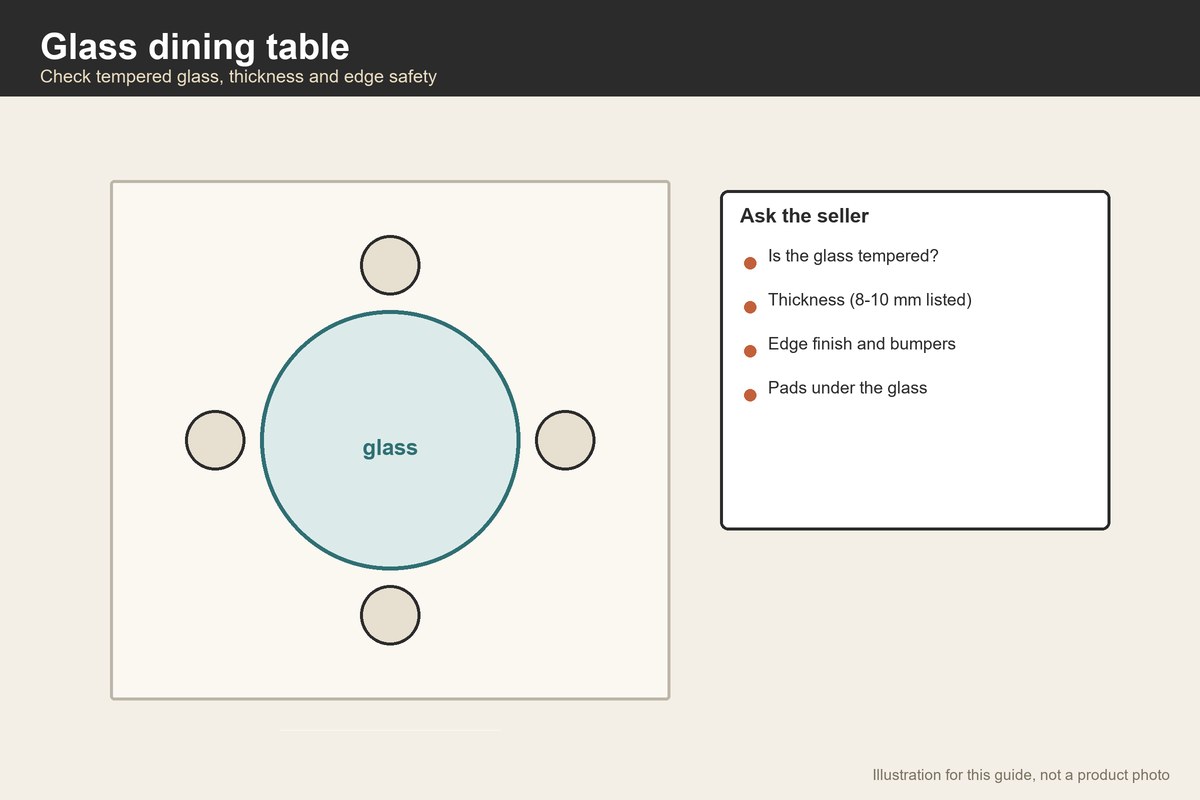
A glass dining table has a glass top on a metal or wood base. It looks light, keeps a small room feeling open and wipes clean, but it shows fingerprints, can be noisy with plates and needs care around children. The checks are glass thickness, whether the glass is tempered, the edge finish, the base and the weight.
The listings we read on Amazon on 2026-10-01 include a 31.5 inch round tempered-glass table at 29.5 inches high and about 39 pounds, a 23.4 inch round glass table with a 10 millimeter top at 28.4 inches high and about 18 pounds, and a 23.5 inch adjustable round glass table with a top of about 0.31 inches (about 8 millimeters) at up to 41 inches high and about 29.1 pounds. We have not tested any of them, and these sizes come from the listings.
A 10 millimeter top is about 0.39 inches thick (10 ÷ 25.4). Glass in this range is thin compared with a wood top, so treat impact and heat with care.
Tempered glass and what it means
Tempered glass is heat-treated so that it resists impact better than ordinary glass and breaks into small pieces. One listing we opened states tempered glass. The others describe glass and thickness without a clear statement in the text we read, so ask the seller whether the top is tempered. Never buy an untempered glass top for a dining table.
Tempered glass can still break, especially from a sharp hit on the edge. Keep the edge protected and avoid placing heavy items on it.
Thickness and weight
Thickness shows in the specs: 10 millimeters on one table, about 8 on another. A 10 millimeter glass is about 0.39 inches thick. Thicker glass is heavier and steadier, and the 31.5 inch round table weighs about 39 pounds against about 18 pounds for the 23.4 inch table. The weight per area helps: the 31.5 inch top is π × 15.75² ≈ 779 square inches, so 39 ÷ 779 = 0.050 pounds per square inch, and the 23.4 inch top is π × 11.7² ≈ 430 square inches, so 18 ÷ 430 = 0.042 pounds per square inch. Both numbers include the base.
Edges, corners and children
Round glass tops have no sharp corners, which is a plus around children. The edge should be polished and rounded. Metal bases can have sharp corners at the feet. If you have toddlers, consider rubber bumpers and keep chairs from being pushed against the glass. Do not let children climb or sit on the table.
Base and stability
The base carries the glass. Look at how the glass sits on it: on rubber pads or suction cups. A top that is not fixed can slide. A pedestal base should be wide enough to resist tipping when someone leans on the edge. The adjustable table we read is tall at 41 inches, and a taller base is less stable.
Noise, heat and stains
Plates and cups clink on glass. A tablecloth, placemats or a runner reduces noise and protects the glass. Hot dishes can stress glass, so use trivets. Glass shows fingerprints and water spots, so keep a microfiber cloth and glass cleaner nearby. Avoid abrasive pads, which scratch.
Fit in a small dining area
Glass keeps a small room visually open, since you see through it, but the footprint is the same. A 31.5 inch round table seats two to four at the usual estimate of about 24 inches of edge per person (π × 31.5 ÷ 24 ≈ 4.1), a rule of thumb. The U.S. Access Board uses 36 inches as a minimum clear width for a route. That is guidance for public accessible design, not a home rule, but a helpful yardstick for passing behind a seated person.
Height and chairs
The tables we read are 28.4 to 29.5 inches high, with an adjustable one reaching 41 inches. The U.S. Access Board’s accessible-design standard places dining surfaces between 28 and 34 inches high, which shows the general range suited to seated use. Chairs with seats of about 17 to 19 inches suit a table of 29 inches; see dining chairs.
Metal parts and emissions
Metal bases avoid composite wood. If a base or apron is engineered wood, federal rules limit formaldehyde emissions from composite wood products sold in the United States, and a listing may state compliance. Ask if it does not.
Delivery and assembly
Glass ships in a heavy, fragile box. Open it carefully, check the glass for chips before you sign for it and keep the box until you are sure it is fine. Assemble the base first, then lift the glass with two people, using suction handles if you have them.
A worked example
These are invented numbers for planning. You consider the 31.5 inch round table for a nook 60 inches wide and 48 inches deep.
Space: a 31.5 inch table in the middle of the 60 inch width leaves (60 − 31.5) ÷ 2 = 14.25 inches on each side, not enough for chairs on all sides. Put the table against one wall and use two chairs on the open sides: the width needed is 31.5 + 20 = 51.5 inches, so 60 − 51.5 = 8.5 inches spare.
Glass: the 10 millimeter top is 0.39 inches. If a child bumps the edge with a chair leg, the thin edge is the weak point, so add a bumper. For two adults, the glass table fits; for a family with toddlers, a wood top is more forgiving.
Weight: at 39 pounds, the table is easy to move with two people but not light enough to lift alone with the glass on.
Questions to ask before you order
Ask the seller whether the glass is tempered and its thickness in inches or millimeters. Ask about the edge finish, the pads under the glass and the base weight. Ask whether the glass can be replaced if it breaks and how. If the listing shows several sizes, confirm that the dimensions match.
A quick decision path
If you have toddlers, avoid glass or choose a rounded, bumpered table. If your room is small and you want it to feel open, choose a clear top with a slim base. If you often serve hot dishes, use trivets or choose another top. Decide the household first.
Care and long-term wear
Clean glass with a soft cloth and a non-abrasive cleaner. Wipe the base and the pads under the glass, since dust and moisture collect there. Check that the glass sits level and does not slide. If a chip appears at the edge, stop using the table until you have checked it, since a damaged edge is a weak point. Never stand on the glass.
Real-life scenarios
A glass table suits a couple in a small apartment who want a light look. It is a harder fit for a house with toddlers, who bump into edges and drop toys on the glass. If you have pets, claw marks and paw prints show. If you work from the table, glare from windows can be a problem, so test it at different times of day.
The day it arrives
Unpack in the room where it will live, check each part against the list and look for dents, chips or scratches before you sign for it. Take photos of any damage and keep the packaging until you are sure about the fit. Assemble on a blanket to protect the finish, and keep the instructions and spare hardware in a labeled bag.
Budget without prices
We leave prices out because Amazon changes them often. When you compare, think about the total cost: the item, delivery or help to carry it, floor protection, and anything you must buy to go with it. A cheaper piece that does not fit the room costs more than a slightly dearer one that does. Check the return policy before ordering, since bulky items can be hard to send back.
Mistakes to avoid
- Buying untempered glass. Ask.
- Ignoring thickness. Thin glass is fragile.
- Letting children climb. Glass can break.
- Placing hot pans on it. Use trivets.
- Skipping edge bumpers. They protect the glass.
When to skip glass
If you have young children or a busy kitchen table, a solid top is more forgiving; see solid wood dining room table. For a tiny kitchen, see kitchenette table.
Related guides
See round dining set for 4, square dining table and bistro table and chairs.
Frequently asked questions
Is a glass dining table safe?
Tempered glass is safer than ordinary glass, but it can still break. Ask whether it is tempered.
How thick should the glass be?
The ones we read are about 8 to 10 millimeters. Thicker is sturdier.
Do glass tables scratch?
They can, from abrasive cleaners and sharp objects.
Are they noisy?
Dishes clink. Use placemats.
Do they suit small rooms?
Yes, visually, but the footprint is the same.
Bottom line
A glass dining table suits a small room if you confirm tempered glass, check thickness and edges and accept the care. Use placemats and bumpers, and choose a solid top if toddlers are around.
Products worth checking
We have not tested these products. Sizes and features come from the Amazon listings, checked on September 30, 2026; where a listing does not say, we say so.
NIERN Round Dining Table for 2-4, 31.5 Inch Tempered Glass
The listing gives 31.5 x 31.5 x 29.5 in; 39 lb. We re-opened the page on September 30, 2026 and found these figures; other details are on the product page.
- Good for: a round glass table for a nook.
- Keep in mind: glass shows fingerprints and can break from edge impact.
HYYTEIBL 23.4 inch Round Glass Dining Table, Modern Circular
The listing gives 23.4 x 23.4 x 28.4 in; 18 lb. We re-opened the page on September 30, 2026 and found these figures; other details are on the product page.
- Good for: a very small glass table for two.
- Keep in mind: 23.4 in is small, and the text we read does not say whether the glass is tempered.
Flash Furniture 23.5 inch Glass Adjustable Round Table
The listing gives 23.5 x 23.5 x 41 in; 29.1 lb. We re-opened the page on September 30, 2026 and found these figures; other details are on the product page.
- Good for: a height-adjustable glass pub table.
- Keep in mind: at 41 in it is tall and less stable.
Sources checked
- Accessible routes guide
- ADA Standards
- Formaldehyde emission standards for composite wood products
- NIERN Round Dining Table for 2-4, 31.5 Inch Tempered Glass
- HYYTEIBL 23.4 inch Round Glass Dining Table, Modern Circular
- Flash Furniture 23.5 inch Glass Adjustable Round Table
Specifications checked on September 30, 2026. Product details and availability can change, so confirm on the product page before you buy.