Fold-Out Desks for Small Spaces: Four Compared on Listed Figures
A fold-out desk hinges or folds flat when you are not using it, so it can sit behind a door, against a wall or under a bed between sessions. That is the whole idea, and it makes a fold-out a sensible option for a bedroom, a dorm or a corner that doubles as a living space. The trade-off is that a fold-out is a narrower, lighter desk than a fixed one, and its weight limit, folded depth and assembly needs vary from one listing to the next. This guide compares four fold-out desks in our product file on their listed figures, and it names the listing details that do not agree.
Quick answer
Choose the TEMI if you want the widest of the four, at 35.8 inches, with no assembly and a listed 200 lb weight limit. Choose the WOHOMO or the Huuger if you want a 31.5-inch top that folds to about 2.8 inches, and you do not mind a short assembly. Choose the alawooder if you want a 31.5-inch top with no assembly, a 15.7-inch depth and a listed 150 lb limit. Check the depth first, because the Huuger is about 3 inches deeper than the other three.
Measure before you compare
A fold-out desk is only useful if the wall or corner can take it when it is open. Measure three things: the width of the wall, the depth you can spare into the room, and the height from the floor to any shelf or window sill above the desk. Then measure the spot where the folded desk will live, because the folded thickness is the number that decides whether it fits behind a door or under a bed.
Every listing in our file gives a folded thickness of about 2.3 to 2.9 inches, so the four desks fold to a similar profile. The open width and depth do the real sorting.
The four desks compared
Specs come from the listing data in our product file, last checked on 12 October 2026. Read the current listing before you buy, because these listings change.
alawooder 31.5″ Folding Desk: No Assembly, Wood Top for Small Spaces
- Size: 31.5 in wide × 15.7 in deep × 29.1 in high (product dimensions, listed)
- Folded: the bullet points say it folds flat to about 2.3 inches, or 6 cm
- Weight limit: the bullet points say it holds up to 150 lb (68 kg)
- Weight: 16 lb item weight (listed)
- Assembly: the listing says no assembly is required, with the legs unfolded and joined in place (bullet points)
- Top and frame: engineered wood top with a metal frame, in walnut (listed)
View on Amazon (Affiliate link)
WOHOMO Folding Desk, 31.5″ Foldable Computer Table for Small Spaces, Oak
- Size: 31.5 in wide × 15.75 in deep × 29.52 in high (product dimensions, listed)
- Folded: 2.76 in thick, according to the bullet points
- Weight limit: 200 lb maximum recommended weight (listed)
- Weight: 14.9 lb item weight (listed)
- Assembly: needs assembly, with a manual and the tools included, and the listing recommends one person
- Top and frame: melamine-faced chipboard top with an engineered wood and alloy steel base (listed)
View on Amazon (Affiliate link)
TEMI Small Computer Desk Folding Table, 35.8″ Foldable Office Desk, No Assembly
- Size: 35.8 in wide × 15.7 in deep × 28.7 in high (product dimensions, listed)
- Folded: 2.9 in high when folded, according to the bullet points
- Weight limit: the bullet points give 200 lb as the supported weight
- Weight: 16 lb item weight (listed)
- Assembly: the listing says it arrives fully assembled and is ready to use once unfolded
- Top: engineered wood top with a metal base, in rustic brown wood finish (listed)
View on Amazon (Affiliate link)
Huuger Folding Desk for Small Spaces, 31.5 Inch Foldable Computer Table
- Size: 31.5 in wide × 18.9 in deep × 29.7 in high (product dimensions, listed)
- Folded: 2.76 in thick, according to the bullet points
- Shelf and drawers: one shelf and no drawer (listed)
- Frame: metal legs with an X-frame support and a frame and panel joint, in rustic brown (listed and bullet points)
- Assembly: a screwdriver is needed, and the listing says one person can finish it in under 20 minutes
- Weight: the bullet points call it lightweight, but our file does not give a weight figure
View on Amazon (Affiliate link)
Side-by-side table
| Desk | Listed width | Listed depth | Listed height | Folded thickness | Weight limit | Assembly |
|---|---|---|---|---|---|---|
| alawooder | 31.5 in | 15.7 in | 29.1 in | About 2.3 in | 150 lb (bullets) | None |
| WOHOMO | 31.5 in | 15.75 in | 29.52 in | 2.76 in | 200 lb recommended | Some, one person |
| TEMI | 35.8 in | 15.7 in | 28.7 in | 2.9 in | 200 lb (bullets) | None |
| Huuger | 31.5 in | 18.9 in | 29.7 in | 2.76 in | Not stated in our file | Screwdriver, under 20 min |
The table lists what each listing says. The folded figures come from the bullet points or dimension fields, and they are not measured in our file. We have not tested any of these desks, so stability when the desk is open and the way the hinge behaves over time are not checked here.
What changes in daily use
Width. The TEMI is 35.8 inches wide, about 4 inches wider than the other three. That extra width is the main reason to pick it, because a laptop and a notebook side by side can fit more comfortably on it.
Depth. The Huuger is 18.9 inches deep, while the alawooder, the TEMI and the WOHOMO are 15.7 to 15.75 inches. A deeper top gives room for a monitor stand or a laptop with a stand, but it also takes more of the room when open. If the wall is shallow, the 15.7-inch depth is the safer figure.
Weight limit. The alawooder and the TEMI bullet points give 150 lb and 200 lb, while the WOHOMO specification gives 200 lb as a recommended maximum. The Huuger listing does not give a weight limit in our file, so check its product page before you put heavy items on it.
Assembly. The alawooder and the TEMI arrive assembled, according to their listings. The WOHOMO needs assembly with the tools included, and the Huuger needs a screwdriver and takes under 20 minutes. If you want to move the desk often, a desk you assemble once may be the one to pick, but check the instructions on each product page first.
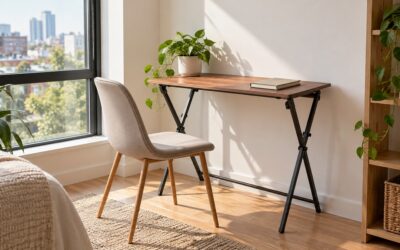
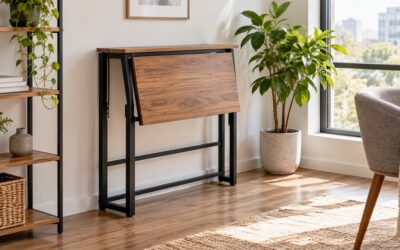
Folding. Each desk folds flat, and the listings give a folded thickness of 2.3 to 2.9 inches. That is enough to slide one behind a door or under a bed frame. The desk still needs to stand on its own when opened, so check the floor space for the legs and any clearance under the top.
Who should pick which
Pick the TEMI if you want the widest top in this group and no assembly. Its 35.8-inch width is the only one in the four above 31.5 inches.
Pick the WOHOMO if you want a 31.5-inch top with a 200 lb recommended limit and you are happy to assemble it once with one person.
Pick the alawooder if you want a 31.5-inch top with no assembly and a 15.7-inch depth, and a 150 lb limit is enough for your use.
Pick the Huuger if you need the deepest top in this group, at 18.9 inches, and you are happy to assemble it with a screwdriver. Check the weight limit on its product page, because our file does not give one.
Skip a fold-out if you need a full working surface for a monitor, a printer and a chair at the same time. A fold-out of this size is for a laptop or a light workspace, and none of the listings in our file states a monitor capacity.
Listing conflicts to check
- WOHOMO width field. The product dimensions give 31.5 inches wide, but the item dimensions field gives 15.75 × 15.75 × 29.52 inches. The width shown in the item field is the depth, so use the product dimensions and check the product page.
- WOHOMO minimum height. The minimum height field gives 15.75 inches, which is the depth of the desk and not a working height. The maximum height field gives 75 cm, which matches the 29.5 inches in the product dimensions.
- Huuger minimum height. The minimum height field gives 2.76 inches, which is the folded thickness, not the lowest height of the open desk. The open height is 29.7 inches.
- Weight limits in the bullet points. The alawooder bullets give 150 lb, and the WOHOMO and TEMI listings give 200 lb. These are different limits for different desks, not a conflict, but check each product page before you rely on one.
Measurement checklist
- Open width and depth against the wall or corner you plan to use.
- Folded thickness against the door, bed or wall gap where the desk will store.
- Chair clearance and room for your legs when the desk is open.
- Power outlet location for a laptop or lamp.
- Weight limit against what you plan to put on the desk.
What we could not confirm
- We have not tested any of these desks. Stability, hinge wear and the quality of the folding mechanism are not checked here.
- The bullet-point claims about strength and quality come from the listings, not from our own checks.
- The Huuger listing gives no weight limit or item weight in our file.
Frequently asked questions
Is a fold-out desk enough for a laptop?
Yes, for most laptop work. All four desks in this guide are 31.5 to 35.8 inches wide and 15.7 to 18.9 inches deep, which is enough for a laptop and a notebook. Check the depth against your chair and your knees before you buy, because a 15.7-inch top is narrow for a large keyboard.
How much weight can a fold-out desk hold?
The listings give different limits. The alawooder bullets say 150 lb, the WOHOMO specification gives 200 lb as a recommended maximum, and the TEMI bullets give 200 lb. Our file does not give a limit for the Huuger. Check the product page for the exact limit on the model you choose.
Do any of these need assembly?
The alawooder and the TEMI are listed as arriving assembled, with no assembly needed. The WOHOMO needs assembly, with the tools included, and the Huuger needs a screwdriver and takes under 20 minutes according to its listing.
Which fold-out desk fits a corner?
None of the listings states corner dimensions. A 15.7-inch depth is the shallowest in this group, and the TEMI and the alawooder share it. Measure the corner and the space for the chair before you choose, because the corner depends on the wall and the room more than on the desk.
Related guides
Disclosure: some links on this page are affiliate links. We may earn a commission if you buy through them, at no extra cost to you. We do not show prices, star ratings or review counts here, so check the current figures on Amazon.