As an Amazon Associate I earn from qualifying purchases. Links marked “Affiliate link” may earn us a commission at no extra cost to you. Learn more.
Quick answer
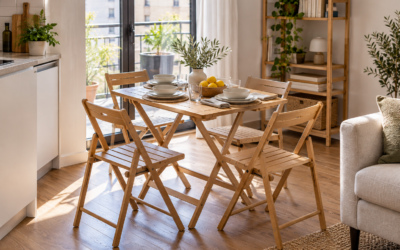
A nook breakfast table is a small table, usually 24 to 32 inches across, that sits in a corner or under a window and seats two. The best size is the one that still leaves about 36 inches of walkway after you pull a chair out. A pedestal or tulip base helps because there are no corner legs to bump, and a square top fits tight against two walls.
The three tables we read on Amazon on 2026-10-01 show the range: a 24 by 24 inch walnut-top tulip table at about 20 pounds, a 27.6 by 27.6 inch bamboo table with a listed 200 pound static load, and a 31.5 by 31.5 inch black table at about 39.3 pounds. We have not tested any of them. All figures come from the listings.
What makes a table a nook table
A nook is a small zone, not a room: a window corner, a space beside the fridge, the end of a galley kitchen. Three things matter more here than in a dining room: the top’s footprint, the base style, and whether the table can double as a work surface. Style comes after those.
Size steps
The three sizes differ by a few inches, but the floor area changes more than you might expect. A 24 inch square top covers 24 × 24 = 576 square inches. A 27.6 inch top covers 27.6 × 27.6 = 761.8 square inches. A 31.5 inch top covers 31.5 × 31.5 = 992.3 square inches. Going from 24 to 31.5 inches adds 7.5 inches per side, yet it adds 416.3 square inches, or about 72 percent more top.
Does more top help? At 24 inches there is room for two mugs, a plate each and a small plant. At 31.5 inches there is room for two full place settings and a shared dish. If you eat breakfast on your lap anyway, the smaller table costs you nothing.
Why base style changes the fit
A four-leg table has legs at the corners, and in a small space those legs catch knees and block chairs from tucking in. A tulip or pedestal base puts one column in the middle, so chairs can sit at any side. The 24 inch walnut table is a pedestal design with an 18 millimeter top, which is about 18 ÷ 25.4 = 0.71 inches. The 31.5 inch black table lists a leg length of 29.53 inches, so it appears to be a four-leg table; check in the photos how the legs sit relative to the edge.
The bamboo table lists a 200 pound maximum static load. That is the listed capacity for weight resting on the table, not a recommendation to sit on it.
How to measure a nook
Measure width and depth of the corner, then the distance from the corner to the nearest doorway, appliance door or cabinet door. Take the smallest of those. That is the space your table and chair share. Mark the table footprint on the floor with painter’s tape and sit in a chair for a minute. If you can’t slide into the seat without moving the table, it is too large.
Seats and elbow room
A common planning rule is about 24 inches of table edge per person. It is a rule of thumb. Along one 24 inch side, that is one person. So even on the smallest table, two people can sit on adjacent sides without crowding, but facing each other across 24 inches leaves little space for plates. On the 31.5 inch table the same rule gives 31.5 ÷ 24 = 1.3 people per side, which means two people can sit on adjacent sides with room for elbows.
The walkway yardstick
The U.S. Access Board’s guide to accessible routes sets 36 inches as the minimum continuous clear width for routes in covered public buildings. Your kitchen is not covered, but 36 inches is a sensible planning figure. We also assume 20 inches of chair pull-out; your chairs may need more.
A worked example
Your kitchen is 100 inches wide and you want to push a table into the back-left corner, so the left wall and the back wall have no walkway. The open sides are the front and the right.
- 24 inch table: the right side leaves 100 − 24 = 76 inches. Minus a pulled-out chair at 20 inches, 56 inches remain.
- 27.6 inch table: 100 − 27.6 = 72.4 inches, minus 20, leaves 52.4 inches.
- 31.5 inch table: 100 − 31.5 = 68.5 inches, minus 20, leaves 48.5 inches.
All three pass the 36 inch yardstick here. The difference between the smallest and largest table is 56 − 48.5 = 7.5 inches, exactly the 7.5 inches of added width. If the kitchen were only 80 inches wide, the 31.5 inch table would leave 80 − 31.5 − 20 = 28.5 inches and fail, while the 24 inch table would leave 80 − 24 − 20 = 36 inches and just pass.
Weight and moving
The 24 inch tulip table is listed at about 20 pounds, light enough to move for cleaning but also light enough to tip when someone leans on one edge. The 31.5 inch table is about 39.3 pounds and feels steadier. A pedestal base with a small foot can tip if the load is off-center, so keep hot drinks near the middle. Check whether the foot is wide enough for your use.
Using the table as a work spot
A nook table often becomes a laptop spot. At about 29 to 29.5 inches high, the tables we read match common dining height, which is a little high for typing on a low chair and fine on a standard one. If you work there daily, read our guide to the table ergonomics for the numbers on elbow height and legroom. A 24 inch top leaves no space for a mouse beside a laptop, so a 27.6 or 31.5 inch top is a better fit.
Material notes
Walnut-look tops, bamboo and painted engineered wood all behave differently around heat and water. Bamboo is a grass that is laminated into boards; the listing names it as the material. Painted tops can chip at the edge where a mug knocks. Use coasters, wipe spills and keep hot pans off any of them. Check the finish and the top thickness in the listing; the black table’s thickness field looked off in the listing we read, so we left it out.
Pairing with seating
A nook is an invitation for a bench or a pair of backless stools that slide under. Stools save floor space because they tuck fully. Chairs with arms usually don’t. If you plan a bench, our guide to the dinette table set compares tables and chairs together, and the rectangle kitchen table covers benches against a wall.
Lighting and the window
A nook usually sits at a window, which gives morning light but also glare on a glossy top. A matte or wood-grain surface hides crumbs and reflections better than a gloss black one. If the window sill is lower than the table, check that a pulled-out chair does not hit the radiator or vent under it; a heat source under a bamboo or engineered top can dry it out over a winter, so leave a few inches of air.
Mistakes to avoid
Buying for looks and ignoring the door swing is the most common. Another is forgetting that a round or tulip top needs a chair on every side to feel balanced, so it can look empty with two chairs. The third is buying a very light table that slides every time you push a chair back; felt pads and a rubber mat help.
Who should skip a nook table
If you cook where you eat and need counter space, a drop-leaf or wall-mounted fold-down is a better use of the corner. If you host more than two, a nook table will frustrate you; consider a table you can extend.
Frequently asked questions
What size table fits a breakfast nook?
For most corners, a table 24 to 32 inches across fits. The deciding number is the walkway: aim for about 36 inches after a chair is pulled out.
Is a round or square nook table better?
A square top fits flush into a corner and uses the wall. A round or tulip top has no corners to catch hips, but leaves gaps behind it. In a tight corner, square plus a pedestal base is a good mix.
How many people sit at a 24 inch table?
Two, on adjacent sides, by the 24 inches per person rule of thumb. Facing seats have little plate room.
Can I use a nook table as a desk?
For light use, yes. Table height is near 29 inches, so use a chair that puts your elbows level with the top.
Bottom line
A nook breakfast table is a matter of inches. Tape the footprint, subtract the chair pull-out and check what remains against 36 inches. In the 100 inch example every size passes, but in an 80 inch kitchen only the smallest table does.
Products worth checking
We have not tested these products. Sizes and features come from the Amazon listings, checked on September 30, 2026; where a listing does not say, we say so.
Walnut Square Tulip Table for 2, 24 Inch Small Dining Table with Pedestal
The listing gives 24 x 24 x 29 in; 20 lb. We re-opened the page on September 30, 2026 and found these figures; other details are on the product page.
- Good for: comparing against the measurements in the guide above.
- Keep in mind: we have not tested it, and the listing may show more than one size or finish, so pick the variant that matches your numbers.
HOOBRO Bamboo Dining Table, Square Dining Table for 2, 27.6″ Kitchen Table for Small Spaces
The listing gives 27.6 x 27.6 x 29.5 in; 200 lb static load. We re-opened the page on September 30, 2026 and found these figures; other details are on the product page.
- Good for: comparing against the measurements in the guide above.
- Keep in mind: we have not tested it, and the listing may show more than one size or finish, so pick the variant that matches your numbers.
Small Black Dining Table, 31.5 Inch Square Kitchen Table for 2-4
The listing gives 31.5 x 31.5 x 29.5 in; 39.3 lb. We re-opened the page on September 30, 2026 and found these figures; other details are on the product page.
- Good for: comparing against the measurements in the guide above.
- Keep in mind: we have not tested it, and the listing may show more than one size or finish, so pick the variant that matches your numbers.
Sources checked
- Chapter 4: Accessible Routes
- Walnut Square Tulip Table for 2, 24 Inch Small Dining Table with Pedestal
- HOOBRO Bamboo Dining Table, Square Dining Table for 2, 27.6″ Kitchen Table for Small Spaces
- Small Black Dining Table, 31.5 Inch Square Kitchen Table for 2-4
Specifications checked on September 30, 2026. Product details and availability can change, so confirm on the product page before you buy.