As an Amazon Associate I earn from qualifying purchases. Links marked “Affiliate link” may earn us a commission at no extra cost to you. Learn more.
Quick answer
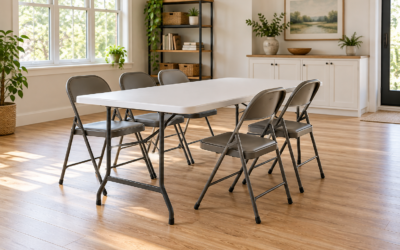
A rectangle kitchen table suits a narrow room better than a round one, because it can sit against a wall and keep the walkway on one side. The width of the table sets how much room you lose, and the length sets how many people sit. For a small kitchen, a table about 30 inches deep and 47 to 55 inches long seats four, and six if two people take the ends.
The three listings we read on Amazon on 2026-10-01 fit that range: a 55.12 by 29.5 inch table at about 45 pounds, a 47.2 by 31.5 inch expandable table at about 52 pounds, and a 31.5 inch table that is listed with an inconsistent width. We have not tested any of them. All figures come from the listings.
Match the shape to the room, not the other way round
Rectangles waste less floor than rounds in a long, narrow room, and they let you push one long side against a wall. A table 29.5 inches deep against a wall takes only 29.5 inches of floor on the open side plus chair room. A 31.5 inch round table takes 31.5 inches in every direction, which leaves less path in a corridor kitchen.
The cost of a rectangle is the corners and the fixed seating pattern. If your kitchen is nearly square, a square or round table can seat the same people in less length; see our notes on the dinette table set.
Length decides how many seats
A common planning rule is about 24 inches of edge per person. It is a rule of thumb, not a standard. On the 55.12 inch table, one long side holds 55.12 ÷ 24 = 2.3, so two people per side. The 29.5 inch ends can each take one person, so the table seats four comfortably and six with the ends in use, which matches the “4-6” in the listing’s title. On the 47.2 inch expandable table, one long side holds 47.2 ÷ 24 = 1.97, so about two people per side, four in total, with tight ends. When the same table is closed to 23.6 inches, a side holds 23.6 ÷ 24 = 0.98, so one person per side.
Depth is the number people forget
Depth is the short dimension. A deep table is comfortable but eats the walkway. A shallow one is easy to pass but crowds plates. The three tables we read are 29.5 inches, 31.5 inches and a listed 31.5 inches deep. Between facing diners that leaves about 29.5 inches for two place settings and a shared dish, which is workable for plates and a bowl, but tight for a large serving platter.
The three listings
The 55.12 inch table is a metal-legged rectangle with a storage shelf. The listing gives 55.12 inches long, 29.5 inches wide and 29.92 inches high on one row, while another row shows 29.5 by 29.5, so we use the row that matches the title and we would confirm the footprint before ordering. It weighs about 45 pounds.
The 47.2 inch table is solid wood, listed as expandable from 23.6 to 47.2 inches long, 31.5 inches deep and 29.5 inches high, with a top thickness of 1.57 inches and a weight of about 52 pounds. The listing page shows several larger variants, so check which one you add to the cart.
The third table is a 31.5 inch solid wood rectangle listed at about 34.9 pounds. Its dimension row labels 31.5 inches as depth and 25 inches as width, while the title calls it a 31.5 inch table, so the labels may be swapped. We read it as 31.5 long by 25 deep, which is a two-seat table, and we would confirm with the seller before relying on it.
Walkway math
The U.S. Access Board’s accessible-route guide sets a 36 inch minimum continuous clear width for walking routes in covered buildings. It is not a rule for private kitchens, but it is a useful yardstick. We also assume 20 inches of chair pull-out; your chairs may need more.
A worked example
Your kitchen is 9 feet by 11 feet, or 108 by 132 inches, and you are considering the 55.12 by 29.5 inch table.
- Centered, the long sides leave (108 − 29.5) ÷ 2 = 39.25 inches to each wall. With a chair pulled out 20 inches, 39.25 − 20 = 19.25 inches remain, which fails the 36 inch yardstick.
- Centered along the length, the ends leave (132 − 55.12) ÷ 2 = 38.44 inches. An end chair pulled out 20 inches leaves 18.44 inches, which also fails.
- Pushed against one long wall, the open side has 108 − 29.5 = 78.5 inches. Subtract a 20 inch pulled-out chair and 58.5 inches remain, which passes with room to spare.
So the same table fails centered and passes against a wall. The trade is seating: against a wall you give up that side’s chairs, so you seat two on the open side plus one at each end, or use a bench on the wall side. A table that works only when pushed against a wall is a table for a nook, not a free-standing island.
Expandable tables as a fix
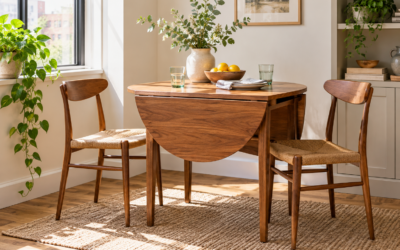
An expandable table doubles its length: 47.2 ÷ 23.6 = 2.0. The top area goes from 31.5 × 23.6 = 743.4 square inches closed to 31.5 × 47.2 = 1,486.8 square inches open, exactly double. That suits a kitchen where the table sits against a wall most days and opens up on weekends. The costs are moving parts, a heavier top and a seam in the surface, so check how the leaf locks.
Height and comfort
The tables we read are about 29 to 29.9 inches high. That is standard dining height. If you plan to use the table as a work surface, add a chair with a seat height that leaves room for your thighs; see the desk chair with adjustable height for the idea.
Material and weight
The 52 pound solid wood table is heavy enough to stay put when someone leans on it; the 45 pound shelf table is lighter. A light table slides on tile, and metal legs can scratch a floor, so add pads. Wood tops react to humidity, so keep them away from the dishwasher vent. Our guide to the solid wood dining room table covers what to verify in the listing.
What a storage shelf does and does not do
The 55 inch table includes a lower shelf. A shelf helps in a small kitchen because it holds a fruit bowl or a stack of mats, but it also blocks your feet under the table. The listing does not give a weight limit for the shelf in the bullets we read, so treat it as light storage.
Benches and wall-side seating
A bench on the wall side solves the against-the-wall problem. A bench seat takes less pull-out room than a chair, because people slide in from the end instead of pushing back. Check the table apron height against the bench: a bench needs clear space under the table edge, and a table with a side rail can block it. If you want to see how a bench changes the count, our guide to the nook breakfast table works through a corner example.
Mistakes to avoid
Ordering by the title’s seat count is one. Another is measuring the room but not the door swing, so a fridge door hits a pulled-out chair. The third is buying a table with legs at the corners when you want to tuck chairs: corner legs block the end seats, so look at the leg position in the photos.
Who should skip a rectangle
If your kitchen is close to square or has a doorway on every wall, a round table may leave a better path. If you have a bay window or a corner banquette, a square table can sit flush. If the table must double as a home office, check the depth against your laptop and mouse space.
Frequently asked questions
What size rectangle kitchen table seats four?
A table about 47 to 55 inches long and about 30 inches deep seats four by the 24 inch per person rule of thumb. Fit depends on chair width and how close you sit.
How much space do I need around a rectangle kitchen table?
Plan for about 36 inches of walkway beyond the chairs, plus about 20 inches for chair pull-out. These are planning figures, not building code for homes.
Can a rectangle table sit against a wall?
Yes. Against a wall a 29.5 inch deep table takes only that depth on the wall side. You lose seats on that side unless you use a bench.
Is an expandable rectangle table worth it?
If you host a few times a month, yes. The 47.2 inch table doubles its top area when open. If you never host, a fixed table is simpler.
Bottom line
A rectangle kitchen table works when you measure the long side, the short side and the walkway. In the example, the same 55.12 inch table fails centered and passes against a wall, so decide where it sits before you decide what you buy.
Products worth checking
We have not tested these products. Sizes and features come from the Amazon listings, checked on September 30, 2026; where a listing does not say, we say so.
55 inch Dining Table for 4-6, Rectangle Kitchen Table with Storage Shelf
The listing gives 55.12 x 29.5 x 29.92 in (L x W x H); 45 lb. We re-opened the page on September 30, 2026 and found these figures; other details are on the product page.
- Good for: comparing against the measurements in the guide above.
- Keep in mind: we have not tested it, and the listing may show more than one size or finish, so pick the variant that matches your numbers.
DONGMUWUJEE Solid Wood Small Dining Table for 2-6, 23.6 to 47.2 inch Expandable
The listing gives 31.5 x 47.2 x 29.5 in open; 52 lb. We re-opened the page on September 30, 2026 and found these figures; other details are on the product page.
- Good for: comparing against the measurements in the guide above.
- Keep in mind: we have not tested it, and the listing may show more than one size or finish, so pick the variant that matches your numbers.
31.5 inch Solid Wood Dining Room Table, Rectangular Kitchen Real Wooden Table
The listing gives 31.5 x 25 x 29 in as listed; 34.9 lb. We re-opened the page on September 30, 2026 and found these figures; other details are on the product page.
- Good for: comparing against the measurements in the guide above.
- Keep in mind: we have not tested it, and the listing may show more than one size or finish, so pick the variant that matches your numbers.
Sources checked
- Chapter 4: Accessible Routes
- 55 inch Dining Table for 4-6, Rectangle Kitchen Table with Storage Shelf
- DONGMUWUJEE Solid Wood Small Dining Table for 2-6, 23.6 to 47.2 inch Expandable
- 31.5 inch Solid Wood Dining Room Table, Rectangular Kitchen Real Wooden Table
Specifications checked on September 30, 2026. Product details and availability can change, so confirm on the product page before you buy.