As an Amazon Associate I earn from qualifying purchases. Links marked “Affiliate link” may earn us a commission at no extra cost to you. Learn more.
Quick answer
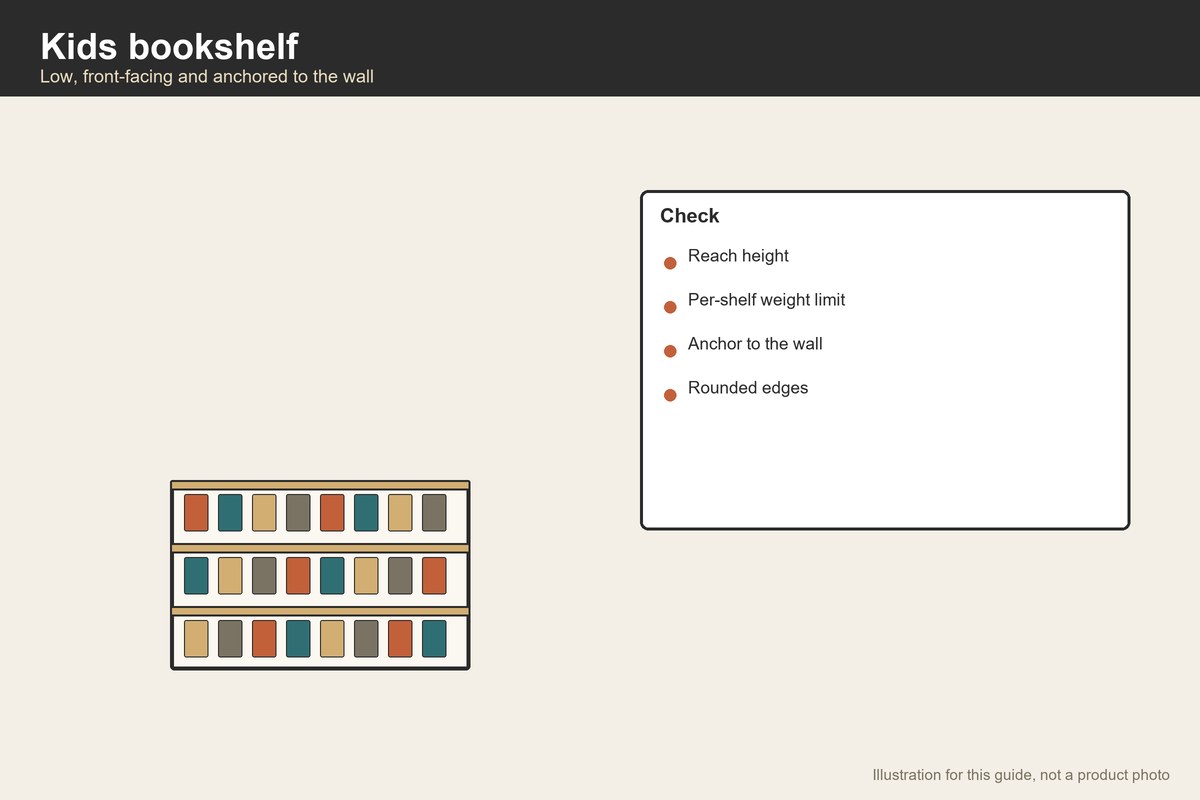
A kids bookshelf is a low shelf at a child’s reach height, often with front-facing shelves that show book covers so a young child can pick a book without pulling the whole row. The checks are height, shelf depth, the weight each shelf can carry, stability and the finish. Low shelves are safer than tall ones, but they still need care around toddlers.
The listings we read on Amazon on 2026-10-01 include a front-facing shelf set with a 25 inch width, 11 inch depth and 24 inch height variant and a stated shelf capacity of 12.6 pounds, a three-tier scalloped shelf of 10.7 by 29.6 by 27.6 inches at about 16.57 pounds and a four-tier wooden shelf of 11.4 by 24 by 23.6 inches at about 6 pounds. We have not tested any of them, and these sizes come from the listings.
A shelf of 6 pounds is easy to move and easy to tip. Check the anchor options.
Front-facing or spine-out
A front-facing shelf holds books with the cover toward the child. It suits toddlers and early readers because they can see the picture and choose without pulling books out. Shelves are shallow and sloped or pocketed. They hold fewer books than a spine-out shelf of the same size. A spine-out shelf holds more books, which suits older children.
Count the books the child owns. A front-facing four-tier shelf may hold about 8 to 12 picture books per tier, so 32 to 48 in total, which is our estimate, not a listed capacity. A spine-out shelf of 24 inches holds about 24 paperbacks per shelf.
Height and reach
A young child’s reach is short, and the shelves we read are 23.6 to 27.6 inches high, low enough for many toddlers to reach the top shelf. A low shelf is unlikely to fall far, but a child can still climb it. Keep it against a wall and discourage climbing.
For older children, a taller shelf may be better. If a child will use the shelf for years, an adjustable design lets you raise the shelves.
Weight limits
The shelf capacity we saw is 12.6 pounds per shelf on one model. Picture books weigh about 0.5 to 1 pound each, so 12 books can reach the limit. Do not use the shelf for toys if the limit is low. If a listing gives no limit, treat it as unknown.
Tip-over and anchoring
Even low furniture can tip when a child climbs or pulls. The Consumer Product Safety Commission’s Anchor It campaign explains why furniture should be anchored where children live. Fasten the shelf to the wall with the kit if one is included, or use a bracket. A 6 pound shelf is easy for a child to drag; an anchor prevents it.
One listing we opened mentions a children’s product certificate (CPC). We could not read what that covers from the page text, so ask the seller for the certificate and the standards it refers to rather than relying on the badge.
Materials, finish and emissions
Kids’ shelves are wood, engineered wood or fabric bins. Ask what finish is used and whether it is non-toxic and low in odor. Federal rules limit formaldehyde emissions from composite wood products sold in the United States, and listings may state compliance. Ask if it does not. Air a new shelf before use.
Edges, corners and pinch points
Check for rounded corners and smooth edges. Fabric bins can have loose threads. Scalloped edges look pretty but can have small gaps where fingers can catch. If a shelf has doors or drawers, check the pinch points.
Where to put it
Place the shelf in a spot where the child can sit and read, such as a corner with a rug. Keep it away from windows with cords and from heaters. Leave a clear path to the door. The U.S. Access Board uses 36 inches as a minimum clear width for a route. That is a public accessible-design reference, not a rule for a child’s room, but a clear path helps in the dark.
Growing with the child
A toddler shelf with front-facing pockets works for a few years. Plan a switch to a spine-out bookcase for chapter books. Keep the old shelf for toys or a baby sibling. If you buy an adjustable unit, you may avoid a second purchase.
A worked example
These are invented numbers for planning. A child has 30 picture books and 20 board books. The shelf you consider has four front-facing tiers and a width of 24 inches.
Capacity: if each tier holds about 8 books, the shelf holds 4 × 8 = 32 books, so 18 books remain without a place. If you add a second shelf, 2 × 32 = 64 books fit.
Weight: each tier at the 12.6 pound limit holds about 12 picture books at 1 pound each; 8 books at 0.7 pounds is 5.6 pounds, which is below the limit.
Floor space: the shelf is 11.4 inches deep and 24 inches wide, about 274 square inches (11.4 × 24), or 1.9 square feet. In a room 9 feet by 10 feet (90 square feet), it takes about 2 percent of the floor.
Compare the 29.6 inch wide scalloped shelf: 10.7 × 29.6 = 317 square inches. It is 16 percent larger ((317 − 274) ÷ 274) but also taller at 27.6 inches against 23.6.
Questions to ask before you order
Ask the seller for the per-shelf weight limit, the finish and the certificate. Ask whether an anchor kit is included. Ask whether the shelf is assembled and how long it takes. If the listing shows several sizes, confirm that the dimensions match.
A quick decision path
If your child is under about three, choose a low front-facing shelf. If your child reads chapter books, choose a spine-out shelf. If you have several children, choose a larger shelf and anchor it. Decide the age first.
Care and long-term wear
Wipe the shelves with a damp cloth. Check screws and anchors every few months, since children are rough on furniture. Re-tighten wobbly parts at once. Rotate the books so the covers stay interesting, and set aside a few for a basket if the shelf is small. If fabric bins are used, wash them according to the label.
Real-life scenarios
A toddler’s shelf near the bed makes a bedtime reading routine easy. In a shared room, each child can have a shelf. In a living room, a low shelf in a corner makes a reading nook with a rug and a cushion. Think about where your child already sits, and put the shelf there.
The day it arrives
Unpack in the room where it will live, check each part against the list and look for dents, chips or scratches before you sign for it. Take photos of any damage and keep the packaging until you are sure about the fit. Assemble on a blanket to protect the finish, and keep the instructions and spare hardware in a labeled bag.
Budget without prices
We leave prices out because Amazon changes them often. When you compare, think about the total cost: the item, delivery or help to carry it, floor protection, and anything you must buy to go with it. A cheaper piece that does not fit the room costs more than a slightly dearer one that does. Check the return policy before ordering, since bulky items can be hard to send back.
Choosing between shelf types
A front-facing shelf suits a child who cannot yet read; a spine-out shelf suits a child who can. A shelf with bins suits toys as well as books. A shelf with drawers adds weight and pinch points. If your child will use the room for years, a simple low shelf that you can move later is the flexible choice. Match the type to the child’s age and the room.
Rotating books
Children enjoy a small, changing selection more than a full shelf. Keep a box of books in a closet and swap a few each week. This also keeps the shelf under its weight limit and makes it easier for a child to tidy up. It is a habit, not a requirement.
Mistakes to avoid
- Skipping the anchor. Children climb.
- Overloading a shelf. Check the limit.
- Choosing a shelf that is too tall. Reach matters.
- Trusting a badge. Ask for the certificate.
- Forgetting the path. Keep the room clear.
When to skip it
If you have a tall bookcase already, a small basket on the floor may suffice. For a general bookcase, see bookcase bookshelf.
Related guides
See toddler bed, small bookshelf and white bookshelf.
Frequently asked questions
What height is a kids bookshelf?
The ones we read are about 24 to 28 inches high.
Are front-facing shelves better?
For toddlers, yes, because they show covers.
Do I need to anchor a low shelf?
Yes, a child can pull or climb it.
How much weight can it hold?
One listing states 12.6 pounds per shelf. Others give none.
How many books fit?
About 8 to 12 picture books per tier is our estimate.
Bottom line
A kids bookshelf should be low, stable and anchored, with shelves that suit the child’s age. Check the weight limit, ask for certificates and keep the path to it clear.
Products worth checking
We have not tested these products. Sizes and features come from the Amazon listings, checked on September 30, 2026; where a listing does not say, we say so.
Humble Crew Kids Bookshelf, Montessori Front Facing Toddler Bookcase
The listing gives 25 W x 11 D x 24 H in (variant); 12.6 lb shelf capacity. We re-opened the page on September 30, 2026 and found these figures; other details are on the product page.
- Good for: a front-facing shelf for toddlers.
- Keep in mind: the page lists several sizes, so confirm the variant.
SpaceAid 3-Tier Scalloped Bookshelf, Montessori Bookcase for Toddlers
The listing gives 10.7 x 29.6 x 27.6 in; 16.57 lb. We re-opened the page on September 30, 2026 and found these figures; other details are on the product page.
- Good for: a wider three-tier wooden shelf.
- Keep in mind: the text we read gives no per-shelf limit.
KiddoCood 4-Tier Wood Kids Bookshelf and Front Facing Toddler Bookcase
The listing gives 11.4 x 24 x 23.6 in; 6 lb. We re-opened the page on September 30, 2026 and found these figures; other details are on the product page.
- Good for: a very light four-tier shelf.
- Keep in mind: at 6 lb it is easy for a child to move, and the CPC mention in the title should be checked with the seller.
Sources checked
- Anchor It
- Formaldehyde emission standards for composite wood products
- Accessible routes guide
- Humble Crew Kids Bookshelf, Montessori Front Facing Toddler Bookcase
- SpaceAid 3-Tier Scalloped Bookshelf, Montessori Bookcase for Toddlers
- KiddoCood 4-Tier Wood Kids Bookshelf and Front Facing Toddler Bookcase
Specifications checked on September 30, 2026. Product details and availability can change, so confirm on the product page before you buy.