As an Amazon Associate I earn from qualifying purchases. Links marked “Affiliate link” may earn us a commission at no extra cost to you. Learn more.
Quick answer
An oval dining table is a rounded rectangle that seats people along the sides and at the ends, with no sharp corners. It is easier to walk around than a rectangle, and it takes a little less floor for the same length, but it seats about the same number along the sides and fewer at the ends. The checks are length, width, base and weight.
The listings we read on Amazon on 2026-09-30 and 2026-10-01 include a 70.9 inch oval table that is 35.4 inches wide and 29.99 inches high at about 91.5 pounds, a 60 inch oval with an artificial marble top at 35.5 inches wide and about 165 pounds, and a 55 to 70.8 inch oval with a flip leaf at about 83 pounds. We have not tested any of them, and these sizes come from the listings.
A 165 pound table is a fixture, not furniture you move. Plan the room first.
How an oval seats
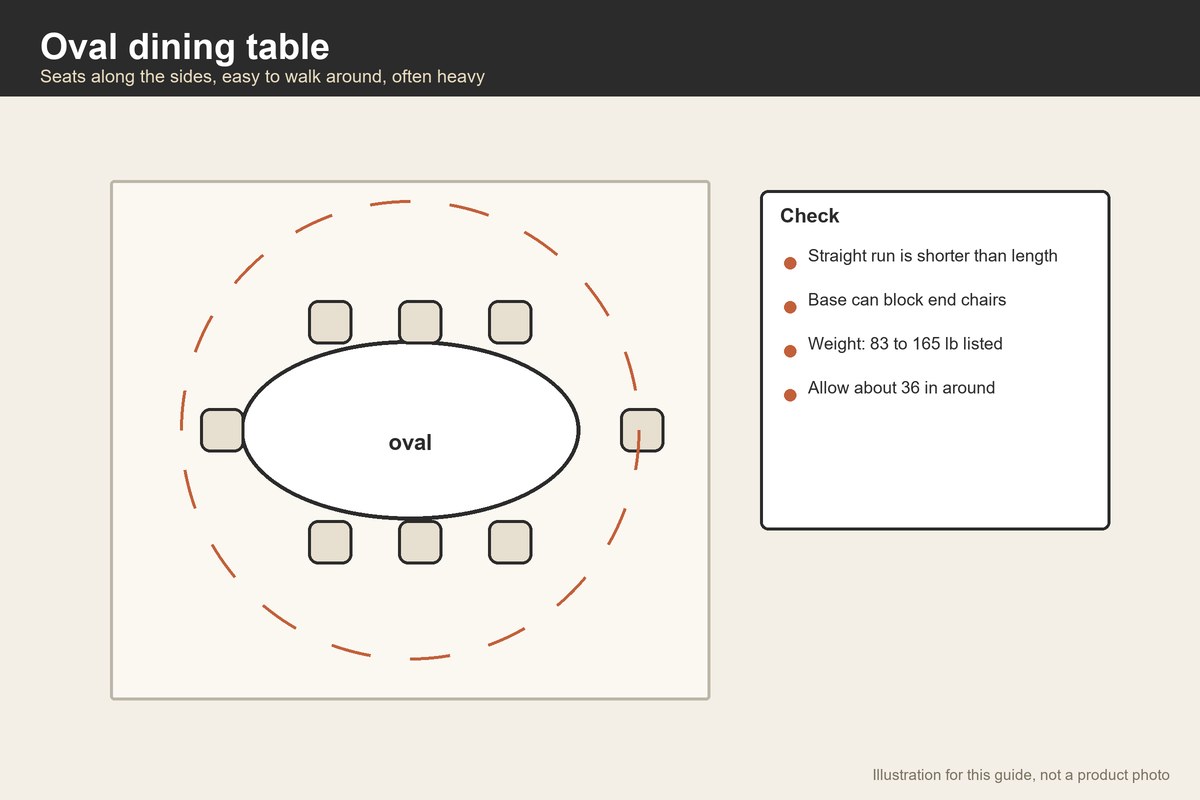
Seating is mostly along the long sides. A common planning estimate is about 24 inches of edge per person, a rule of thumb. On a 70.9 inch table, each long side is about 70.9 inches long, but the ends curve inward, so the straight run is shorter, perhaps 50 to 55 inches, which seats two per side at 24 inches (48 inches) and a third only tightly. The curved ends seat one person each, so six people is the practical limit, and eight is a squeeze.
A 60 inch oval seats four to six; a 55 inch oval seats four. These counts are our estimates, not listed capacities. For comparison with a rectangle, see rectangle dining room table.
Floor space compared with a rectangle
The area of an oval is about π ÷ 4 = 78.5 percent of its bounding rectangle if it is a true ellipse; real tables are a rounded rectangle, so the difference is smaller. As a rough check, a 70.9 by 35.4 inch bounding rectangle has an area of 2,510 square inches, and a true ellipse of the same bounds has about 1,971 square inches. A rounded rectangle falls in between. The point is that an oval frees the corners, which helps in a room where people walk past the ends.
Base, legs and knee room
An oval table often has a pedestal or two trestle bases. A pedestal leaves room for every seat but may block end chairs if it is wide. Four legs at the corners are less common on an oval. Check the photos of the base, and ask for the distance between legs. The listings we read describe a fluted leg style on one oval and a white base on another.
Weight and floors
The oval tables we read weigh about 83 to 165 pounds. The heaviest, with an artificial marble top, weighs about 165 pounds at 60 by 35.5 inches. Heavy tables are stable but hard to move and can mark soft floors. Use floor protectors under the base, and plan for two or three people to carry the top.
The weight per area is 165 ÷ (60 × 35.5) = 0.077 pounds per square inch, compared with 91.5 ÷ (70.9 × 35.4) = 0.036 for the other oval, so the marble-top table is about 2.1 times as heavy per area. Artificial marble tops are heavy and can chip at the edge.
Height and chairs
The tables we read are about 29.5 to 30 inches high. The U.S. Access Board’s accessible-design standard places dining surfaces between 28 and 34 inches high, which shows the general range that suits seated use. Chairs with seats of about 17 to 19 inches suit that height; see dining chairs and average dining table height.
Materials and emissions
The oval tables we read use engineered wood and, on one, artificial marble. Federal rules limit formaldehyde emissions from composite wood products sold in the United States, and listings may state compliance. Ask if the listing does not.
Room fit and walkway
The U.S. Access Board uses 36 inches as a minimum clear width for a route. That is guidance for accessible design in public buildings, not a home rule, but it is a helpful yardstick for passing behind a seated person. Add about 20 inches for a chair pulled out.
A worked example
These are invented room numbers for planning. A dining room is 11 feet by 12 feet (132 by 144 inches). You consider the 70.9 by 35.4 inch oval centered in the room.
Length: (144 − 70.9) ÷ 2 = 36.55 inches at each end, just above the 36 inch yardstick. With an end chair pulled out 20 inches, 36.55 − 20 = 16.55 inches remain behind it, so the end seats block the way.
Width: (132 − 35.4) ÷ 2 = 48.3 inches at each side. With a side chair pulled out 20 inches, 48.3 − 20 = 28.3 inches remain behind it. That is below 36, so passing behind a seated guest is a squeeze, but the oval’s curve helps at the ends.
Now shift the table 8 inches toward one side so the other side has 48.3 + 8 = 56.3 inches (56.3 − 20 = 36.3 behind the chair). That gives one clear route.
Compare the 60 by 35.5 inch oval: ends (144 − 60) ÷ 2 = 42 inches, with a chair 22 inches behind; sides (132 − 35.5) ÷ 2 = 48.25. It fits more comfortably but seats fewer.
Questions to ask before you order
Ask the seller for the length and width of the top, the thickness, the base type and the weight. Ask whether the top is one piece or glued, and how the base attaches. Ask whether the leaf, if any, locks. If the listing shows several finishes, confirm that the dimensions match.
A quick decision path
If you walk past the ends of the table, choose an oval. If you want the most seats along the edge, choose a rectangle. If you want to move the table, avoid very heavy tops. Decide how many people sit most days, then check the length.
Care and long-term wear
Oval tops have no corners, so wear shows along the edges and where plates sit. Use placemats, wipe spills and keep heavy centerpieces on a mat. If the table has a pedestal, check the base bolts after the first month. A heavy marble-look top should be lifted by two people and never dragged across the base.
Real-life scenarios
If you host family meals of six, an oval gives easy access to every seat. If you often have a large group, a rectangle or an extendable table is easier to expand. If your room is long and narrow, an oval can sit lengthwise with room at the ends. Think about how people move around the table, not just how many sit at it.
The day it arrives
Unpack in the room where it will live, check each part against the list and look for dents, chips or scratches before you sign for it. Take photos of any damage and keep the packaging until you are sure about the fit. Assemble on a blanket to protect the finish, and keep the instructions and spare hardware in a labeled bag.
Budget without prices
We leave prices out because Amazon changes them often. When you compare, think about the total cost: the item, delivery or help to carry it, floor protection, and anything you must buy to go with it. A cheaper piece that does not fit the room costs more than a slightly dearer one that does. Check the return policy before ordering, since bulky items can be hard to send back.
Mistakes to avoid
- Counting the full length as seating. The ends curve in.
- Ignoring weight. Heavy tops need help.
- Forgetting the base. A wide pedestal can block end chairs.
- Skipping floor protection. Heavy tables mark floors.
- Not measuring the room. Allow chair pull-out.
When to skip an oval
If you want to seat eight often, a longer rectangle or an extendable table works better; see dining table extendable. For a small kitchen, see kitchenette table.
Related guides
See round dining set for 4, farmhouse dining table and solid wood dining room table.
Frequently asked questions
How many does an oval table seat?
Along the long sides about two to three each at the usual estimate, plus one at each end.
Is an oval easier to walk around?
Yes, it has no corners, which helps in tight rooms.
Do oval tables take less space?
Slightly less than a rectangle of the same bounds, but the saving is modest.
Are oval tables heavy?
The ones we read are about 83 to 165 pounds.
Can I extend an oval table?
Some have a flip leaf. Check the listing.
Bottom line
An oval dining table seats mostly along its long sides, is friendly to walk around and can be heavy. Measure the room with chairs pulled out and choose the length that leaves a route.
Products worth checking
We have not tested these products. Sizes and features come from the Amazon listings, checked on September 30, 2026; where a listing does not say, we say so.
Lecafur HL 70.8 inch Oval Dining Table for 4 6 Person
The listing gives 70.9 x 35.4 x 29.99 in (D x W x H); 91.5 lb. We re-opened the page on September 30, 2026 and found these figures; other details are on the product page.
- Good for: a large oval for six.
- Keep in mind: it is heavy, and the text we read does not state the top material.
Modway Lippa 60 inch Oval Mid-Century Modern Dining Table, Artificial Marble Top
The listing gives 35.5 x 60 x 29.5 in (D x W x H); 165 lb. We re-opened the page on September 30, 2026 and found these figures; other details are on the product page.
- Good for: a heavy oval for four to six.
- Keep in mind: at 165 lb it is hard to move and can mark floors.
55-70.8 inch Extendable Oval Dining Table for 4-8 with Built-in Flip Leaf
The listing gives 55 to 70.87 in long x 31.5 in wide x 29.53 in high; 83 lb. We re-opened the page on September 30, 2026 and found these figures; other details are on the product page.
- Good for: an oval that extends with a built-in leaf.
- Keep in mind: the listing does not describe the lock.
Sources checked
- ADA Standards
- Formaldehyde emission standards for composite wood products
- Accessible routes guide
- Lecafur HL 70.8 inch Oval Dining Table for 4 6 Person
- Modway Lippa 60 inch Oval Mid-Century Modern Dining Table, Artificial Marble Top
- 55-70.8 inch Extendable Oval Dining Table for 4-8 with Built-in Flip Leaf
Specifications checked on September 30, 2026. Product details and availability can change, so confirm on the product page before you buy.