As an Amazon Associate I earn from qualifying purchases. Links marked “Affiliate link” may earn us a commission at no extra cost to you. Learn more.
Quick answer
A corner bookshelf turns a dead corner into storage. The three shapes we read about on Amazon on 2026-09-30 differ a lot in footprint: a semicircular six-tier unit is 11.8 by 11.8 by 71.2 inches and about 14.7 pounds; a triangular five-tier unit is 11.6 by 11.6 by 57.7 inches and about 9 pounds; an L-shaped six-shelf case is 23.6 by 23.6 by 63.8 inches and about 44.9 pounds. We have not tested any of them. The L-shaped case covers four times the floor of the slim ones (23.6² ÷ 11.8² = 4), but it holds much more.
Choose by what you will store. Slim units suit small decor and paperbacks. The L-shaped case suits real book collections. And all tall units need anchoring: the lightest unit we read is about 9 pounds and 57.7 inches high, which is easy to knock over.
If you have a long wall and not a corner, see bookcase bookshelf.
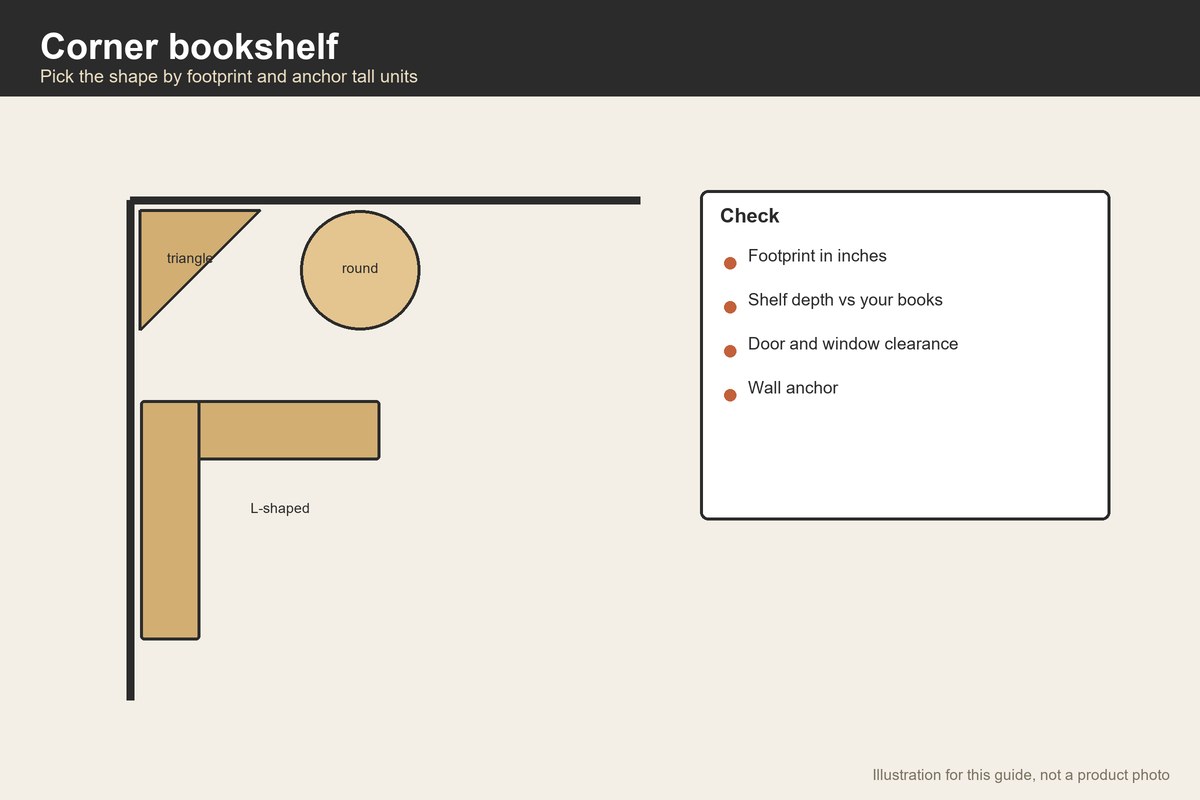
Three corner shapes
Triangular or semicircular. A narrow unit that fits tight into a right-angle corner. Its shelves are small, since a triangle at 11.6 inches on a side has a short back edge. Good for plants, small frames and paperbacks.
L-shaped. Two arms meet at 90 degrees, each about 23.6 inches long. The shelves wrap the corner and hold more, but the inside corner is a dead zone that you reach less easily.
Wall-mounted corner shelves. They free the floor but need mounting hardware and a wall that can hold them. We opened none of these.
Count capacity honestly
A triangular shelf with 11.6 inch sides has a usable depth well below its width, so books may not fit flat. A paperback is about 4 to 5 inches wide and 7 inches tall, so a triangle shelf may hold a short row, not a stack. As a rough estimate, a 5-tier triangular unit holds 5 shelves × perhaps 6 books = about 30 paperbacks; that is our guess, not a listed number.
The L-shaped case has two arms of about 23.6 inches. With six shelves, each arm shelf holds about 23 paperbacks at 1 inch each: 6 × 2 × 23 = 276 paperbacks as an upper estimate, less the corner overlap, so perhaps 200 in practice. Measure your own books, since thickness varies.
Footprint and floor space
Compare the floor each unit uses: the 11.8 inch semicircle is about 11.8 × 11.8 ÷ 2 = 70 square inches if it were a half square, and the 11.6 inch triangle about 67 square inches (11.6 × 11.6 ÷ 2). The L-shaped case, 23.6 inches on each arm, covers about 557 square inches of bounding square, though its arms are only the depth of the shelf, so the actual floor under the shelves is less. Check the listing for the shelf depth.
The U.S. Access Board uses 36 inches as a minimum clear width for a route, and 32 inches at short obstructions. That is public accessible-design guidance, not a home rule, but a corner case should not stick out far enough to narrow a route much below it.
Height and stability
The slim units we read are 57.7 to 71.2 inches high and light. A tall light shelf with a small footprint is the easiest to tip. The Consumer Product Safety Commission’s Anchor It campaign explains why anchoring furniture matters where children live. Fasten the unit to the wall studs with the kit or a bracket, and place heavy items low. The L-shaped case at about 44.9 pounds is steadier but still needs anchoring.
Corners also hide wall quirks. Walls may not be square, so check the fit before you tighten, and use shims if the unit rocks.
Material and look
The slim units we read use metal frames with wood-look shelves. The L-shaped case is engineered wood. Metal frames are slim and light; engineered wood is heavier and cheaper. Federal rules limit formaldehyde emissions from composite wood products sold in the United States, and listings may state compliance. Ask if it does not.
Open shelves show everything, so choose items you like to see. A unit with a baffle or a back panel keeps small items from falling.
LED lights and power
One listing mentions an LED light on a corner unit. Lights need a power source: a cord to a wall outlet or batteries. Plan the cord so it does not cross a walkway. Do not cover bulbs with fabric.
Assembly and delivery
Slim corner units ship in long boxes; the L-shaped case ships in a heavy box of about 45 pounds, so plan for two people. Assemble in the corner and anchor before loading.
A worked example
These are invented room numbers for planning. A living room corner has a window sill at 30 inches high on one wall and a door 20 inches from the other wall.
Option A: the 11.8 inch semicircle, 71.2 inches high. It takes about 11.8 inches along each wall, leaving 20 − 11.8 = 8.2 inches to the door. It blocks the window below the sill, so only the lower 30 inches is a concern.
Option B: the 23.6 inch L-shaped case, 63.8 inches high. It takes 23.6 inches along each wall, so it overlaps the door’s trim area: 20 − 23.6 = −3.6 inches, which means it would block the door by 3.6 inches. It does not fit.
Option C: the 11.6 inch triangle, 57.7 inches high. It leaves 20 − 11.6 = 8.4 inches to the door and stays below the window top.
The slim units fit this corner, and the L-shaped case does not. If you need more capacity, use a second slim unit on another wall.
Questions to ask before you order
Ask the seller for the shelf depth, the weight limit per shelf, the anchor kit and whether the unit can be placed against a corner that is not perfectly square. Ask how many boxes it ships in. If the listing shows several finishes, confirm that the dimensions match.
A quick decision path
If you want a few decor pieces, choose a slim unit. If you have many books, choose the L-shaped case or a straight bookcase. If a door or a window is near the corner, measure first. If children are around, anchor everything.
Styling and loading a corner shelf
A corner shelf looks tidier if you group items by size. Put taller books or plants on the lower shelves of a slim unit, since a light tall unit tips more easily with weight at the top. Keep fragile items on the middle shelves, where they are less likely to be knocked. If the unit has an LED strip, keep cords tidy and out of reach. Re-check the anchor after the first month, and again if you load more weight.
Choosing the corner
Not every corner suits a shelf. A corner by a door can become a hazard if a person opens the door into the shelf. A corner by a window blocks light. A corner behind a sofa is rarely used. A corner in a hallway can narrow the route. The best corner is one that you pass but do not need to cross. Walk the room and note where you would reach into a corner shelf from without being in the way.
The day it arrives
Unpack and check the parts. Assemble in the corner, since an L-shaped case is hard to move once built. Check that the unit sits flat, shim if needed and anchor it. Load the lower shelves first and check the stability before adding the rest.
Budget without prices
We leave prices out. A slim unit is cheap but holds little; an L-shaped case holds more but covers more floor. Compare capacity per square foot of floor, not just the sticker. If a corner is rarely used, even a modest shelf adds value.
Mistakes to avoid
- Trusting shelf counts. Triangular shelves are small.
- Skipping the anchor. Slim tall units tip.
- Ignoring doors and windows. Measure the corner.
- Overloading light shelves. Check the limit.
- Assuming a square corner. Test the fit.
When to skip a corner shelf
If you need to store many books, a straight bookcase against a wall holds more per floor inch. If you only need to hold a plant, a stand may be enough. See best floating shelves for a home office.
Related guides
See bookcase bookshelf, ladder shelf and best small bookcases with doors.
Frequently asked questions
How much does a corner bookshelf hold?
It depends on the shape. Slim triangular units hold small items; L-shaped cases hold far more.
Do corner shelves need anchoring?
Yes, especially tall, light ones.
Can I put a corner shelf in front of a window?
Only if you accept blocking light. Check the height against the sill.
Are corner shelves good for books?
L-shaped ones can be. Triangular ones suit paperbacks and decor.
Will it fit if my corner is not square?
Maybe. Test it and use shims.
Bottom line
Choose a corner bookshelf by footprint and capacity, then anchor it. Measure the corner, doors and windows and choose a slim unit for decor and an L-shaped case only if the corner can hold it.
Products worth checking
We have not tested these products. Sizes and features come from the Amazon listings, checked on September 30, 2026; where a listing does not say, we say so.
CHOEZON 6-Tier Corner Shelf, Industrial Corner Bookshelf, 71.2 inch
The listing gives 11.8 x 11.8 x 71.2 in; 14.74 lb. We re-opened the page on September 30, 2026 and found these figures; other details are on the product page.
- Good for: a tall slim corner unit for small items.
- Keep in mind: 14.74 lb at 71 in tall needs anchoring.
Armocity Corner Book Shelf, 6-Shelf L Shaped Corner Bookshelf
The listing gives 23.6 x 23.6 x 63.8 in; 44.9 lb. We re-opened the page on September 30, 2026 and found these figures; other details are on the product page.
- Good for: a corner case that holds real books.
- Keep in mind: it covers about 4 times the floor of the slim units.
Furinno Turn-N-Tube Corner Shelf, 5-Tier Corner Bookshelf
The listing gives 11.6 x 11.6 x 57.7 in; 9 lb. We re-opened the page on September 30, 2026 and found these figures; other details are on the product page.
- Good for: a very light corner shelf for decor.
- Keep in mind: 9 lb is very light, so anchor it.
Sources checked
- Accessible routes guide
- Anchor It
- Formaldehyde emission standards for composite wood products
- CHOEZON 6-Tier Corner Shelf, Industrial Corner Bookshelf, 71.2 inch
- Armocity Corner Book Shelf, 6-Shelf L Shaped Corner Bookshelf
- Furinno Turn-N-Tube Corner Shelf, 5-Tier Corner Bookshelf
Specifications checked on September 30, 2026. Product details and availability can change, so confirm on the product page before you buy.