As an Amazon Associate I earn from qualifying purchases. Links marked “Affiliate link” may earn us a commission at no extra cost to you. Learn more.
Quick answer
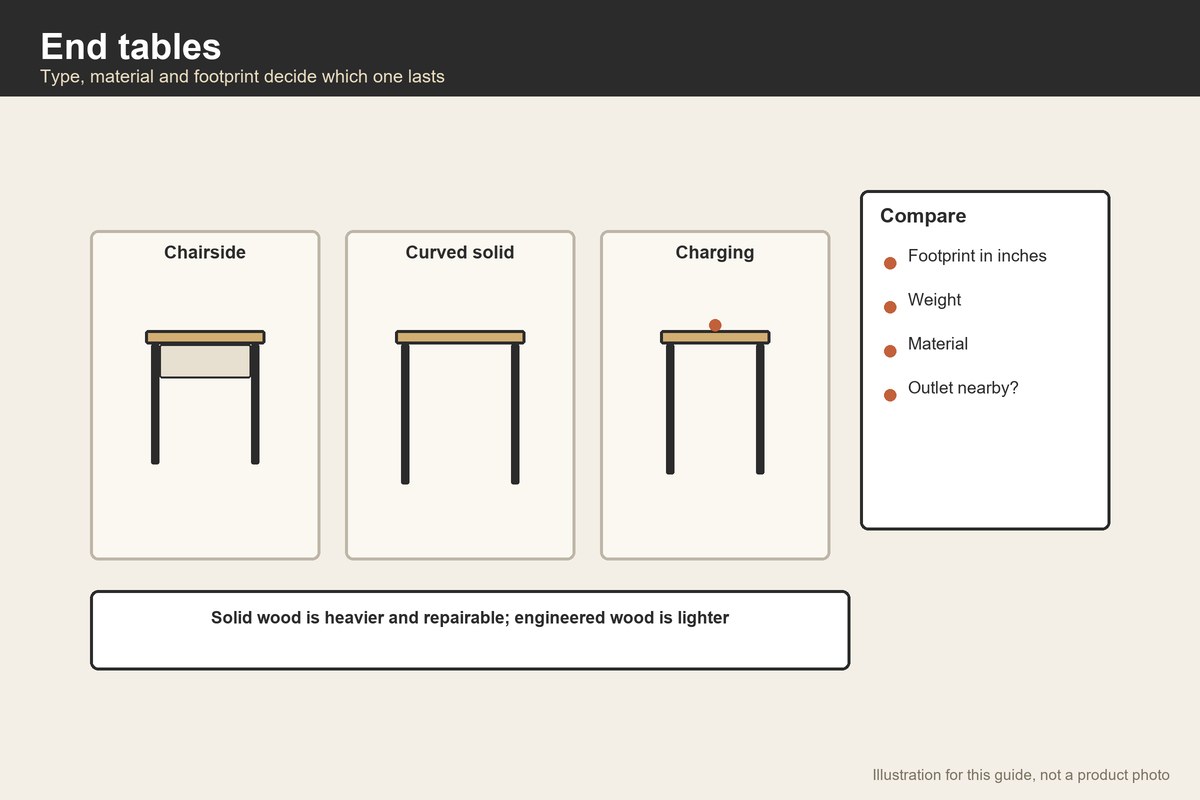
An end table is a small table beside a sofa or chair, and the choices come down to type, material and footprint. The types are chairside tables with a drawer, round or curved tables, tables with charging ports and nesting sets. The materials are solid wood, engineered wood and metal. Solid wood tends to be heavier and repairable, while engineered wood with a metal frame is lighter and cheaper but marks more easily.
The three tables we opened on Amazon on 2026-09-30 show the spread. A narrow chairside table with a drawer and open shelf lists 11.8 by 18.9 by 24 inches in particleboard and metal. A curved end table lists 18 by 18 by 22 inches, about 20 pounds and solid wood. A table with charging ports lists 15.3 by 15.3 by 23.2 inches in particleboard, MDF and metal. We have not tested any of them.
If you already know your sofa and need a size, read end tables for living room. If you need a slide-under table, read side table.
The main types
Chairside with a drawer. A slim table that holds remotes and coasters in a drawer, with an open shelf below. The one we opened is 11.8 inches deep and 18.9 inches wide, which fits beside an armchair.
Curved or round. A table without sharp corners. The curved table we opened is 18 by 18 inches, about 324 square inches of floor. It suits a spot where people pass close, but it takes more floor than a slim table.
With charging ports. USB and outlet models let you charge devices beside the sofa. They still need a wall plug, and the cord must not cross a walking route.
Nesting. Two or more tables that slide together and pull apart. Useful when you host, but the small top limits what you can set down.
Materials
Solid wood. The curved table we opened lists solid wood and weighs about 20 pounds. Solid wood can be sanded and refinished, and it holds screws well. It can dent and it reacts to humidity.
Engineered wood. Particleboard and MDF are made of wood fibers or chips and resin. They are light and inexpensive, and the surface is often a printed laminate. The edges chip, and water can swell them. Federal rules limit formaldehyde emissions from composite wood products sold in the United States, and a listing may state compliance. Ask if it does not.
Metal and glass. Metal frames are slim. Glass tops show fingerprints and can break. Tables with glass tops need care around children.
Stability and safety
Small tables tip. A wide base and low weight distribution help. Keep hot drinks away from the edge. If children are around, avoid glass and sharp corners. The Consumer Product Safety Commission’s Anchor It campaign covers anchoring furniture where children live. A small table is a lower risk than a tall chest, but a light table with a lamp can still be pulled over.
Power and cords
A lamp on an end table needs an outlet. Plan the cord along the baseboard and not across the floor. A table with built-in ports still plugs into a wall outlet. Use only the cords that come with a device, and do not cover chargers with fabric. Working smoke alarms in living areas are recommended by the U.S. Fire Administration.
Footprint and the walking route
The U.S. Access Board uses 36 inches as a minimum clear width for a route and 32 inches at short obstructions. That is guidance for accessible design in public buildings, not a rule for your home, but a helpful yardstick. An end table narrows the space beside the sofa. Measure the gap before you choose.
What to check in a listing
- Footprint. Width, depth and height; check that the order of numbers is what you expect.
- Material. Solid wood, particleboard, MDF or metal.
- Weight. Heavier tables tip less and move less.
- Load rating. The listings we opened rarely state one for the top.
- Assembly. Some need tools and an hour.
A worked example
These are invented room numbers for planning. You compare the three tables by footprint and weight.
Chairside table: 11.8 × 18.9 = 223 square inches. Curved table: 18 × 18 = 324 square inches. Charging table: 15.3 × 15.3 = 234 square inches.
The curved table takes 324 − 223 = 101 square inches more than the chairside table, about 45 percent more (101 ÷ 223). The charging table takes 234 − 223 = 11 square inches more, about 5 percent more.
Now weight, using the listing weight of 20 pounds for the curved solid-wood table. If an engineered-wood table of similar size weighed about 10 pounds (an assumed number), the solid table would be twice as heavy. A heavier table resists tipping but is harder to move. Height: the three tables are 24, 22 and 23.2 inches high; a sofa arm of 24 inches makes the first the closest match, and the 22 inch table sits 2 inches below it.
The choice depends on the room. If the gap beside the sofa is 20 inches, the 18.9 inch chairside table leaves 1.1 inches, and the 15.3 inch charging table leaves 4.7 inches. If you want a path, choose a slimmer table or a wall shelf.
How to test a table in your home
After delivery, put the table in place and check for wobble by pressing each corner. Set a full glass on it and nudge the table gently. Open the drawer and close it several times to check the runners. Charge a phone if the table has ports. Look at the edges for chips, and check that the top is flat. Keep the packaging for a couple of weeks in case you need to return it.
Questions to ask before you order
Ask the seller for the top thickness, the drawer interior size and the weight the top can hold. Ask whether the legs have adjustable feet for uneven floors. Ask whether the assembly hardware is included, whether replacement parts are sold and how long assembly takes. If the table has charging ports, ask how many outlets and how many USB ports, and whether the surge protection is stated.
Care
Wipe engineered wood with a slightly damp cloth and dry it. Use coasters to prevent rings. Keep the table out of direct sun, which can fade a printed laminate. Tighten screws after a month and again every few months. For solid wood, follow the maker’s finish guidance, and avoid harsh cleaners.
A quick decision path
If your gap beside the sofa is narrow, choose the slim chairside table. If people pass close by, choose a rounded or curved table. If you charge devices at the sofa, choose a table with ports and plan the cord. If you want a table that lasts and can be repaired, choose solid wood and accept the extra weight. Write down which describes your room and buy for that.
Choosing a finish that lasts
Dark finishes hide dust but show scratches; light finishes hide scratches but show stains. A printed laminate can look like wood and wipes clean, but chips at edges. Solid wood with a clear finish shows grain and can be sanded and refinished when it wears. Metal frames can be powder coated, which resists chips better than paint. Check the photos of the corners and edges.
Mistakes to avoid
- Choosing by looks. Check the listed width, depth and height.
- Ignoring weight. Very light tables tip.
- Forgetting the outlet. Plan the cord.
- Buying glass with small children. Consider a solid top.
- Trusting a missing load rating. Keep heavy items light.
- Buying pairs by default. One table may be enough.
When to skip an end table
If the sofa has no room beside it, a wall shelf or a floor lamp may work better. If you mostly need a surface for a laptop, a C-shaped table is more useful; see side table.
Related guides
See end tables for living room, nightstands and coffee tables for living room.
Frequently asked questions
What is the difference between an end table and a side table?
The terms overlap. End tables usually sit at the end of a sofa; side tables may slide under it or stand beside a chair.
Is solid wood better?
It is repairable and heavier. Engineered wood is lighter and cheaper but marks more easily.
How tall should an end table be?
Close to the sofa arm height. Measure your sofa.
Do I need charging ports?
Only if you charge devices there. They still need a wall outlet.
How do I stop a table tipping?
Choose a wide base, keep heavy items low and consider anchoring if children are around.
Bottom line
Choose an end table by type, material and footprint. Compare the listed sizes and weights, plan the cord and pick the slimmer table if the gap beside the sofa is tight.
Products worth checking
We have not tested these products. Sizes and features come from the Amazon listings, checked on September 30, 2026; where a listing does not say, we say so.
HOOBRO End Table, Narrow Chairside Table with Drawer and Open Storage Shelf
The listing gives 11.8 x 18.9 x 24 in (D x W x H). We re-opened the page on September 30, 2026 and found these figures; other details are on the product page.
- Good for: a slim chairside table with a drawer.
- Keep in mind: the page shows several colors and materials, so check the one you choose.
Winsome Wood Curved End Table with One Drawer, Brown
The listing gives 18 x 18 x 22 in; 20 lb. We re-opened the page on September 30, 2026 and found these figures; other details are on the product page.
- Good for: a solid-wood curved table with a drawer.
- Keep in mind: at 18 in square it takes more floor than a slim table.
HOOBRO End Table with Charging Station, Bedside Table with Drawers
The listing gives 15.3 x 15.3 x 23.2 in (D x W x H). We re-opened the page on September 30, 2026 and found these figures; other details are on the product page.
- Good for: a table with USB and Type-C ports.
- Keep in mind: it still needs a wall outlet, and the page shows several finishes.
Sources checked
- Formaldehyde emission standards for composite wood products
- Anchor It
- Smoke alarm guidance
- Accessible routes guide
- HOOBRO End Table, Narrow Chairside Table with Drawer and Open Storage Shelf
- Winsome Wood Curved End Table with One Drawer, Brown
- HOOBRO End Table with Charging Station, Bedside Table with Drawers
Specifications checked on September 30, 2026. Product details and availability can change, so confirm on the product page before you buy.