As an Amazon Associate I earn from qualifying purchases. Links marked “Affiliate link” may earn us a commission at no extra cost to you. Learn more.
Quick answer
A dinette set is a small dining table with chairs, usually seating two to four, designed for kitchens and compact dining areas. For a small space, the winning set is the one whose table shape, chair type and expansion method match how many people really sit and how often. A drop-leaf table gives a small footprint most days and seats more when open. A round pedestal table gives leg room and no corners. A rectangular table with chairs tucked in suits a wall.
Choose by three tests: the closed and open footprint, the clearance behind seated diners and the storage of the chairs when not in use. Rules of thumb suggest leaving roughly 36 inches between a table edge and the nearest wall or object, and about 44 to 48 inches where people walk behind chairs. These are widely cited planning numbers, not standards.
This article is about comparing layouts. We have not tested any set, and no models are recommended here.
The four layouts to compare
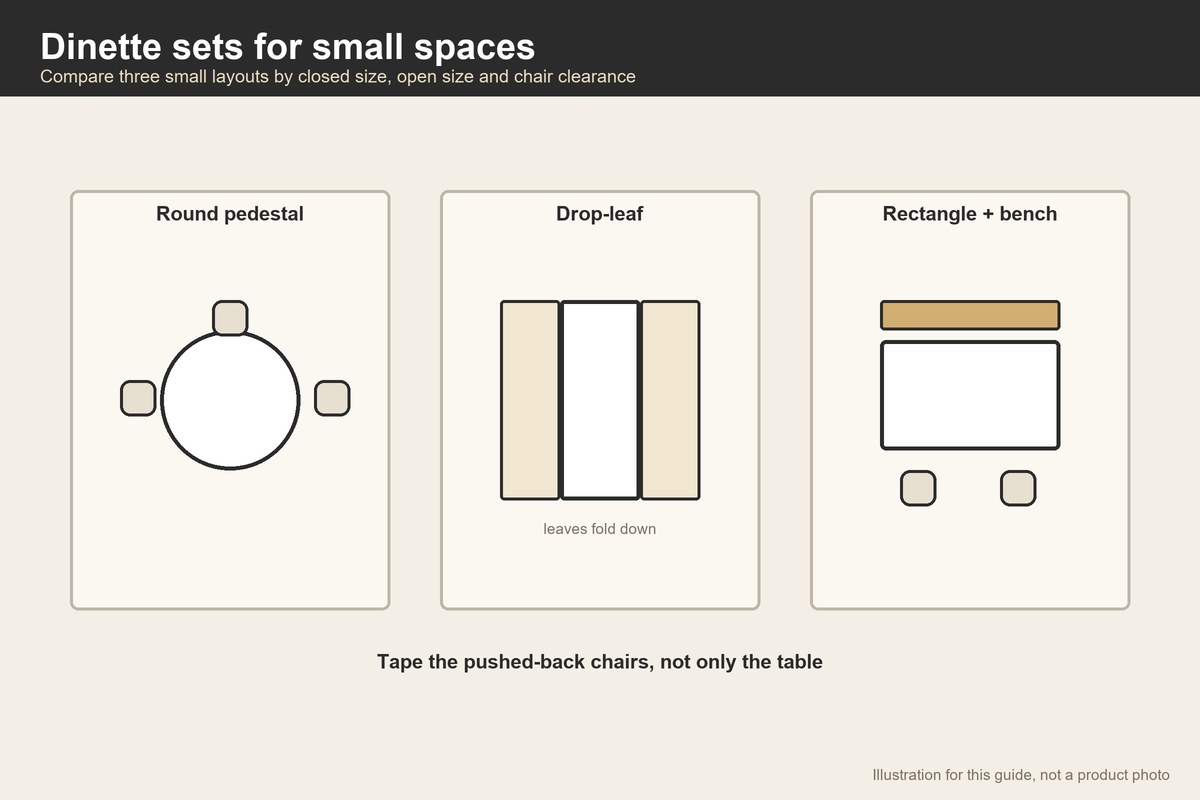
Round pedestal. A single central base means no legs to bump and easy chair access from any side. Round tables suit corners and small squares, and seat four in about the space a square table needs for two. The trade-off is less usable surface for plates and a table that does not fit flush to a wall.
Drop-leaf or gateleg. One or two leaves fold down to make a narrow table. It sits against a wall most days and opens for meals. The trade-off is a support mechanism that must be sturdy, and leaves that limit legroom at the sides when open.
Extending rectangle. A rectangular table with a leaf or an extension mechanism, usually stored under or beside the table. It seats more for guests. It needs floor space for the extended shape and storage for the leaf.
Wall-attached or counter-height. Some dinettes are pub-height tables with stools, or a table attached to a wall. Pub-height sets use less floor for the same seating in some layouts but require taller seats. A related guide covers small kitchen table and chairs for standard-height sets.
Each one solves a different problem. The best choice depends on whether your issue is width, depth, guest capacity or floor visibility.
Count real diners
Most dinettes are sold as a “4-piece set” or a “5-piece set.” That says how many items are in the box, not how many seats you need daily. Write down how many people sit at the table on a normal day and on busy days. If you sit two on most days, a table for two that extends to four may work better than a permanent four-seat set.
A common planning estimate is about 24 inches of table edge per person for comfortable elbow room. It is a rule of thumb, not a standard. A 36-inch round table has a circumference of about 113 inches (π × 36), so roughly four people at 24 inches each fit with room to spare, though real comfort depends on chair width and table shape.
Chairs: storage and comfort
Chairs take a lot of floor when pulled out. Ways to reduce it:
- Stackable or folding chairs store away when not needed.
- Backless stools tuck fully under the table.
- Benches seat several people and tuck under, but lack backs.
- Armless chairs slide closer to the table.
A chair with a narrow back and no arms saves several inches per seat. If you eat for long periods, comfort matters more than saving inches; test a chair by sitting for a while before buying, or read the listing for seat depth and back height.
Chair seat height and table height must match. Most dining tables are roughly 29 to 31 inches high, and dining chairs about 17 to 19 inches, but check the listing. The U.S. Access Board’s standards, written for accessible design, place dining surfaces between 28 and 34 inches high with knee clearance underneath, which shows the general range that suits seated use.
Clearance: the size that matters is the pushed-back chair
A table that seems to fit a room can fail when a chair is pushed back. Add the chair depth to the table dimension when you plan. If a chair needs about 20 inches to pull out and sit, then a table plus chair on one side needs the table width plus 20 inches at least, before the walkway.
The U.S. Access Board’s accessible-route guidance uses 36 inches as a minimum clear width for a route, narrowing to 32 inches at short obstructions. For a home it is only a reference, but a path narrower than that will feel cramped behind a seated person.
Draw the arrangement on paper with squares for chairs pulled out. Tape it on the floor and sit in each chair.
Expandable designs: what to check
Drop-leaf and extension tables save space but have moving parts. Check:
- Leaf support. Does the leaf sit on brackets, swing-out legs, or a hinged support? Wobble is common when supports are thin.
- Open and closed size. The listing should give both. If it gives only one, treat the other as unknown.
- Where the leaf goes. An extension leaf needs a closet or shelf.
- Legroom. Gatelegs and hinged supports can sit where knees want to be.
A table that is good closed but poor open may still work if you rarely have guests. Be honest about the frequency.
Materials and durability
Small dinettes see daily use. A wipeable top resists spills; laminate is easy to clean but can chip at edges, while solid wood can be refinished. Glass shows marks and can be hazardous around children.
Composite wood is common in dinettes at lower price levels. In the United States, federal rules limit formaldehyde emissions from composite wood products, and a listing may state compliance. If it does not, ask.
Check the weight capacity of the table and chairs. If the listing gives none, treat it as unknown.
Delivery and assembly
Dinette sets often arrive in multiple boxes. Check that the largest box fits through your door and stairs. Assembly time varies; tables with mechanisms take longer. Two people are often needed for the tabletop.
A worked example
This is an illustration with invented numbers, for planning. Your dining corner is 8 feet by 6 feet, or 96 by 72 inches, and it is a walkway between the kitchen and the living room along the 96-inch side.
Test a 30-by-48-inch rectangular table with its long side against the 96-inch wall. The table extends 30 inches into the room, leaving 72 − 30 = 42 inches to the opposite wall. Two chairs pulled out on the room side each need about 20 inches, so the pulled-out chairs reach 30 + 20 = 50 inches into the room, leaving 72 − 50 = 22 inches to the far wall. That is far below the 32- to 36-inch route reference, so the walkway is blocked whenever someone sits.
Try a 36-inch round table centered in the corner area: the table leaves 72 − 36 = 36 inches to the far wall with chairs tucked in, which is passable. With chairs pulled out you would need more, so stackable chairs or a drop-leaf pushed against the wall between meals would help.
The result depends on the numbers, but the process—closed size, open size, chairs pulled out, walkway—gives a clear answer.
When to skip a dinette
If you eat at the couch or the counter, a dinette may be unused furniture. A folding table that appears only for guests can meet the same need with far less floor; see folding table. If the dining corner doubles as a workspace, a table that also serves as a desk might be more useful.
A short decision path
If your dining area is a walkway, choose a drop-leaf or a round pedestal that clears the route. If it is a dead-end corner, a round or square table with a bench uses the corner best. If guests come only a few times a year, choose the smallest table that suits daily use and add a folding table for gatherings. If you eat in the room daily and for long periods, favor comfortable chairs over the smallest footprint. Write down which of these describes you before comparing listings, because it narrows dozens of sets to a few. Then check open and closed dimensions, chair tuck depth and delivery box size for each remaining candidate.
Mistakes to avoid
- Trusting piece counts. A “5-piece” set is not a five-seat plan.
- Ignoring pushed-back chairs. They add about 20 inches per side.
- Buying expandable without checking the open size. Confirm both dimensions.
- Choosing chairs by looks. Test comfort and tuck-in depth.
- Skipping delivery checks. Large boxes can be hard to move.
- Forgetting storage for leaves. They need a place.
Frequently asked questions
What is the smallest dinette that seats four?
There is no fixed answer. A small round or square table may seat four tightly. Check chair clearance and comfort before buying.
Are drop-leaf tables sturdy?
They can be, but the support mechanism matters. Check reviews and photos of the support.
Is a round or rectangular table better for a small kitchen?
Round works in corners and offers easy access; rectangular fits a wall. Test both by taping.
Do I need a bench?
Not necessarily. Benches save space but lack backs; stackable chairs offer flexibility.
How do I store extra chairs?
Use stackable or folding chairs and a closet or wall hook.
Bottom line
A dinette set works in a small space when its closed and open sizes, chair type and clearance match how many people sit and how often. Tape the layout, measure the pushed-back chairs and choose the shape and expansion method that solve your specific constraint.
Related guides
Compare corner seating in breakfast nook dining set, occasional-use options in card table and chairs, and daily-kitchen fit in small kitchen table and chairs.
Products worth checking
We have not tested these products. Sizes and features come from the Amazon listings, checked on September 30, 2026; where a listing does not say, we say so.
YATINEY 3-Piece Round Dining Table Set for 2
The listing gives 31.5 x 31.5 x 29.5 in; 44.1 lb. We re-opened the page on September 30, 2026 and found these figures; other details are on the product page.
- Good for: buying the table and both chairs in one purchase.
- Keep in mind: it seats two only.
HOOBRO 3-Piece Industrial Dining Table Set, Kitchen Table
The listing gives 31.5 x 23.6 x 29.5 in; 37.9 lb. We re-opened the page on September 30, 2026 and found these figures; other details are on the product page.
- Good for: a compact rectangular dinette that fits against a wall.
- Keep in mind: the depth is under 24 inches, so the tabletop is narrow for plates and shared dishes.
VASAGLE Folding Dining Table, Drop Leaf Extendable Table
The listing gives 30.7 x 47.2 x 30 in open; 38.6 lb. We re-opened the page on September 30, 2026 and found these figures; other details are on the product page.
- Good for: two people on most days and up to four when the leaves are up.
- Keep in mind: chairs are not included, and the open and closed sizes should be confirmed before you plan the layout.
Sources checked
- ADA Standards
- Accessible routes guide
- Formaldehyde emission standards for composite wood products
- YATINEY 3-Piece Round Dining Table Set for 2
- HOOBRO 3-Piece Industrial Dining Table Set, Kitchen Table
- VASAGLE Folding Dining Table, Drop Leaf Extendable Table
Specifications checked on September 30, 2026. Product details and availability can change, so confirm on the product page before you buy.