As an Amazon Associate I earn from qualifying purchases. Links marked “Affiliate link” may earn us a commission at no extra cost to you. Learn more.
Quick answer
A bed frame with storage is worth buying when you have a specific list of things to store, and when the storage can open fully in your room. The three common formats are drawers that pull out from the side or foot, a base that lifts up on hinges or gas struts, and an open under-bed space with a raised frame. Each one fails in a different way. Drawers fail when there is no floor space to pull them out. Lift-up bases fail when the bed is pushed against two walls or the mattress is too heavy to lift comfortably. Open space fails when the items stored there collect dust and are awkward to reach.
Before comparing models, do three things: measure the floor space around the bed, list what you would put in the storage, and check the listing for the interior dimensions of each drawer or compartment. If a listing gives only the overall bed size, treat the storage capacity as unverified.
This is a planning guide, not a list of tested products. We have not tested any frame, and the checklist below comes from how these beds are built and used, not from a lab measurement.
Start with what you will store
“More storage” is not a plan. Write the list first. Typical candidates are off-season clothing, spare bedding, shoes, luggage, and items that rarely get used. Now separate the list into two groups.
Things you reach for weekly need easy access: a drawer that opens with one hand, or a shelf. Things you reach for a few times a year can live in a lift-up base or a deep bin under a raised frame, where access is slower.
This one sorting step usually decides the format. If most of your list is weekly items, drawers are the better fit. If most is seasonal or bulky, such as duvets, suitcases or a spare comforter, a lift-up base holds more per square foot of bedroom, because the entire footprint of the mattress becomes one large compartment.
Match the mattress size first
The storage frame has to fit the mattress, and the room has to fit the frame. Standard U.S. mattress sizes are widely published: a twin is about 38 by 75 inches, a full about 54 by 75, a queen about 60 by 80 and a king about 76 by 80. Storage frames add a border of frame material around the mattress, and that border varies by model. It is common for a frame to be several inches wider and longer than the mattress it holds, so never assume the frame footprint equals the mattress size.
Ask for three figures before you buy: overall frame width and length, the mattress size the frame is built for, and the height from the floor to the top of the mattress platform. The third figure matters because a tall storage platform, combined with a thick mattress, can put the sleeping surface high enough to be awkward for a shorter person or for a child.
The three storage formats compared
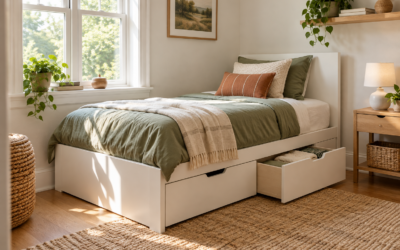
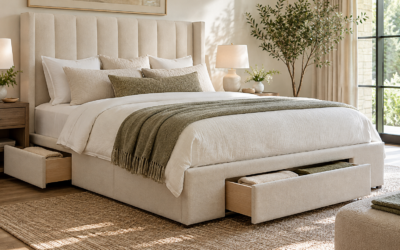
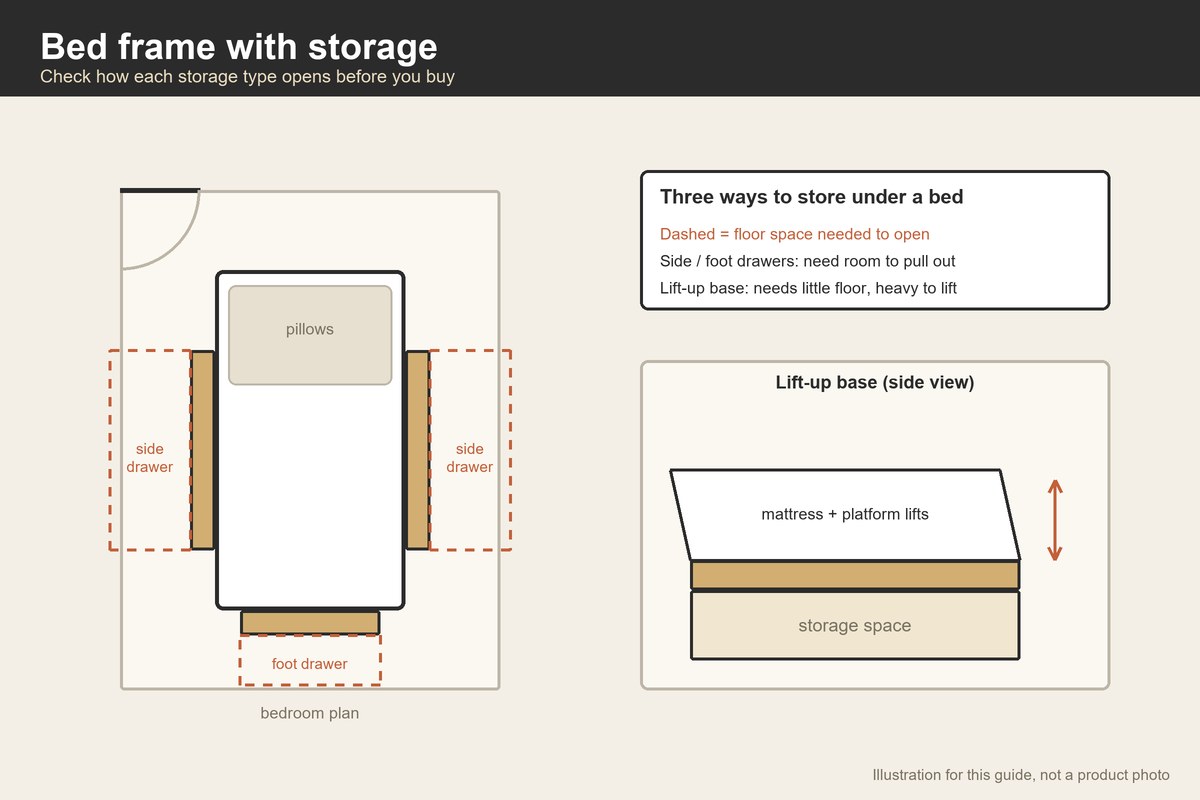
Side or foot drawers. Drawers on the side let you reach items without moving the mattress. The trade-off is floor space: a drawer that is 20 inches deep needs at least that much clear floor beside the bed, plus room to stand and bend. In a small room where the bed sits against a wall, drawers on the wall side are wasted, so look for frames with drawers only on the accessible side or at the foot.
Lift-up base. The mattress and platform lift together on hinges or struts, revealing one big compartment. This design needs very little floor space beside the bed, which suits a narrow room. The risks are lifting weight and access with a made bed. A queen mattress with bedding is heavy, and you have to strip or shift the bedding to open the storage. Check whether the listing describes a lift assist and whether the mechanism holds the base open on its own; if it does not say, assume you may be holding the weight yourself.
Raised frame with open under-bed space. This is the simplest format. You buy or already own bins that slide under. It has no moving parts to break and you choose the containers, but nothing is enclosed, so dust settles, and pets can get underneath. Verify the clearance height: a listing that states a few inches of clearance cannot hold standard under-bed bins.
Do the floor-space test before ordering
The most common return reason for a storage bed is that the drawers or base cannot open in the room. You can test this with painter’s tape in ten minutes.
- Tape the outline of the frame on the floor using the listed overall size.
- Tape a second rectangle beside each drawer or at the foot showing the drawer’s full pull-out length. If the listing does not give it, use the drawer depth as a working estimate and label it as an estimate.
- Stand in the taped area and pretend to open a drawer. There should be room for your feet and for bending down, not only for the drawer itself.
- Check that the pull-out zone does not block the door swing, a closet door, or the one path you use to cross the room.
For a walking route, the U.S. Access Board’s accessible-route guidance uses 36 inches as a minimum clear width, narrowing to 32 inches only at short obstructions. That standard is written for accessible design in public settings, not for your bedroom, but it is a useful reference for the width of a comfortable path. If an open drawer leaves less than about that much room, you may have to close it every time you walk past.
Weight, materials and assembly
Drawers carrying clothing add real load. Look for what the listing says about the support system: slats or a solid deck, the center support on queen and larger sizes, and whether a weight capacity is stated. If the listing gives no capacity, say so in your notes and treat it as unknown rather than assuming a number.
Materials matter for drawers. Metal or wood runners generally hold up better than thin plastic ones, but the listing may not describe them. Look at customer photos, and treat photos and reviews as hints, not proof.
Assembly is the other hidden cost. A storage bed has more parts than a simple frame, and it often needs two people. Check the delivery: some frames ship in several boxes, and you should confirm that each box will fit through your stairs and hallway.
Composite wood, common in furniture at this price level, is regulated for formaldehyde emissions in the United States under federal rules for composite wood products. A listing that states compliance is a good sign, but the absence of a statement is not proof of a problem. It is a reason to ask.
Storage beds and safety in a bedroom
A few safety habits are worth building in. Keep the path to the bedroom door clear so an open drawer does not trap a floor route at night. Do not store items that could pose a hazard, such as loose electrical strings or heat sources, in enclosed spaces. Follow local fire guidance on smoke alarms in and near sleeping areas, and check that the bed does not block access to a window if that window is an emergency exit.
A worked example
This example uses invented numbers for planning, not a measured room or product. Suppose a bedroom is 10 feet by 11 feet (120 by 132 inches). A queen mattress is about 60 by 80 inches, and the storage frame around it is 62 by 84 inches. Two people share the room, and the bed sits centered on the 120-inch wall.
That leaves (120 − 62) ÷ 2 = 29 inches on each side. A side drawer that pulls out 20 inches leaves only 9 inches of floor beside it, and a nightstand 16 inches deep would block it completely. At the foot, the room is 132 − 84 = 48 inches long. A foot drawer pulling out 20 inches leaves 28 inches to the door wall, below the 32- to 36-inch route reference, so it would block the path to the closet.
A lift-up base needs almost no floor space beside the bed, so the 29-inch side gaps stay usable. In this room it is the practical choice for seasonal storage, with a slim shelf handling weekly items. The lesson is general: pick the format that matches the room’s tightest measurement, not the one with the most drawers.
Mistakes to avoid
- Buying on the number of drawers. Four small drawers hold less than one large compartment.
- Ignoring pull-out space. Measure the room around the bed, not only the bed.
- Forgetting the mattress weight. If you cannot lift the mattress, a lift-up base will go unused.
- Assuming any mattress fits. Check the mattress size the frame is built for and the depth it accepts.
- Skipping the delivery check. A large box that cannot turn a corner in your stairwell becomes a return.
- Treating the storage as free. Extra weight in the bed makes it harder to move and to clean under.
Who should skip a storage bed
If the room has a large closet or a wardrobe with spare capacity, or if you move often, a simple frame and a set of stackable bins may be cheaper, lighter and easier to carry. A storage bed is a fixed piece of furniture. It makes the most sense when the bedroom is the only storage you have and you plan to stay for a while.
For related sleeping options that combine seating or guest space with storage, see our guides to a platform bed frame and a solid wood bed frame. If your bedroom also works as an office, how to fit a desk in a small bedroom covers a different way to free the floor.
Frequently asked questions
Are drawers or a lift-up base better for a small bedroom?
It depends on the room’s constraint. Drawers need floor space beside or at the foot of the bed. A lift-up base needs very little floor space but requires lifting the mattress and clearing the bedding. If floor space is the constraint, a lift-up base is often more practical.
How much can a storage bed hold?
The listing may state the drawer or compartment interior size. If it gives only overall dimensions, treat the capacity as unknown and compare against the size of the items you plan to store.
Do I need a special mattress for a storage bed?
You need the mattress size the frame is built for. Some lift-up designs also work better with lighter mattresses, so check the frame’s guidance on mattress weight and thickness.
Is a storage bed harder to assemble?
Usually, yes. There are more parts and heavier sections. Read the assembly notes and box dimensions in the listing before ordering.
Can I put a storage bed in a rental?
Yes, but confirm that it can be disassembled to move out, and that the boxes it ships in were not the only way it fits through your door.
Bottom line
Choose a bed frame with storage by starting from what you own. Tape the open drawers or lifted base, check the mattress and platform height, and pick the format that fits the room. If storage already exists, skip it.
Products worth checking
We have not tested these products. Sizes and features come from the Amazon listings, checked on September 30, 2026; where a listing does not say, we say so.
MapleGrace Queen Platform Bed Frame with 2 Storage Drawers and Hidden-Storage Headboard
The listing gives 87.79 x 61.81 x 43.5 in; 106 lb. We re-opened the page on September 30, 2026 and found these figures; other details are on the product page.
- Good for: a bedroom that needs both drawer storage and a headboard with a compartment and charging station.
- Keep in mind: the drawers need pull-out floor space, the listed size includes a tall headboard, and the text we read gives no drawer interior dimensions or weight capacity.
IDEALHOUSE Queen Bed Frame with 2 Storage Drawers, Wooden Floor Bed Frame
The listing gives 81.1 x 61.42 x 10.24 in; 82 lb. We re-opened the page on September 30, 2026 and found these figures; other details are on the product page.
- Good for: a low, headboard-free look with two drawers and a frame that sits flat on the floor.
- Keep in mind: the frame is low, so a thick mattress puts the sleeping surface near the floor, and the text we read gives no drawer interior size or weight capacity.
Amazon Basics Bed Frame with Storage, Foldable Metal Platform, 14-inch, Queen
The listing gives 80 x 60 x 14 in; 45.6 lb. We re-opened the page on September 30, 2026 and found these figures; other details are on the product page.
- Good for: a light, tool-free platform frame with open space underneath.
- Keep in mind: it is a bare metal frame with no headboard, and deck spacing is not something we could read from the text, so check it against your mattress maker.
Sources checked
- Mattress size chart
- Accessible routes guide
- Formaldehyde emission standards for composite wood products
- Smoke alarm guidance
- MapleGrace Queen Platform Bed Frame with 2 Storage Drawers and Hidden-Storage Headboard
- IDEALHOUSE Queen Bed Frame with 2 Storage Drawers, Wooden Floor Bed Frame
- Amazon Basics Bed Frame with Storage, Foldable Metal Platform, 14-inch, Queen
Specifications checked on September 30, 2026. Product details and availability can change, so confirm on the product page before you buy.