As an Amazon Associate I earn from qualifying purchases. Links marked “Affiliate link” may earn us a commission at no extra cost to you. Learn more.
Quick answer
The best daybed for a small space is one whose full frame, mattress, cushions and any storage or trundle features fit without shrinking the only useful walkway. Measure the outside frame—not just the mattress—then map doors, desk chairs, drawers and the route a person takes through the room. A daybed saves space only when the room genuinely benefits from a fixed sleep surface that can double as seating; it is not automatically smaller than a sofa or a conventional bed.
Small rooms expose every extra inch. A bulky side rail, deep cushion stack, protruding drawer pull or open trundle can turn a “compact” frame into the room’s main obstacle. The right choice begins with the room’s job and circulation, not the number of storage features in a listing.
Decide what space you are trying to save
There are several kinds of space, and a daybed does not save all of them in the same way.
| Scarce resource | Does a daybed help? | Better comparison |
|---|---|---|
| Open floor all day | Sometimes, but the frame remains visible | Murphy bed |
| Wall length | Depends on exact frame width | Smaller fixed bed or loveseat |
| Seating plus one sleeper | Often yes | Sleeper sofa or futon |
| Second occasional sleep surface | Only with compatible trundle | Trundle bed |
| Closed storage | Only if drawers work in the room | Separate storage cabinet |
Write one sentence defining the main goal: “This room needs a reading seat for most days and a single guest bed twice a month,” or “This studio needs a primary bed that does not look like a bedroom at noon.” The first case may suit a daybed; the second might benefit more from a wall bed. The best furniture is the one that solves the right constraint.
For the category overview, see our daybed guide. For a guest-first layout, use the guest-room daybed guide. For a bed that disappears to recover more floor, compare our small-space Murphy bed guide.
Measure the full furniture footprint
Start with the manufacturer’s exact outside width, depth and height. Then add what the listing photo may hide: cushion thickness, side rails, posts, drawer pulls, a trundle’s lower frame and the space needed to sit down or change bedding. Mark this on the floor with tape.
Next, mark the room door and closet-door arcs. Put a chair where it would normally live and pull it out. Walk from the entry to the window, desk and closet. This original small-room daybed check should be done with the room’s usual furniture present. A frame that fits in an empty room may become impractical once a desk chair, hamper or floor lamp returns.
Use a simple clearance rule of your own: if a route feels like a squeeze during the tape test, do not expect it to feel better after adding blankets, a guest bag and everyday clutter. This is a practical estimate, not a universal building standard. The purpose is to test the room’s lived experience before delivery.
Pick a frame that is visually calm
Small rooms can feel crowded even when every object technically fits. Frame style changes that effect. Open metal rails or legs can keep more of the floor and wall visible. A solid upholstered base may look more sofa-like but can feel visually heavier. Tall sides can create a cozy seating nook and make the frame look larger. Storage fronts, handles and shelves add lines and objects to an already busy room.
Choose visual simplicity after you have confirmed sleep and seating function. A plain frame with washable bedding and a few purposeful cushions often works better than a heavily styled daybed that requires many accessories. Keep the top surface easy to reset; if daytime styling requires eight cushions, plan where they live at night.
Do not choose a low, minimal frame solely because it appears smaller. Consider how the intended sleeper gets in and out, how sheets are changed, and whether the mattress support is compatible. Function should lead appearance.
Storage and trundles need their own space plans
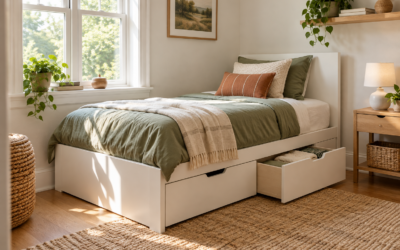
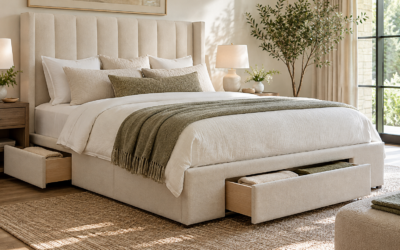
Under-bed drawers can be useful only when they open into a real clear area. Tape the drawer projection and test it with the bed made and nearby doors open. A storage daybed is not efficient if every drawer collides with a chair or must be emptied to reach its contents. See our daybed-with-storage guide for a storage-specific check.
A trundle creates a second bed, not storage. Sleep Foundation describes trundle beds as lower frames that roll or slide beneath a primary bed, commonly requiring a thinner lower mattress to fit. Mark its full open position and a route for the lower sleeper. In a very small room, a trundle may leave no usable floor once open; that can still be acceptable for rare sleepovers, but only if the household understands the trade-off.
Avoid using the trundle path as overflow storage. Bins, loose toys, cables and thick rug edges can stop it moving smoothly. A simple frame plus an adjacent storage cabinet may be more functional than a daybed trying to carry every role.
Plan sitting, sleeping and working separately
Daybeds often appear in multipurpose rooms. Test each use separately:
Sitting: Add your planned back cushions and see whether a person can sit with usable depth and feet supported. A deep mattress can feel different from a sofa.
Sleeping: Remove the cushions, make the bed and verify that the available side access is comfortable. Confirm the exact compatible mattress support before buying.
Working: If a desk shares the room, pull out the chair and check that it does not invade the daybed’s approach zone. Store office equipment away from bedding and guest paths.
If one of these uses needs a major daily reset, decide whether the room can sustain it. A daybed is valuable when it provides graceful dual use; it becomes a burden when it asks the room to become three incompatible rooms every day.
Lighting, exits and room safety
Keep a clear route to the door with the daybed made and occupied. Avoid putting a floor lamp or cable where a guest will step when leaving the bed at night. A compact wall-mounted light or a safely placed table lamp can be better when supported by the room’s layout, but do not modify electrical systems without appropriate help.
The U.S. Fire Administration recommends smoke alarms inside each bedroom, outside sleeping areas and on every level of a home. Furniture should not block a route to an exit, conceal switches, or interfere with safety devices. These are particularly important in studios and converted rooms where one small space does several jobs.
When not to choose a daybed
Skip a daybed if the room needs the floor completely free during the day, if the primary need is comfortable multi-person sofa seating, if a fixed mattress surface makes the circulation path too narrow, or if the intended daily sleeper cannot comfortably use the available frame access. A Murphy bed, conventional bed, small sofa or sleeper sofa may better match the real problem.
Choosing another option is not losing the space-saving contest. It means selecting furniture that lets the room function without a constant compromise.
Common small-space daybed mistakes
Measuring the mattress only. Rails, cushion depth, storage and trundle projection all change the real footprint.
Adding storage without checking drawer clearance. A drawer that cannot open is not usable storage.
Treating a trundle as hidden free space. It needs a full guest-night floor plan.
Copying a staged photo. Real doors, desks, rugs and bags make a different room.
Using too many cushions. A seating look should not turn bed setup into an evening chore.
Frequently asked questions
Is a daybed good for a studio apartment?
It can be if a fixed mattress surface suits the room’s daytime use and the frame leaves a real circulation path. If open floor is the priority, a wall bed may be a better comparison.
Is a daybed smaller than a sofa?
Not necessarily. Compare exact outside dimensions and the seating zone after cushions are added. A daybed is based on a mattress footprint, which can be deeper than a compact sofa.
Can I add a trundle in a tiny room?
Only if the room can support the complete lower-bed footprint, compatible lower mattress and a usable second-sleeper route when the trundle is open.
How can a daybed look less bulky?
Choose a frame whose outer dimensions and visual weight fit the room, use simple washable bedding, keep cushions purposeful, and avoid adding storage features that crowd the wall or aisle.
Bottom line
The best daybed for a small space is not the one with the most functions. It is the one that fits the wall, preserves a clear route, supports the intended sleeper and resets easily between sitting and sleeping. Measure every moving part before you buy, and choose a different furniture type when the daybed’s fixed footprint defeats the room’s purpose.
Products worth checking
We have not tested these products. Sizes and features come from the Amazon listings, checked on September 30, 2026; where a listing does not say, we say so.
Amazon Basics Twin Daybed and Trundle Bed Frame Set, Steel Slat Support
The listing describes a steel twin daybed with a rolling twin trundle, steel slats on both beds, two locking and two non-locking casters on the trundle, and tools included for assembly. It says the set takes two twin mattresses and gives a weight capacity of 250 pounds.
- Good for: a guest room where you want a plain steel frame and a trundle on casters.
- Keep in mind: the listing does not say the 250 lb limit is per bed, and you should check the trundle’s maximum mattress thickness before buying a mattress.
IDEALHOUSE Twin Daybed with Pop-Up Trundle, Charging Station and LED Light
The listing describes a metal twin daybed with a pop-up trundle, a storage headboard with a charging station and an RGB LED strip. It gives 77 inches long, 45.9 wide and 35.4 high, and 76.8 lb.
- Good for: a room where the second bed should rise to daybed height, with a headboard that holds a charger.
- Keep in mind: at 45.9 inches wide it is about 5.6 inches wider than the Amazon Basics frame (40.3 inches), and we did not find a weight limit in the text we read.
Amazon Basics Full Size Daybed and Twin Size Trundle Bed Frame Set, Steel Slat Support
The listing describes a steel full-size daybed with a rolling twin trundle underneath, steel slats on both beds and tools included for assembly. The measurements table gives 77.3 by 55.3 by 35.4 inches and 71.9 lb.
- Good for: a guest room where the daybed is full size and the second sleeper takes a twin trundle.
- Keep in mind: the trundle is a twin while the daybed is full, so the two beds differ in width; check the maximum mattress thickness before buying mattresses.
Sources checked
Specifications checked on September 30, 2026. Product details and availability can change, so confirm on the product page before you buy.