As an Amazon Associate I earn from qualifying purchases. Links marked “Affiliate link” may earn us a commission at no extra cost to you. Learn more.
An office chair with a footrest can be useful when you recline for short breaks, read at a desk, or use a computer in a room where there is no space for a separate ottoman. It is less useful if the real problem is that your feet do not reach the floor while you type. In that situation, a chair-height adjustment or a stable floor footrest is usually the better fix.
The key distinction is simple: a pull-out chair footrest supports a reclined position. A floor footrest supports your feet while you work upright. They solve different problems.
What a built-in chair footrest does well
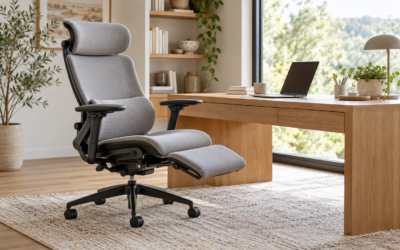
Most office-chair footrests slide or flip out from beneath the seat. They are designed for leaning back, not for keeping your feet supported at the keyboard. This can make a small bedroom office more comfortable because the extra support disappears under the chair when you do not need it.
Choose this style if you regularly take short, reclined breaks in the same chair and have enough floor space in front of it. Check the extension length. The footrest must clear the desk, a drawer unit, and any bed or wall opposite the chair. A room can fit the chair when it is closed but not when the footrest is extended.
When a separate floor footrest is the better answer
If your feet hang because the desk is high, pulling out a chair footrest will not help while you are working upright. You need firm support below your feet, with the chair close enough to the desk for your back to touch the backrest. A small adjustable footrest on the floor is often more useful because it stays in the correct place as you type.
Start by lowering the chair if that keeps your elbows and keyboard comfortable. If lowering it makes the desk too high, raise the chair back to a workable typing height and use a floor footrest. Our desk-height calculator explains the planning relationship between your body and a fixed desk, while our under-desk footrest guide covers what to measure in the leg space.
Check these five things before buying
Footrest position
Look at photos and dimensions that show the footrest fully extended. A short, low platform may only suit a slight recline. A longer extension needs much more clear floor space.
Recline and lock
A footrest is most useful when the backrest can recline and hold a comfortable position. If the chair only rocks freely, it may be hard to use a keyboard, read, or rest without constantly pushing against the back.
Seat height and depth
Do not let the footrest distract from chair fit. Check the actual seat-height range and seat depth. A chair that is too high or deep can cause more problems than a footrest fixes.
Desk and room clearance
Mark the footrest’s fully extended path with tape. Leave space for your lower legs and for standing up. Never assume it can slide under a desk unless the desk’s underside and crossbars leave room.
Footrest construction
The platform should feel stable, have no sharp edges near your legs, and retract without catching cables or loose clothing. Treat vague product descriptions as a reason to look for a listing with clearer dimensions and instructions.
Who should skip this type of chair?
Skip a built-in footrest if you work upright most of the day, have very limited floor depth, need a chair that tucks tightly under the desk, or are buying it only because your feet do not reach the floor. In those cases, a regular adjustable chair plus a compact floor footrest is usually easier to fit and use.
For another useful comparison, see our guide to office chairs with or without arms. The same rule applies: an extra feature is only worthwhile if it does not interfere with the way the chair meets the desk.
What OSHA says about feet and recline
OSHA says feet should be fully supported by the floor, or by a footrest if the desk height is not adjustable, and that a chair should let you recline at least 15 degrees from vertical (OSHA chair guidance). A pull-out chair footrest helps with the second, not the first, which is why it belongs to reclined breaks. Use our footrest guide to find the height of a floor footrest, and our guide to numb feet in an office chair to check that your seat is not too deep.
Products worth checking
These products match the topic above. We have not tested them. Sizes and features come from the Amazon listings, checked on September 30, 2026; where a listing does not say, we say so.
NZFYTRT Gaming Chair for Adults with Footrest, 330 lb
The listing describes a 52 cm wide seat with a four-layer pocket spring cushion, a high backrest with two removable pillows, linkage armrests that change angle with the backrest, a backrest that locks at 90, 115 or 135 degrees and a pull-out footrest. The table gives 27.87 by 27.87 by 53.87 inches, a seat depth of 20.47 inches and a weight of 42.9 lb.
- Good for: a wide seat, sitting cross-legged sometimes, and a built-in footrest.
- Keep in mind: it needs about 28 inches of depth even before you recline, and the footrest needs more floor when extended.
Wikabex Step-to-Adjust Foot Rest (2.7 to 13.1 Inches)
The listing describes a footrest you adjust by stepping on it, with any height from 2.7 to 13.1 inches, a carbon-steel frame at 9.5 lb for stability, and a contoured high-density foam cushion. It says it is ready to use with no tools.
- Good for: someone who needs a tall footrest or who shares a desk with people of different heights.
- Keep in mind: at 9.5 lb it is a heavy footrest, and it is described as patent pending, so check the return terms and read recent buyer feedback on how it holds height.
Mind Reader Under-Desk Footrest, Height Adjustable
A lightweight plastic footrest with a massage-textured surface that adjusts from 3.25 to 6.25 inches. The listing gives its size as 17 by 13 inches and its weight as 5.5 lb.
- Good for: a smaller height gap of up to about 6 inches and a light footrest that is easy to move.
- Keep in mind: the tallest position is 6.25 inches, so it may not suit a large gap, and the bullet points we read do not state a weight capacity.
Frequently asked questions
Is an office chair with a footrest good for working?
It can be comfortable for short reclined breaks. For upright keyboard work, your feet normally need support on the floor or on a separate floor footrest.
Will a chair footrest fit under a desk?
Not always. Measure its full extension and check the desk’s underside, crossbars, drawers, and the space opposite the chair.
Does a chair footrest fix feet that do not reach the floor?
Usually not while you are typing. A floor footrest is designed for that upright working position.
Do I need a reclining chair to use a built-in footrest?
It is much more useful with a backrest that reclines and can hold position. Otherwise the footrest may be an unused feature.
Last updated: September 29, 2026. General information, not medical advice.
Related guides
- Best Computer Desks for Small Spaces
- Best Office Chairs for Small Spaces
- Saddle Chair vs Kneeling Chair vs Office Chair: Which Is Right for You?
- Best Chair for a Standing Desk: Regular Chair, Drafting Chair or Stool?
- Criss-Cross Office Chair: Is It Good for Working at a Desk?
- How to Choose an L-Shaped Desk With Drawers for a Small Room
- Standing Desk With Storage or Drawers: Which Layout Works Better?