As an Amazon Associate I earn from qualifying purchases. Links marked “Affiliate link” may earn us a commission at no extra cost to you. Learn more.
Quick answer
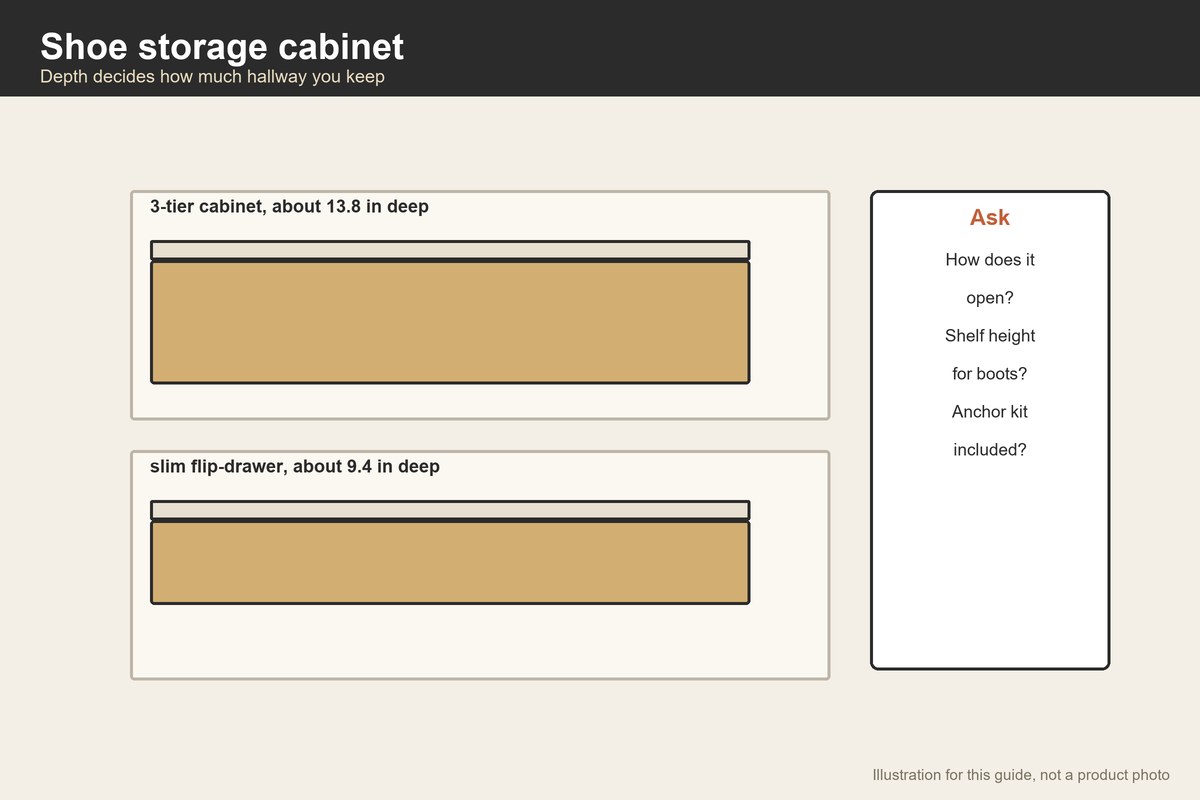
A shoe storage cabinet keeps shoes out of sight and off the floor, and in a small entryway the deciding numbers are its depth, its capacity in pairs and how it opens. A slim cabinet with flip-down drawers or tilt-out compartments can be only 9 to 10 inches deep, while a cabinet with fixed shelves and doors is usually 13 to 14 inches deep. That difference of about 4 inches can decide whether your front door still opens fully.
The listings we read on Amazon on 2026-09-30 give a 3-tier cabinet with adjustable shelves at 13.8 by 31.5 by 27.6 inches and about 35 pounds, and slim flip-drawer cabinets at about 9.4 to 9.5 inches deep, 31.5 inches wide and 38 to 38.6 inches high. One listing states 38.5 pounds for a flip-drawer cabinet. We have not tested any of them.
Do not trust a stated number of pairs without checking the shelf height. A cabinet with 4 tiers may hold four pairs across only if each pair is a sneaker or a flat.
Count your pairs and types
Before comparing cabinets, lay out the shoes you want to store. Group them by type: sneakers, flats, boots, heels. Count pairs, then measure the tallest pair. Most sneakers need about 5 to 6 inches of shelf height; boots need much more. A slim flip drawer has a shallow opening that fits sneakers and flats but may not fit boots.
The capacity figure in a listing is often an estimate for average shoes, and it varies with shoe size. A cabinet of 31.5 inches width with 4 tiers might hold 12 pairs at 3 pairs per tier if each pair takes about 10 inches of width. That is our estimate, not a listed figure. Adjustable shelves help if you own mixed heights.
Depth is the entryway number
Measure the space from the wall to your door swing and to the walking path. The U.S. Access Board’s accessible-route guidance uses 36 inches as a minimum clear width for a path. That is for public accessible design, not your entryway, but it is a helpful reference. In a hallway 42 inches wide, a 13.8 inch cabinet leaves 42 − 13.8 = 28.2 inches, below the reference, while a 9.4 inch slim cabinet leaves 42 − 9.4 = 32.6 inches, which is closer to a comfortable path.
Depth also affects what fits. A cabinet 9.4 inches deep will not hold a size 12 shoe lying flat, so most slim cabinets store shoes at a tilt. Check the listing description of how shoes sit.
How it opens: doors, flip drawers, tilt-outs
Hinged doors open outward and need swing space. In a narrow hall, check that a door swing does not block the route.
Flip-down drawers tilt open toward you and need clearance at the front equal to their tilt. They are compact and hide shoes, but they can only hold shoes at an angle.
Barn-style sliding doors need no swing space but leave half the opening blocked at a time.
Open shelves need no opening clearance, but show everything.
Tape the cabinet outline and its opening on the floor, and check that you can still open the front door, hang a coat and pass.
Ventilation and odor
Shoes can smell, especially if damp. A closed cabinet traps moisture. Look for ventilation holes, slatted shelves or a mesh panel. Let wet shoes dry before storing them. A cabinet on legs, with a gap at the bottom, lets air circulate and makes cleaning easier. This is general practical advice, not a claim from the listings.
Weight, stability and mounting
Tall narrow cabinets can tip when doors or drawers are open. The Consumer Product Safety Commission’s Anchor It campaign explains why anchoring furniture matters where children live. Many shoe cabinets ship with a wall anchor. Use it, especially for a 38 inch tall slim cabinet with flip drawers.
Check the shelf weight limit. The listings we read do not always state one, and a pair of boots is heavier than a pair of sandals. If a listing gives none, treat it as unknown.
Materials and emissions
Most shoe cabinets use engineered wood with a metal frame. Federal rules limit formaldehyde emissions from composite wood products sold in the United States, and a listing may state compliance. If it does not, ask, since shoes and a closed cabinet can trap odors. Metal cabinets avoid the issue but can dent.
Assembly and delivery
Shoe cabinets ship flat and take one to two hours. A 35 to 40 pound box is a two-person lift on stairs. Read the listing’s assembled dimensions and the box size. Assemble near where it will live.
A worked example
These are invented numbers for planning. An entry hallway is 42 inches wide and 8 feet (96 inches) long, with the front door on the short wall. You own 14 pairs: 9 sneakers or flats, 3 boots and 2 dress shoes.
Slim flip-drawer cabinet: 9.4 inches deep, 31.5 inches wide, 38 inches high with 2 drawers each holding 2 to 3 pairs per row over 2 rows. Estimated capacity is 8 to 12 pairs, our estimate. It leaves 42 − 9.4 = 32.6 inches for the path. It stores sneakers and flats but probably not the boots.
Three-tier cabinet with adjustable shelves: 13.8 inches deep, 31.5 inches wide, 27.6 inches high. Estimated capacity is 9 to 12 pairs at 3 to 4 per shelf. It leaves 42 − 13.8 = 28.2 inches. It holds the boots if you remove a shelf.
So the slim cabinet gives 4.4 inches more path but cannot hold boots. If you store boots elsewhere, the slim cabinet wins. If you want everything in one place, you need the deeper cabinet or a second storage spot such as a closet.
Questions to ask before you order
Ask the seller how the shelves attach and whether they are adjustable in steps or fixed. Ask for the internal height of each compartment, since a flip drawer’s opening may be lower than its outer height. Ask whether the cabinet includes a wall anchor and whether it has vents or mesh. Ask whether a listing that shows several sizes uses one set of photos for all of them, since sizes and photos sometimes do not match.
Setting up and organizing
Assemble the cabinet near the entry and place it against a stud if you will anchor it. Put shoes in by type: everyday shoes at the front and seasonal shoes at the back or on the top shelf. Keep a small mat or tray beside the cabinet for wet or muddy shoes, so that moisture does not enter the cabinet. Re-check the door and drawer alignment after the first week, since screws settle. If the cabinet has a top surface, use it for a tray or a lamp, and keep weight low.
Keeping the entry tidy
A cabinet only helps if it is used. Give each person a shelf or a drawer. Keep the number of pairs you own to what fits. Once a season, remove shoes you no longer wear. A shoe cabinet with a bench-height top can double as a seat for putting shoes on, but only if the listing says the top holds weight.
Mistakes to avoid
- Trusting the pair count. Check shelf height and your shoe types.
- Ignoring depth. A few inches change the path.
- Skipping the door swing. Tape it.
- No ventilation. Closed cabinets trap moisture.
- Not anchoring. Tall slim cabinets can tip.
- Buying for looks. Match the opening to your space.
When to skip a cabinet
If your entryway has a closet, a shoe rack inside it may cost less and use no floor. If you own a few pairs, a bench with a shelf or a tray may be enough. For a hallway console with storage, see best narrow console tables for small entryways.
Related guides
See best wood console tables for an entry surface, buffet cabinet for wider storage and best storage cabinets for home office for closed storage ideas.
Frequently asked questions
How many pairs does a shoe cabinet hold?
It depends on the shoes. Count your pairs and check shelf height; the listing’s number is an estimate.
How deep is a slim shoe cabinet?
The flip-drawer cabinets we read are about 9.4 to 9.5 inches deep. Fixed-shelf cabinets are about 13.8 inches.
Can boots fit in a slim cabinet?
Usually not. Check the opening height and use an adjustable-shelf cabinet for boots.
Do I need to anchor it?
Yes, for tall slim cabinets. Use the wall anchor in the box.
Do shoe cabinets smell?
Closed cabinets can trap odors. Choose ventilation and dry shoes first.
Bottom line
Choose a shoe storage cabinet by counting pairs, measuring depth against the door and path, and picking an opening style that fits. Tape the outline, anchor tall cabinets and store boots elsewhere if the cabinet is slim.
Products worth checking
We have not tested these products. Sizes and features come from the Amazon listings, checked on September 30, 2026; where a listing does not say, we say so.
VASAGLE Shoe Storage Cabinet, 3-Tier with Height-Adjustable Shelves
The listing gives 13.8 x 31.5 x 27.6 in; 35 lb. We re-opened the page on September 30, 2026 and found these figures; other details are on the product page.
- Good for: a shoe cabinet with shelves you can space for boots.
- Keep in mind: at 13.8 in deep it takes more hallway than the slim flip-drawer types.
QIVOMIX Shoe Cabinet Storage, Freestanding with 2 Flip Drawers
The listing gives 9.4 x 31.5 x 38 in. We re-opened the page on September 30, 2026 and found these figures; other details are on the product page.
- Good for: a slim cabinet for a narrow entry.
- Keep in mind: flip drawers hold shoes at a tilt and may not fit boots; we did not read a weight.
Homleke Farmhouse Shoe Storage Cabinet with Flip Drawers and Barn Door Design
The listing gives 9.5 x 31.5 x 38.6 in; 38.5 lb. We re-opened the page on September 30, 2026 and found these figures; other details are on the product page.
- Good for: a slim cabinet with a barn-door look.
- Keep in mind: the page lists several variants with other sizes, so pick the one that matches your numbers.
Sources checked
- Accessible routes guide
- Anchor It
- Formaldehyde emission standards for composite wood products
- VASAGLE Shoe Storage Cabinet, 3-Tier with Height-Adjustable Shelves
- QIVOMIX Shoe Cabinet Storage, Freestanding with 2 Flip Drawers
- Homleke Farmhouse Shoe Storage Cabinet with Flip Drawers and Barn Door Design
Specifications checked on September 30, 2026. Product details and availability can change, so confirm on the product page before you buy.