As an Amazon Associate I earn from qualifying purchases. Links marked “Affiliate link” may earn us a commission at no extra cost to you. Learn more.
Quick answer
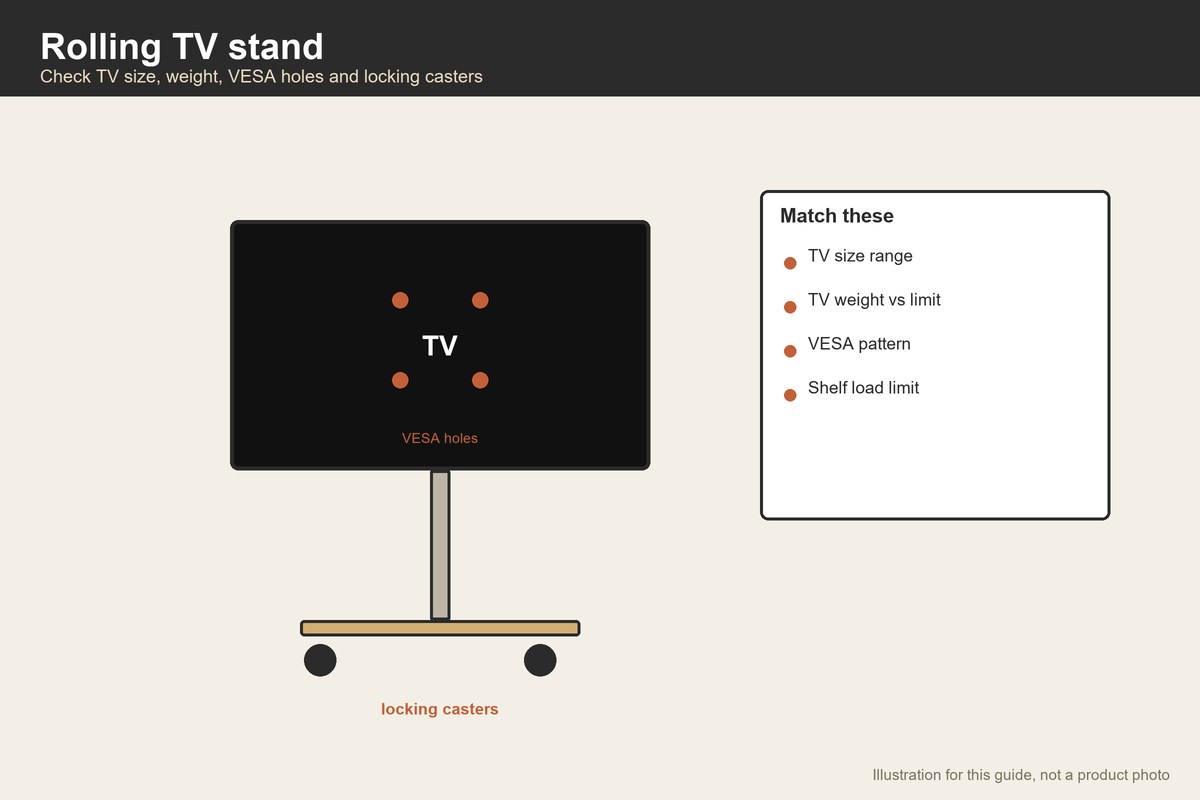
A rolling TV stand is a cart with a pole, a mount and wheels that lets you move a TV between rooms or park it in a corner. It works when the TV’s size, weight and mounting pattern fit the cart, the casters lock and the base is stable. The checks are the supported TV size range, the maximum weight, the VESA mounting pattern, the height range and whether the wheels lock.
The listings we read on Amazon on 2026-09-30 give carts for TVs from about 14 or 23 inches up to about 55 or 65 inches, with stated TV weight limits of 88 pounds for the ones we read, and cart weights of about 13.8 to 14.3 pounds. Some list a maximum VESA of 400 by 400 mm. We have not tested any of them, and these figures come from the listings and titles. Listings can show several variants, so pick the one that matches your TV.
A rolling stand is a good fit for a movable TV. It is a poor fit if you need a lot of shelves or a long media console.
Check the TV first
You need three numbers from your TV.
Diagonal size. Compare it with the cart’s stated range, for example 23 to 65 inches.
Weight. Check the TV’s weight in the manual or on the maker’s site, and compare it with the cart’s limit. The carts we read state 88 pounds. Add a soundbar or a console only if the shelf can hold it.
VESA pattern. The mounting holes on the back of a TV follow a pattern measured in millimeters, such as 200 by 200 or 400 by 400. The cart’s mount must support your pattern. A listing that says max VESA 400 by 400 mm means the mount handles patterns up to that size. Measure the holes on your TV, since some TVs need spacers or have curved backs.
If any number does not match, do not force it. Contact the seller or choose another model.
Stability, base and casters
A tall pole with a heavy TV is top heavy. Look for a wide base, a low center of gravity and locking casters. Most carts have four casters, some with locks on two or four. The listings we read mention lockable casters, but the number of locking wheels may not be stated. If a listing does not say, treat it as unknown.
Roll the cart slowly and avoid thresholds and cords. Lock the wheels when the cart is parked. Do not roll a cart with a TV on a slope or across a thick rug. Two adults help if you need to go over a step.
Height and viewing
Rolling carts often have adjustable TV height. A height that puts the screen center at about eye level when you are seated is comfortable, though the ideal depends on your seat. Measure the seated eye height from the floor and compare it with the cart’s range, which the listing may not state; if not, treat it as unknown.
Viewing distance depends on the screen size. Many people sit about 1.5 to 2.5 times the diagonal away, a rule of thumb rather than a standard. For a 55 inch TV, that is about 82 to 138 inches, or roughly 7 to 11.5 feet. A bedroom may be shorter, which limits the TV size.
Shelves and storage
Most rolling carts include a small shelf for a cable box or console. The shelf weight limit is often lower than the TV limit and may not be stated. A soundbar may not fit if the pole is in the way. Keep heavy items low.
Tip-over and safety
TVs and carts can tip. The Consumer Product Safety Commission’s Anchor It campaign explains why TVs and furniture need to be secured, especially where children live. A rolling cart cannot be anchored to a wall in the usual way, so keep it in a low-traffic spot, lock the wheels and do not let children climb. Route cords along the pole, and keep them out of reach.
Check that the TV is attached with all screws, and that the mount holds the TV level.
Cords and outlets
A rolling TV needs a cord long enough to reach the outlet in each place you park it. Do not stretch cords across the room. A power strip mounted on the pole can help, but follow the instructions. If you will move the cart often, coil the cords and secure them with ties.
Assembly and delivery
Rolling carts ship flat and weigh about 14 pounds, so one person can assemble one in about 20 to 40 minutes. Mounting a TV needs two people. Check the box for all the hardware, and tighten bolts after the first week.
Where a rolling cart makes sense
A bedroom or office. Move the TV out of the way when you do not use it.
A workshop or a garage. Roll it where you need it.
A room without wall mounting. Rentals often prohibit drilling.
A room that changes function. A studio or a guest room can use the same TV in two positions.
For a fixed setup with storage and a heater, see fireplace tv stand. For a console with drawers, see buffet cabinet.
A worked example
These are invented numbers for planning. You own a 55 inch TV that weighs 40 pounds, with a VESA pattern of 300 by 300 mm, and you want a cart for a 10 foot by 11 foot bedroom (120 by 132 inches).
Check 1: size range. A cart for 23 to 65 inches supports 55 inches. Check 2: weight. 40 pounds is below 88 pounds, so it passes with a margin of 88 − 40 = 48 pounds. Check 3: VESA. 300 by 300 mm is below 400 by 400 mm, so it passes.
Viewing distance: the bed is 132 − 30 = about 102 inches from the wall where the TV sits, assuming the cart is 30 inches into the room; 102 inches is 8.5 feet, within the 7 to 11.5 foot range for a 55 inch TV.
Base: the cart’s base is about 20 inches deep, so it takes 20 × 24 = 480 square inches. In a 36 inch path, a cart in the way leaves 36 − 20 = 16 inches, so park it against a wall.
Questions to ask before you order
Ask the seller for the pole height range, the mount’s tilt range and the shelf size and limit. Ask whether the mount includes different screw lengths and spacers. Ask how many casters lock and whether the base is steel or plastic. Ask whether the cart accepts a soundbar, and where it would sit. If your TV has a curved back or recessed mounting holes, ask about spacers.
Setting up and checking the cart
Assemble the base and the pole on a flat floor, and tighten all bolts. Attach the mount to the TV before you place the TV on the cart, since it is easier with two people. Level the mount and tighten the safety screws. Route cords along the pole and secure them with ties. Roll the cart slowly to check the wheels, then lock the wheels. Push gently at the top of the TV to check that the cart does not rock.
Everyday use
Park the cart in a low-traffic spot with the wheels locked. Keep children away from the pole and the cords. Check the bolts after the first week and every few months. If you move the cart often, check that the cords are not pulled tight and that the plug is not strained.
Mistakes to avoid
- Ignoring VESA. Measure the holes.
- Ignoring weight. Compare with the cart’s limit.
- Using the wrong variant. Check the listing’s size range.
- Rolling with wheels unlocked when parked. Lock them.
- Putting a heavy console on a light shelf. Check the limit.
- Leaving cords loose. Secure them.
When to skip a rolling cart
If you want a permanent setup with lots of storage, a console is better. If you can mount on a wall, a wall mount saves floor. If children are small, a low, wide console is more stable.
Related guides
See fireplace tv stand, buffet cabinet and best wood console tables.
Frequently asked questions
What is VESA?
A standard for the pattern of mounting holes on the back of a TV, measured in millimeters. Your TV manual lists it.
How heavy a TV can a rolling stand hold?
The carts we read state 88 pounds. Check your TV’s weight.
Do the wheels lock?
Many do, but check how many casters lock.
Can I use it outdoors?
Only if the listing says so, and keep the TV protected from weather.
Can I put a soundbar on it?
Only if the shelf or mount allows. Check the shelf limit.
Bottom line
Choose a rolling TV stand by matching your TV’s size, weight and VESA pattern to the cart and by checking the casters. Lock the wheels, keep cords tidy and choose a console instead if you need storage.
Products worth checking
We have not tested these products. Sizes and features come from the Amazon listings, checked on September 30, 2026; where a listing does not say, we say so.
PERLESMITH Rolling TV Stand, Mobile TV Stand for 23-60 Inch TVs
The listing gives 23-60 in TVs; 14.3 lb. We re-opened the page on September 30, 2026 and found these figures; other details are on the product page.
- Good for: a mobile cart with a tilt mount.
- Keep in mind: the page lists several variants with different limits, so pick yours carefully.
BONTEC Rolling TV Stand for 23-65 Inch TVs, Mobile TV Cart
The listing gives 23-65 in TVs; 14.28 lb. We re-opened the page on September 30, 2026 and found these figures; other details are on the product page.
- Good for: a cart for TVs up to 65 in with a media shelf.
- Keep in mind: the shelf limit is not in the text we read.
Hovadova Rolling TV Stand with Wheels, Mobile TV Cart for 14-55 Inch TVs
The listing gives 14-55 in TVs; 13.82 lb. We re-opened the page on September 30, 2026 and found these figures; other details are on the product page.
- Good for: a cart for small to mid-size TVs.
- Keep in mind: it tops out at 55 in.
Sources checked
- Anchor It
- PERLESMITH Rolling TV Stand, Mobile TV Stand for 23-60 Inch TVs
- BONTEC Rolling TV Stand for 23-65 Inch TVs, Mobile TV Cart
- Hovadova Rolling TV Stand with Wheels, Mobile TV Cart for 14-55 Inch TVs
Specifications checked on September 30, 2026. Product details and availability can change, so confirm on the product page before you buy.