As an Amazon Associate we earn from qualifying purchases. Details
Best posture for sitting at desk starts with feet flat, thighs supported, back upright or reclined slightly, and screen at eye level. This guide helps renters and small-space workers decide which type of posture aid fits their body, chair, and desk footprint. You will see what matters for posture at a desk, six compact options with exact dimensions and fit limits from the listings, a fit check with real measurements, and common mistakes to avoid. Measure your chair, desk clearance, and doorway before you order anything.
Quick answer
Best posture for sitting at desk means your feet rest fully on the floor, the backs of your knees stay clear of the seat edge, your back reclines at least 15 degrees from vertical when you lean back, and your monitor top sits at or slightly below eye level with the center 15 to 20 degrees below eye level at 20 to 40 inches viewing distance. For small spaces, choose by problem: seat-based supports if you slouch in a dining or task chair, wearable braces if you want an upper-body reminder at a desk or on chores, and a desktop study aid only for kids. If your feet do not reach the floor, add foot support for desk rather than raising your shoulders. Check each listing for size limits before buying.
What matters for best posture for sitting at desk
Posture at a desk is about fit between you, the chair, and the work surface. These five points change what you should buy.
1. Foot contact and seat height
Chair height is right when the entire sole of the foot rests on the floor with the back of the knee slightly higher than the seat. OSHA states no numeric seat-height range, so check the listing and measure yourself. If the listing does not state seat height, you cannot confirm fit from the listing. People with shorter legs often need a desk chair for short people or a footrest so the thighs do not press on the seat edge.
2. Back support and recline
A backrest should let you recline at least 15 degrees from vertical. The seat pan should support most of the thigh without the back of the knee touching the front edge and should be wide enough for the hips. Seat add-ons that push the lumbar area forward use your body weight for leverage. Wearable braces work differently. They give a tactile reminder around the shoulders or waist and knees. Neither type replaces adjusting chair height and desk clearance.
3. Screen position and reach
Place the top of the screen at or slightly below eye level. Aim for the center of the screen 15 to 20 degrees below horizontal eye level. Keep the preferred eye-to-screen distance at 20 to 40 inches. For small desks, that distance decides whether you need a monitor arm, a laptop riser, or a different table. Learn the setup basics in best correct desk posture and best ergonomic sitting.
4. Leg clearance under the desk
OSHA describes leg clearance under the work surface as at least 20 in wide, 17 in deep at knee level, 24 in deep at foot level, and 4 in high at the foot, with height adjustable 20 to 27 in near the user. A second method lists hip height 20 to 28 in and knee height 20 to 25 in. A bulky posture cushion or a wearable frame with straps must still leave that knee and foot space. Measure the width between desk legs and the depth to any modesty panel or wall.
5. Body fit limits and footprint
Every posture aid has fit limits. Some list height, weight, waist, or chest ranges. Others list one size only. Small-space buyers should also check product dimensions and item weight to judge storage and travel use. Measure your space and doorway. A 14.96 in wide seat insert fits a different chair than a brace worn on the body. If you use a stool or an active seat, read best posture stool and best active sitting desk chair.
Products that fit this
1. Portable Computer Chair Posture Corrector For Sitting At Desk – Home&Travel (Best overall)
Specs from the listing (checked 2026-10-09):
- Product Dimensions: 8.66″D x 1.97″W x 7.87″H
- Item Weight: 12.64 ounces
- Material: Polyester
Pros
- Listed dimensions 8.66″D x 1.97″W x 7.87″H and 12.64 ounces for travel
- Adjustable straps with secure buckle rest against waist and knees
- Listed for desk, floor, sofa, studying and gaming use
Cons
- Fit capped at up to 6'0″, 210 lbs and 40″ waist/hips so larger users must skip
- No chair padding, only a wearable awareness cue
Best for: adults within listed height and weight who share chairs or travel
Skip if: you are over 6'0″, over 210 lbs, or over 40″ waist/hips
View on Amazon (affiliate link)
2. At-Home Women's Posture Corrector for Desk Work and Daily Chores (Best for home desk and chores)
Specs from the listing (checked 2026-10-09):
- Size: One Size
- Item Dimensions: 11.02 x 5.91 x 1.57 inches
- Material: Foam
Pros
- Two fastening positions change anchor point and support feel
- Broad breathable shoulder straps plus flexible plastic back strip
- Foam panel at 11.02 x 5.91 x 1.57 inches worn over clothing
Cons
- Narrow fit window of 5'1″-5'7″ and 110-149 lb excludes many buyers
- Listing does not state item weight or chest range
Best for: women in the listed height and weight range doing desk work and chores
Skip if: you fall outside 5'1″-5'7″ or 110-149 lb
View on Amazon (affiliate link)
3. chislim Sitting Posture Corrector for Kids,Student Desktop Writing Board with Book Stand,Height (Best for kids study desks)
Specs from the listing (checked 2026-10-09):
- Product Dimensions: 14″D x 3″W x 18″H
- Item Weight: 2.2 pounds
- Maximum Height: 18 inches
Pros
- Tabletop board 14″D x 3″W x 18″H with 12 degree angle adjustment
- Foldable reading shelf for books and tablets plus 7:3 writing area
- PVC and plastic build at 2.2 pounds with assembly instructions included
Cons
- Tabletop kids aid only, not an adult back support
- Needs 14 inches of desk depth and listing states no weight limit
Best for: children needing angled writing and reading surface on study table
Skip if: you are an adult or lack 14 inches of desk depth
View on Amazon (affiliate link)
4. curble Wider – Ergonomic Desk Chair Seat Cushion, Everyday Passive Posture Trainer for Work from (Best seat insert)
Specs from the listing (checked 2026-10-09):
- Product Dimensions: 12.4″D x 14.96″W x 12.44″H
- Item Weight: 2 pounds
- Maximum Weight Recommendation: 600 pounds
Pros
- Seat insert 12.4″D x 14.96″W x 12.44″H with 12.4-inch seat depth
- Lists 600 pounds max weight recommendation and 802 lbs compressive load
- 2-pound Polyamide 6 resin frame with foam cushion and air holes
Cons
- Needs seat at least 14.96 inches wide, too wide for narrow chairs
- Listing suggests starting at 30 minutes a day, not all-day use at first
Best for: workers wanting lumbar contact on hard dining or task chairs
Skip if: your chair seat is narrower than 14.96 inches wide
View on Amazon (affiliate link)
5. Foldable Lumbar Support Seat Cushion for Office Chair, Ergonomic Posture Corrector with Hip (Best foldable support)
Specs from the listing (checked 2026-10-09):
- Item Dimensions L x W x H: 16″L x 13″W x 4″H
- Fill Material: sponge
- Shape: L-shape
Pros
- L-shape seat 16″L x 13″W x 4″H with built-in carrying handle
- Contoured support for lower back, hips and pelvis on many seat types
- Folds flat for office, vehicle, airplane or home use
Cons
- Listing does not state item weight or weight limit
- Needs 16 by 13 inches of seat space, too large for petite chairs
Best for: long sitters moving between office, car and home seats
Skip if: you need a stated weight capacity or exact folded size
View on Amazon (affiliate link)
6. Posture Corrector for Women and Men – Back Brace for Rounded Shoulders & Upper Back Support (Best wearable reminder)
Specs from the listing (checked 2026-10-09):
- Size: Medium
- Item Weight: 5 ounces
- Material: Polyester
Pros
- Medium brace fits chest 32″ to 45″ with fully adjustable straps
- 5-ounce Polyester build described as wearable under clothes
- Listed start schedule of 20-30 minutes to 1 hour daily
Cons
- Chest range only, no product dimensions or weight limit stated
- Upper-back reminder only, no seat cushioning
Best for: desk workers wanting a light shoulder reminder for computer work
Skip if: your chest is outside 32″ to 45″
View on Amazon (affiliate link)
PRAKTIO portable wearable seat – for shared chairs and travel
This is a wearable, strapped aid described as a posture corrector for sitting at a desk. The listing states Product Dimensions of 8.66″D x 1.97″W x 7.87″H and Item Weight of 12.64 ounces. It uses adjustable straps with a secure buckle and rests against the waist and knees to cue awareness. The material is listed as Polyester. The listing states it is designed as a non-medical comfort accessory, not a medical brace. It is listed as armless in style and as a single pack with one item. The fit guide matters here. The listing states designed for heights up to 6’0″ and weight capacity up to 210 lbs, with fit up to 40″ waist/hips. It also notes Men’s pant size 40 and Women’s size 18 as the upper edge. The listing suggests use at a desk, on the floor, on a sofa, for studying, reading, or gaming. Who should skip it: skip if you are over 6’0″, over 210 lbs, or over a 40″ waist/hips, or if you want padding on the chair itself. Check the listing for strap length and cleaning steps.
RNEMP at-home women’s corrector – for desk work and chores
This is a foam upper-back wearable listed as One Size in Black with Item Dimensions of 11.02 x 5.91 x 1.57 inches. It uses broad shoulder straps and one flexible plastic strip at the back to give a steadier cue. The listing describes two support feels by switching between under-bust and shoulder fastening to change the anchor point. It is worn over clothing like a backpack with a centered panel. The listing is specific about fit. It states the brace is for users 5’1″-5’7″ and 110-149 lb and tells buyers to check both measurements first. The use case spans desk work and daily chores at home. Who should skip it: skip if you fall outside 5’1″-5’7″ or 110-149 lb, or if you need lower-back or hip support rather than an upper-body reminder. The listing does not state chest size or strap pressure numbers, so check the listing for return rules if you are between sizes.
chislim kids study board – for children’s writing posture only
This is a tabletop study aid in Pink, not a chair or wearable brace. The listing states Product Dimensions of 14″D x 3″W x 18″H and Size of 3x14x18 inches, with Item Weight of 2.2 pounds. Base material is listed as Polyvinyl Chloride (PVC) with plastic top material and plastic frame material. It mounts as Tabletop and lists Maximum Height of 18 inches. It includes a writing board with a 12 degree angle adjustment and a foldable reading shelf for books or tablets, with assembly required and instructions included. The listing describes a 180-degree viewing range and a large 7:3 writing area ratio. These are listing claims, not independent standards. Who should skip it: adults should skip it, and anyone without 14 inches of desk depth for the base should skip it. The listing does not state a child weight limit or exact desk-thickness compatibility, so check the listing and measure your study table first.
curble Wider seat insert – for turning a hard chair ergonomic
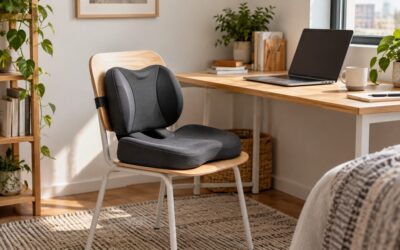
This is an L-shape seat insert that sits on a regular chair to push the lumbar region forward with body-weight leverage. The listing states Product Dimensions of 12.4″D x 14.96″W x 12.44″H and Item Weight of 2 pounds, with Seat Depth of 12.4 inches and Chair Backrest Width of 15 inches. Materials are listed as Polyamide 6 resin frame with plastic seat material and foam fill, plus a basic foam cushion style. The color is Grey and the style is Modern with armless and sled-base labels in the listing. The listing states Maximum Weight Recommendation of 600 pounds and separately describes a maximum compressive load of 802 lbs (364 kg), with a warning to avoid forcefully bouncing or pushing backward. It suggests starting with 30 minutes a day initially. The listing notes air-hole ventilation and high-density foam cushioning. Who should skip it: skip if your chair seat is narrower than 14.96 inches wide or shallower than 12.4 inches deep, or if you want a wearable reminder rather than a seat insert. Check the listing for cleaning guidance.
Foldable lumbar and hip seat – for long sitting on many seats
This is a foldable L-shape support seat in Dark Gray Upgrade with Item Dimensions L x W x H of 16″L x 13″W x 4″H. Fill material is listed as sponge and shape as L-shape. It folds flat and includes a built-in carrying handle for moves between office chair, vehicle, airplane seat, stadium seat, or home workspace. The listing describes contoured support for lower back, hips, and pelvis to encourage spinal alignment and reduce slouching, with multi-zone weight distribution to reduce pressure on lower back, tailbone, and hips. It lists use on office chairs, car seats, dining chairs, and wheelchairs. The listing does not state item weight, weight limit, foam density, or folded thickness beyond the 4 in height figure. Who should skip it: skip if you need stated weight capacity or exact folded size for a small bag, or if your chair cannot spare 16 inches of length and 13 inches of width. Check the listing for frame material and cover care.
GROKIE upper-back brace – for computer work reminder
This is a wearable upper-back brace in Black, Size Medium, with Item Weight of 5 ounces and Material of Polyester. The listing states it fits chest sizes from 32″ to 45″ and uses fully adjustable straps for clavicle, shoulder, and upper-back positioning. It is described as wearable under clothes for desk work, exercise, or home use. The wear schedule in the listing says to start with 20-30 minutes to 1 hour daily for the first two weeks, then increase gradually. The listing describes soft breathable materials and a lightweight build. It does not list product dimensions beyond Medium, nor does it list a weight limit. Who should skip it: skip if your chest measures outside 32″ to 45″, or if you need seat padding or lower-back structure rather than a shoulder reminder. Also skip if you want a one-size product without measuring your chest. Check the listing for washing and strap-adjustment details. If neck strain is your main issue, also read best ergonomics for neck pain.
How to choose for your desk and body
Start with the chair you own. If the seat pan presses behind your knees, the chair is too high or too deep for you. Lower it if you can, or add best desk foot rest so your soles rest fully. Then check width. A 14.96 in wide insert needs a seat at least that wide. A 13 in wide folding seat needs 13 in of clear seat width plus room for the 16 in length. Measure the inside width between armrests or side frames.
Pick the aid type by habit. Choose a seat insert or folding lumbar seat if you slide forward or round your lower back on hard dining chairs. The curble-type insert uses leverage from body weight. The folding seat adds padding under hips and behind the lower back. Choose a wearable brace if you round your shoulders at a laptop or drift forward during chores. Wearables do not add cushioning. They remind you to reset position. For seat comfort questions, compare best seat for posture and most comfortable desk chair.
Check body fit before footprint. The PRAKTIO listing caps at 6’0″, 210 lbs, and 40″ waist/hips. The RNEMP listing narrows to 5’1″-5’7″ and 110-149 lb. The GROKIE listing spans chest 32″ to 45″. If you fall outside those numbers, that pick does not fit you even if the desk space works. For kids, the chislim board is a desktop aid, not a wearable. It needs 14 inches of desk depth and up to 18 inches of height clearance under shelves.
Confirm desk clearance and storage. Keep at least 20 in wide knee space, 17 in deep at knee level, and 24 in deep at foot level where possible. A wearable that packs flat helps in dorms and shared rooms. The PRAKTIO aid at 12.64 ounces and the GROKIE brace at 5 ounces store in a drawer. The folding seat folds flat with a handle. The curble insert at 2 pounds moves between home, office, and car. The kids board needs tabletop space and assembly. If floor sitting is your setup, see low table for sitting on the floor.
Know when seating is not the fix. If your screen is low, you will crane your neck no matter which brace you wear. Raise the screen so the top is at or slightly below eye level and keep 20 to 40 inches of viewing distance. If your desk is too high and your shoulders shrug, a footrest alone will not fix it. You may need a lower table, a foldable work desk for home, or an adjustable chair. The listing states specs. It does not state medical outcomes. Follow the maker’s manual and ask a professional about pain.
Fit check: will a seat insert and screen fit a 48 inch desk
These sample numbers test fit before buying. They are not a rule for your room.
Use this setup: a small bedroom desk that is 48 inches wide and 20 inches deep. Task chair seat measures 17 inches wide and 16 inches deep. Eye-to-screen distance today is 24 inches. The buyer considers the 14.96 in wide curble-type insert and wants to keep knee clearance 20 in wide.
Step 1: check seat width. Seat width is 17 inches. Insert width is 14.96 inches. Subtract: 17 – 14.96 = 2.04 inches of spare width. Result leaves 2.04 inches total side margin.
Step 2: check seat depth. Seat depth is 16 inches. Insert depth is 12.4 inches. Subtract: 16 – 12.4 = 3.6 inches of spare depth. Result leaves 3.6 inches for knee clearance behind the knees.
Step 3: check desk depth for screen distance. Desk depth is 20 inches. Current viewing distance is 24 inches, which already exceeds desk depth because the user sits back from the desk edge. Preferred range is 20 to 40 inches, so 24 inches is inside the preferred range. No change needed for distance.
Step 4: check knee width. Required yardstick width is 20 inches. Chair plus user knees need that open width under the desk. Desk is 48 inches wide with legs at the ends, so 48 – 0 = 48 inches of gross width. Even after allowing 2 inches for each leg, 48 – 2 – 2 = 44 inches of clear width, which is more than 20 inches.
Step 5: Check the sums. Width margin 2.04 inches is correct because 14.96 + 2.04 = 17. Depth margin 3.6 inches is correct because 12.4 + 3.6 = 16. Clear width 44 inches exceeds 20 inches. Viewing distance 24 inches sits inside 20 to 40 inches.
Result: the 14.96 by 12.4 in insert fits this 17 by 16 in seat on paper. Keep 3.6 inches clear behind the knees and keep screen center 15 to 20 degrees below eye level. If the insert pushes you forward and your eyes drop below 20 inches from the screen, move the monitor back or choose a thinner support.
5 mistakes that hurt posture at a desk
1. Buying a brace without checking body limits
Chest, waist, height, and weight limits decide fit. A Medium brace for 32″ to 45″ chests does not help if you do not measure first. A one-size foam brace for 5’1″-5’7″ and 110-149 lb does not stretch to every adult. Measure before ordering.
2. Adding bulk without keeping leg clearance
A thick cushion can steal knee depth. Keep 17 in of knee depth and 24 in of foot depth where possible. If your knees hit a panel, move the setup or pick a lower-profile aid. Do not stack two cushions.
3. Fixing the chair while the screen stays low
A laptop flat on a 29 in high desk forces neck flexion. Raise the screen so the top is at or slightly below eye level. Keep 20 to 40 inches of distance. A brace cannot correct a screen that sits 10 inches too low.
4. Wearing a new brace too long at first
Listings suggest short starts, such as 20-30 minutes to 1 hour daily or 30 minutes a day initially. Long first sessions can feel uncomfortable and distract from work. Follow the listing schedule and the maker’s manual. Stop and ask a professional if you feel numbness or sharp pain.
5. Choosing a kids desktop aid for adult back pain
The 14 by 3 by 18 in study board with a 12 degree adjustment is a tabletop writing aid for kids. It does not support an adult back or replace a chair with proper height and recline. Adults with long sitting hours should address seat height, back recline of at least 15 degrees, and screen placement first. See best chair for long hours at computer for chair criteria.
Comparison table
| Pick | Type | Listed size | Listed weight | Listed fit limit |
|---|---|---|---|---|
| PRAKTIO wearable seat | Wearable waist-knee cue | 8.66″D x 1.97″W x 7.87″H | 12.64 ounces | Up to 6’0″, up to 210 lbs, up to 40″ waist/hips |
| RNEMP women’s corrector | Foam upper-back wearable, One Size | 11.02 x 5.91 x 1.57 inches | Listing does not state weight | 5’1″-5’7″ and 110-149 lb |
| chislim kids board | Tabletop writing board, Pink | 14″D x 3″W x 18″H | 2.2 pounds | Listing does not state weight limit |
| curble Wider insert | Seat insert, Grey | 12.4″D x 14.96″W x 12.44″H | 2 pounds | Maximum Weight Recommendation 600 pounds; compressive load 802 lbs |
| Foldable lumbar seat | Folding L-shape seat, Dark Gray Upgrade | 16″L x 13″W x 4″H | Listing does not state weight | Listing does not state weight limit |
| GROKIE brace | Upper-back wearable, Medium Black | Medium only, no inch dimensions | 5 ounces | Chest 32″ to 45″ |
FAQ
What is the best posture for sitting at desk?
Keep both soles flat on the floor, knees slightly lower than hips in effect with backs of knees clear of the seat, back supported and able to recline at least 15 degrees from vertical, shoulders relaxed, and screen top at or slightly below eye level with 20 to 40 inches of viewing distance. Adjust the chair and screen first, then add a support if needed.
Do posture correctors work for desk jobs?
Wearable braces and seat inserts can remind you to sit upright or add lumbar contact, but listings describe them as comfort or awareness aids. They do not change desk height, screen height, or leg clearance. Check fit limits, start with short wear periods from the listing, and follow the maker’s manual.
How should I set my monitor height?
Set the top of the screen at or slightly below eye level. Keep eyes 20 to 40 inches from the screen. If you use a laptop on a small desk, you often need a riser plus an external keyboard to hold both neck and wrist position.
How much leg room do I need under a small desk?
Use 20 in wide, 17 in deep at knee level, 24 in deep at foot level, and 4 in high at the foot as a yardstick, with height adjustable 20 to 27 in near the user. These come from workplace guidance, not a home rule. Measure between legs and to any wall or panel before adding a thick cushion.
Which type fits a dorm or shared apartment best?
Low-bulk options store fastest. A 5-ounce brace or a 12.64-ounce folding wearable fits a drawer. A folding seat with a handle moves between rooms. A 14.96 in wide insert stays on one chair. A tabletop kids board needs dedicated desk depth and assembly. Measure your space and doorway.
When should I skip a posture brace?
Skip a brace if your measurements fall outside its listed range, if your main problem is screen height or desk height, or if you need cushioning rather than a shoulder reminder. Also skip wearables during tasks that need full shoulder motion unless the listing says otherwise. Ask a professional about ongoing pain.
How do I help a child sit better for homework?
Give the child a chair where feet rest flat, a table where forearms rest without shrugging, and light on the work. A tabletop board with angle adjustment can hold books at a set angle, but it does not fix a chair that is too high. The kids pick here lists 14″D x 3″W x 18″H and 2.2 pounds and needs assembly. Measure the study table first.
Bottom line
Choose by fit first. Choose the PRAKTIO-type wearable if you are within 6’0″, 210 lbs, and 40″ waist/hips and want a light travel cue. Choose the RNEMP-type foam brace only if you match 5’1″-5’7″ and 110-149 lb and want an upper-back reminder for desk work. Choose the curble-type insert if your seat holds 14.96 in width and 12.4 in depth and you want lumbar contact. Choose the folding seat if you move between chairs and can spare 16 by 13 in. Choose the GROKIE-type brace only if your chest is 32″ to 45″. Choose the kids board only for children with 14 in of desk depth. If your screen or desk height is wrong, fix that before buying any brace.
Sources
- OSHA Chairs: back recline 15 degrees, seat pan fit and foot contact
- OSHA Monitors: screen height, 15-20 degrees and 20-40 inches distance
- OSHA Work Space: leg clearance 20 in wide, 17/24 in deep and height range