As an Amazon Associate I earn from qualifying purchases. Links marked “Affiliate link” may earn us a commission at no extra cost to you. Learn more.
Before you buy a single piece of furniture for a small home office, run through this checklist. Most bad purchases come from skipping a measurement, so take ten minutes with a tape measure and answer each item honestly. Tick the boxes as you go to see how ready you are.
Small home office checklist
Space
Desk and chair
Screen and posture
Power, light and cables
Storage and routine
Based on common sizing rules and OSHA guidance on screen distance, elbow angle and leg clearance.
How to read the result
- Under 70 percent: keep measuring. The most expensive mistake is a desk or chair that does not fit.
- 70 to 99 percent: finish the unchecked items. The missing one is often the one that goes wrong.
- 100 percent: you have the information to choose. Compare a few products against your measurements, not against photos.
What to do next
- Choose the desk size with our size guide.
- Choose the height with our desk height calculator.
- Check the chair against the desk with our chair fit checker.
- See layout options in our bedroom layout guide.
- Compare compact options in our desk guide and chair guide.
Not sure about your posture setup? OSHA’s guidance on good working positions and monitor placement explains the positions and distances used in the checklist.
Why each part matters
- Space. A desk that fits on paper but blocks a door or a drawer fails in daily use. The tape outline finds this in a minute.
- Desk and chair. Most discomfort comes from a fixed-height desk and a chair that does not match. OSHA suggests generally 20 to 28 inches of leg clearance under the desktop, and feet supported on the floor or a footrest.
- Screen and posture. OSHA gives a preferred viewing distance of 20 to 40 inches, the top of the screen at or slightly below eye level, and elbows bent about 90 to 120 degrees.
- Power, light and cables. A cord across the floor is a trip hazard, and a screen facing a window causes glare. OSHA suggests placing the monitor perpendicular to a window.
- Storage and routine. A small space without storage fills up. A reset routine keeps it usable.
Measurements to write down
| Measure | Why | Your number |
|---|---|---|
| Free wall length | Sets the desk width | |
| Depth from the wall | Sets the desk depth and chair room | |
| Door swing and walkway | Keeps the path clear | |
| Window and radiator height | Checks what is under the desk | |
| Ceiling or shelf height | Checks the space above the desk | |
| Outlet position | Avoids extension cords |
Products worth checking
One product per item on the checklist: a chair, a monitor arm, a footrest and a cable tray. We have not tested them. Sizes and features come from the Amazon listings, checked on September 30, 2026; where a listing does not say, we say so.
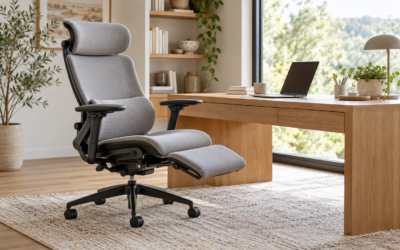
Marsail Ergonomic Office Chair: clearest lumbar range with flip-up arms
The listing gives a lumbar that moves 1.18 inches forward and back and 2.16 inches up and down, a 2D headrest, a 90 to 120 degree recline, 3D armrests that flip up, a 3.14 inch high-density foam seat and a 330 lb rating.
- Good for: someone who wants a stated lumbar range and arms that flip up under a desk.
- Keep in mind: the headrest moves in two ways only, and the user height range is not stated.
WALI Adjustable Single Monitor Arm (13 to 34 Inch, up to 26.4 lb)
A wide range: up to 34-inch screens and 26.4 lb for flat screens (19.8 lb for curved). The listing says the arm extends 19.3 inches, rises 17.3 inches above the desk and swivels, tilts and rotates. It lists a clamp or grommet mount for desks 0.39 to 2.76 inches thick.
- Good for: a larger or heavier screen, or a monitor you need to pull toward you.
- Keep in mind: it is more complex to position, and the reach of 19.3 inches means the arm needs clear space behind and to the side. The bullet points do not name the VESA patterns, so check them.
Mind Reader Under-Desk Footrest, Height Adjustable
A lightweight plastic footrest with a massage-textured surface that adjusts from 3.25 to 6.25 inches. The listing gives its size as 17 by 13 inches and its weight as 5.5 lb.
- Good for: a smaller height gap of up to about 6 inches and a light footrest that is easy to move.
- Keep in mind: the tallest position is 6.25 inches, so it may not suit a large gap, and the bullet points we read do not state a weight capacity.
Univivi No-Drill Under Desk Cable Management Tray, 36 in
The listing describes a 36-inch fabric tray that clamps to the desk without drilling or can be screwed on, and unfolds so cables are easy to add or remove. It says the clamp is heavy duty and the tray is made of 600D oxford fabric.
- Good for: hiding a power strip and cable slack under a desk you rent or cannot drill.
- Keep in mind: check the clamp fits your desk edge thickness, and the listing gives no weight limit in the text we read.
Frequently asked questions
What do I need for a small home office?
A desk that fits, a chair that fits you, a screen at the right height and distance, light and power. Everything else is optional.
How much space do I need for a home office?
A laptop workspace needs a desk of roughly 30 to 40 inches wide and enough depth to sit comfortably. A monitor needs more depth. See our size guide.
What should I buy first for a home office?
The chair, because it affects comfort most, followed by the desk. Check both against your measurements.
Do I need a separate keyboard and monitor?
If you work on a laptop for hours, a separate keyboard and a raised screen help you keep the right posture.
How do I set up a home office on a budget?
Use what you have, add a laptop stand and a separate keyboard, and fix the chair height with a footrest before you buy a new chair.
Last updated: September 29, 2026. General information, not medical advice.