As an Amazon Associate I earn from qualifying purchases. Links marked “Affiliate link” may earn us a commission at no extra cost to you. Learn more.
Quick answer
An oak dining table should say, in the listing, which parts are oak. A frame of oak under a different top is not the same purchase as a table with an oak top, apron and legs. Look for three things: the named species for the top, the top thickness, and the weight compared with the area of the top. Heavier per square inch generally means more solid material and less hollow core, though a hint is not proof.
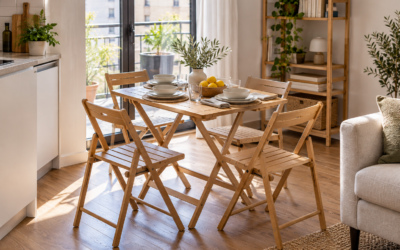
The three listings we read on Amazon on 2026-10-01 are a 31.5 inch square table with an oak wood frame at about 35 pounds, a 31.5 by 25 inch rectangular table whose frame, top and legs are all listed as oak at about 33.6 pounds, and a 35.4 inch square walnut-finish table with an oak frame at about 39.5 pounds. We have not tested any of them. All figures come from the listings.
Oak top, oak frame, or oak look
Listings use “oak” in three ways. It can name the species of the whole table. It can name only the frame while the top is something else. Or it can be a color, as in “oak finish”. In the three listings we read, the rectangular table lists oak for frame material, top material and leg material. The 31.5 inch square table lists an oak wood frame and does not name the top in the rows we read. The 35.4 inch table lists an oak wood frame and a walnut color, so the walnut look is a finish, not the species. If you want oak throughout, the rectangular listing is the one that says so.
Ask the seller for the species of the top (red oak, white oak or another), whether the top is one board, glued boards or veneer, and whether the core is solid.
Thickness and weight as clues
The square tables list a top thickness of 2.5 centimeters, which is 2.5 ÷ 2.54 = 0.98 inches. The rectangular table does not state a thickness in the rows we read. Weight divided by top area gives a second clue:
- 31.5 inch square: 31.5 × 31.5 = 992.3 square inches, so 35 ÷ 992.3 = 0.0353 pounds per square inch.
- Rectangular 31.5 by 25: 31.5 × 25 = 787.5 square inches, so 33.6 ÷ 787.5 = 0.0427 pounds per square inch.
- 35.4 inch square: 35.4 × 35.4 = 1,253.2 square inches, so 39.5 ÷ 1,253.2 = 0.0315 pounds per square inch.
The rectangular table is the heaviest per area, about 21 percent heavier than the first square table ((0.0427 − 0.0353) ÷ 0.0353 = 0.21) and 36 percent heavier than the largest ((0.0427 − 0.0315) ÷ 0.0315 = 0.36). That fits a table that is oak in the top, frame and legs, but it is a hint only. The weights include bases, and a smaller top with the same legs raises the ratio. Use it to decide what to ask, not what to believe.
Why species matters
Oak is a hardwood used for furniture, and the listing is what tells you the species. There are many oaks and the differences between them are not something we measured or a listing states, so we do not rank them. Wood moves with humidity, a general property of solid timber, so a table that is solid oak will expand and shrink across the grain through the seasons. Keep it away from radiators and direct sun, and leave the top free to move on its fixings.
Veneer and composite parts
If the core is a composite, the U.S. Environmental Protection Agency says that since March 22, 2019 composite wood products, including household goods that contain them, must be labeled TSCA Title VI compliant under its formaldehyde rule. A listing for an oak veneer table may mention it. If a listing says “oak” but weighs little for its size, ask whether the top is veneer over a board.
Size, seats and the 24 inch rule
A common planning rule is about 24 inches of edge per person. It is a rule of thumb. On the 31.5 by 25 inch rectangle, the 31.5 inch side holds 31.5 ÷ 24 = 1.3 people, so one per long side, and the 25 inch ends hold 25 ÷ 24 = 1.04, so one each, for four at a squeeze. Because the table is 25 inches deep, two people facing each other have little room for plates and a shared dish. On the 35.4 inch square, each side holds 35.4 ÷ 24 = 1.5 people, so four with elbow room.
A worked example
You have a dining nook 84 inches wide with one wall and an opening on the other side. We assume 20 inches of chair pull-out and use 36 inches as a walkway yardstick, taken from the U.S. Access Board’s minimum clear width for accessible routes in public buildings; it is not a home code.
Push the table against the wall and leave the walkway on the open side:
- 35.4 inch square: 84 − 35.4 − 20 = 28.6 inches, which fails.
- 31.5 inch square: 84 − 31.5 − 20 = 32.5 inches, which fails by 3.5 inches.
- 31.5 by 25 inch rectangle, turned so the 25 inch side faces out: 84 − 25 − 20 = 39 inches, which passes.
In this nook only the rectangle, turned the right way, keeps the path. If the nook were 90 inches wide, the 31.5 inch square would leave 90 − 31.5 − 20 = 38.5 inches and pass. The rectangle is a seat-count trade: you can seat two on the long side but fewer at the ends.
Heights
The tables are listed at about 29 to 29.5 inches high, a standard dining height. We did not find a published table-to-seat gap in the sources we opened, so check by sitting down at a friend’s table of similar height first. If you need to roll a wheelchair under, measure the apron and leg clearance, as the listings do not state it.
Finish and care
Oak finishes vary from an open-grain oil to a closed lacquer. An oiled surface can be refreshed by hand; a thick lacquer is harder to touch up. Oak has visible pores, and spills can stain an open-grain top if left. Wipe with a slightly damp cloth, dry, and use coasters and trivets. We have not tested these tables; this is general care advice, not a result from any listing.
Assembly and moving
Square 31.5 inch tables weigh about 35 pounds, light enough for one person to carry from the box to the room. Tighten the leg bolts after the first week because wood tables rack as screws settle. Felt pads under the feet protect floors.
Pairing with chairs
An oak table suits both dark and pale chairs. A set of identical oak chairs can look heavy; mixing a light fabric seat or a painted frame breaks it up. For finish contrast ideas see the dark wood dining table guide, and for what to check about solid timber see the solid wood dining room table guide.
Questions to ask the seller
Which parts are oak? What species? How thick is the top at its thinnest edge? Is the top solid, glued or veneer? How is the top fixed? What is the finish? What is the load the top supports? A seller who answers these in one line each is a good sign.
Mistakes to avoid
Reading “oak” as “all oak” is the first. Judging a table by its photo is the second. The third is ignoring the depth: a 25 inch deep table seats two comfortably and four only with small plates.
Who should skip oak
If you want a light table to move often, a lighter wood or engineered top is easier. If you cannot keep the room’s humidity steady, solid oak may show seasonal gaps. If you want the cheapest option, a veneer or laminate table will cost less, but you lose the ability to sand and refinish.
Frequently asked questions
Is an oak dining table solid oak?
Not always. In the listings we read one names oak for the top, frame and legs, and two name oak for the frame only. Ask for the top material.
How heavy is an oak dining table?
The three we read run about 33.6 to 39.5 pounds at 25 to 35 inches. Compare weight per square inch of top to judge solidity.
Does oak need special care?
Keep it away from heat and sun, wipe spills at once and use trivets. Solid wood moves with humidity, so avoid sharp swings.
Can I refinish an oak table?
Solid oak can be sanded and refinished. A thin veneer cannot be sanded deeply. Ask what the top is.
Bottom line
An oak dining table is only as oak as the listing says. Read which parts are oak, compare weight per area and check the room before you pay.
Products worth checking
We have not tested these products. Sizes and features come from the Amazon listings, checked on September 30, 2026; where a listing does not say, we say so.
31.5″ Solid Wood Dining Room Table, Rectangular Kitchen Real Wooden Table
The listing gives 31.5 x 25 x 29 in; 33.6 lb. We re-opened the page on September 30, 2026 and found these figures; other details are on the product page.
- Good for: comparing against the measurements in the guide above.
- Keep in mind: we have not tested it, and the listing may show more than one size or finish, so pick the variant that matches your numbers.
31.5″ Square Dining Table, Solid Wood Kitchen Table for 2-4 People, Natural
The listing gives 31.5 x 31.5 x 29.5 in; 35 lb. We re-opened the page on September 30, 2026 and found these figures; other details are on the product page.
- Good for: comparing against the measurements in the guide above.
- Keep in mind: we have not tested it, and the listing may show more than one size or finish, so pick the variant that matches your numbers.
35.4″ Square Dining Table, Solid Wood Kitchen Table for 2-4 People, Walnut
The listing gives 35.4 x 35.4 x 29.5 in; 39.5 lb. We re-opened the page on September 30, 2026 and found these figures; other details are on the product page.
- Good for: comparing against the measurements in the guide above.
- Keep in mind: we have not tested it, and the listing may show more than one size or finish, so pick the variant that matches your numbers.
Sources checked
- Formaldehyde Emission Standards for Composite Wood Products
- Chapter 4: Accessible Routes
- 31.5″ Solid Wood Dining Room Table, Rectangular Kitchen Real Wooden Table
- 31.5″ Square Dining Table, Solid Wood Kitchen Table for 2-4 People, Natural
- 35.4″ Square Dining Table, Solid Wood Kitchen Table for 2-4 People, Walnut
Specifications checked on September 30, 2026. Product details and availability can change, so confirm on the product page before you buy.