As an Amazon Associate I earn from qualifying purchases. Links marked “Affiliate link” may earn us a commission at no extra cost to you. Learn more.
Quick answer
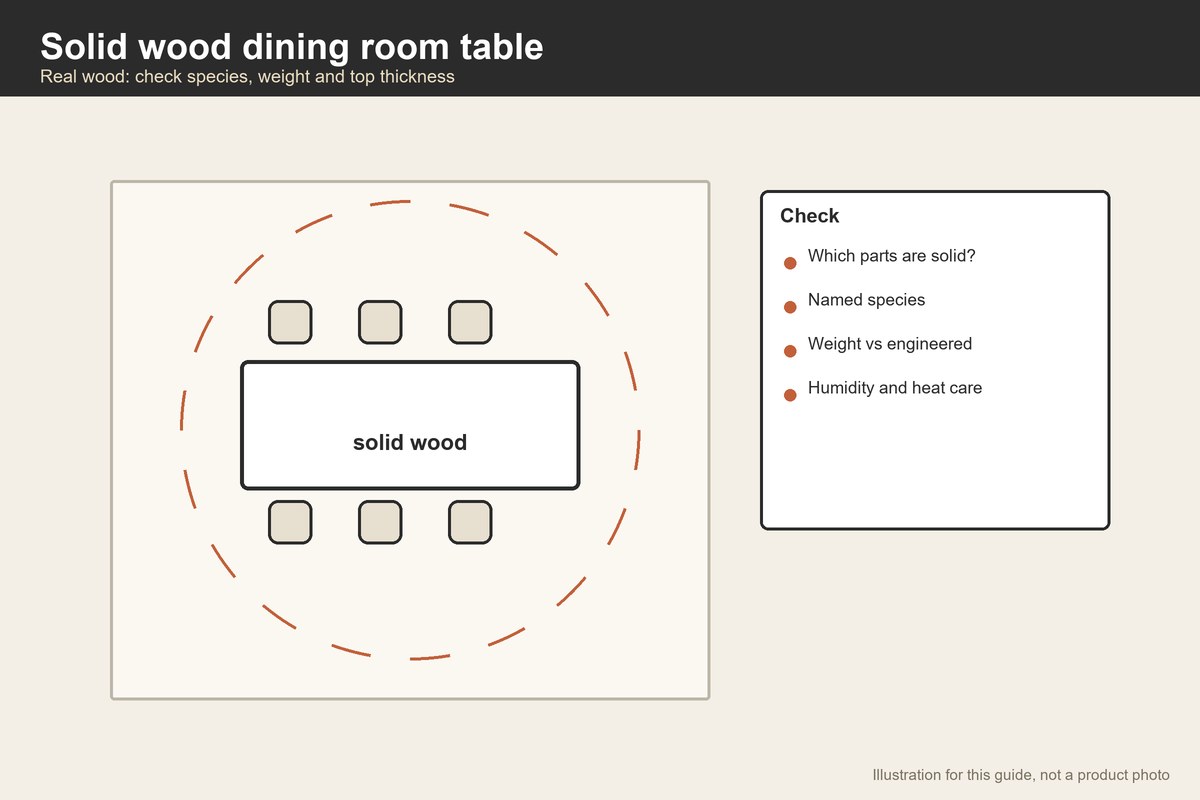
A solid wood dining room table has a top and base made of natural lumber, not particleboard with a thin wood skin. The word “solid” is used loosely in listings, so verify four things: which parts are solid, the species, the top thickness and the weight. Weight is a useful clue, because real wood is heavier than particleboard of the same size.
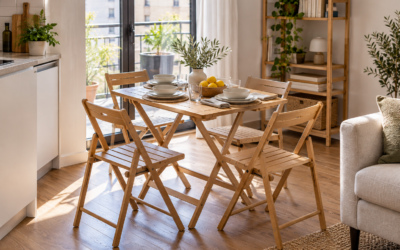
The listings we read on Amazon on 2026-09-30 and 2026-10-01 include a 31.5 by 31.5 inch square table with an oak-wood frame at about 35 pounds, a 31.5 inch rectangular table at about 34.9 pounds, and an expandable rubberwood table that is 31.5 inches deep and 47.2 inches long when open, at about 52 pounds. We have not tested any of them, and these sizes come from the listings.
Real wood can be sanded and refinished, but it reacts to humidity and heat. Decide whether you want that trade.
What “solid” can and cannot mean
Wood-based furniture falls on a spectrum. Solid lumber is boards cut from a tree. Plywood is glued layers. Particleboard and MDF are made of wood fibers or chips and resin, often covered by a veneer or a printed laminate. A listing that says “solid wood” may refer only to the legs, while the top is engineered. Read the parts list, the material row and the photos of the edges. The U.S. Forest Products Laboratory’s Wood Handbook is a standard technical reference on how wood behaves.
Look for a named species. One listing we opened names oak for the frame, and another names rubberwood, a hardwood used in furniture. A listing that gives only “wood” leaves you guessing.
Weight as a clue
Compare weight with size. The expandable rubberwood table is 31.5 by 47.2 inches open and weighs about 52 pounds, which is 52 ÷ (31.5 × 47.2) = 0.035 pounds per square inch of top. A particleboard table we read elsewhere, 29.5 by 63 inches at about 42.2 pounds, comes to 42.2 ÷ (29.5 × 63) = 0.023 pounds per square inch. The wood table is about 52 percent heavier per area ((0.035 − 0.023) ÷ 0.023). The numbers include the bases and the mechanisms, so treat the comparison as a hint, not proof.
Top thickness and construction
A thick top resists warping and looks substantial. The listings we read often give top thickness for tables; for example, other tables list tops of about 0.5 to 1.2 inches. Ask the seller for the thickness of this table’s top, and check whether it is a single slab, glued boards or a veneer. Glued boards are normal and stable; a veneer is a thin layer on a core and should be described as such.
Look at how the legs attach. Bolts through the apron and corner brackets are common; mortise and tenon joints are stronger but harder to see. Retighten hardware after the first weeks, since wood moves with the seasons.
Humidity, heat and movement
Wood swells and shrinks with humidity. A solid top can crack or cup in very dry rooms, and a finish that seals one side only can lead to cupping. Keep the table away from radiators and direct sun, use trivets for hot dishes and wipe spills at once. A felt pad under dishes protects the finish. If the room swings between very dry and very damp, expect small gaps between boards.
Finish and repair
An oiled finish can be refreshed with oil; a lacquer or varnish is harder to spot repair. Scratches on solid wood can be sanded; scratches on a veneer cannot be sanded deeply. If you have children, ask what finish is used and whether it is food-safe, since the listings we read rarely say.
Size and fit
Solid wood tables come in the same sizes as other tables. Seat count follows the usual estimate of about 24 inches of edge per person, a rule of thumb. The square 31.5 inch table seats two comfortably and four tightly. For room checks, leave about 36 inches from the table edge to walls, a planning figure; the U.S. Access Board uses 36 inches as a minimum clear width for a route. The Access Board’s accessible-design standard places dining surfaces between 28 and 34 inches high, and the tables we read are about 29 to 29.5 inches high.
Emissions and composite parts
Even a wood table can include composite parts, such as a plywood shelf or an MDF apron. Federal rules limit formaldehyde emissions from composite wood products sold in the United States, and a listing may state compliance. Ask if it does not.
Delivery and assembly
A solid wood top is heavy. The tables we read weigh about 35 to 52 pounds, which is manageable for two people. Larger tables can exceed 100 pounds. Check box sizes against stairs, assemble in the room and level the table on the floor.
A worked example
These are invented numbers for planning. You compare the square oak-frame table (31.5 × 31.5 inches, 35 pounds) with a particleboard square table of the same size at an assumed 25 pounds.
Top area: 31.5 × 31.5 = 992 square inches for both. Weight per area: 35 ÷ 992 = 0.035 pounds per square inch versus 25 ÷ 992 = 0.025. The wood table is 40 percent heavier ((35 − 25) ÷ 25).
Room fit: a 10 foot (120 inch) square room with the table centered leaves (120 − 31.5) ÷ 2 = 44.25 inches to each wall. With a chair pulled out 20 inches, 44.25 − 20 = 24.25 inches remain behind the chair, short of 36, so passing behind is tight. A rectangular table of 47.2 inches open leaves (120 − 47.2) ÷ 2 = 36.4 inches at the ends, which passes the 36 inch figure.
The weight difference matters when you move; the room fit decides whether you can use the table every day.
Questions to ask before you order
Ask the seller which parts are solid, the species, the top thickness and the finish. Ask how the top attaches to the base and whether it allows for wood movement. Ask about the weight capacity and whether the legs are adjustable. If the listing shows several finishes, confirm that the material is the same in each.
A quick decision path
If you want a table that can be refinished and plan to keep it for years, choose solid wood. If you move often or the room is humid, a lighter engineered table may suit better. If budget is tight, a solid wood frame with an engineered top is a middle path; ask for the top material.
Care and long-term wear
A solid wood table gets better with attention. Wipe it with a slightly damp cloth, dry it at once and use a wax or oil only as the maker advises. Rotate placemats so one area does not fade. In winter, keep the room from becoming extremely dry; a small humidifier can reduce cracking. If a scratch appears, fine sanding and refinishing is possible on solid wood, which is one of its main advantages over a veneer.
Real-life scenarios
A family with young children may value a forgiving finish and a thick top more than a perfect grain. A couple in a small apartment may prefer a lighter table that they can move. Someone who plans to keep the table for decades should look at joinery and repair options. Think about who uses the table most, and let that decide how much you invest in wood.
The day it arrives
Unpack in the room where it will live, check each part against the list and look for dents, chips or scratches before you sign for it. Take photos of any damage and keep the packaging until you are sure about the fit. Assemble on a blanket to protect the finish, and keep the instructions and spare hardware in a labeled bag.
Budget without prices
We leave prices out because Amazon changes them often. When you compare, think about the total cost: the item, delivery or help to carry it, floor protection, and anything you must buy to go with it. A cheaper piece that does not fit the room costs more than a slightly dearer one that does. Check the return policy before ordering, since bulky items can be hard to send back.
Mistakes to avoid
- Trusting the word solid. Check parts and photos.
- Ignoring weight. Heavy tables need help to move.
- Putting hot dishes on the finish. Use trivets.
- Placing it near a radiator. Heat dries and cracks wood.
- Skipping the retighten step. Wood moves.
When to skip it
If you want the lowest cost or a very light table, engineered wood is simpler. For a small kitchen table, see kitchenette table; for an extendable option, see dining table extendable.
Related guides
See solid wood bed frame, rectangle dining room table and average dining table height.
Frequently asked questions
How can I tell if a table is solid wood?
Read the parts list, look for a named species, check the weight and look at the edges and underside.
Is solid wood better than veneer?
It can be refinished more deeply and lasts longer if cared for, but it moves with humidity. A good veneer is stable and lighter.
How heavy is a solid wood table?
The small ones we read are about 35 to 52 pounds. Large ones can be much heavier.
Does solid wood need special care?
Use trivets, wipe spills and keep it away from heat and strong sun.
Can I refinish it?
Often yes. Ask what finish the maker uses.
Bottom line
A solid wood dining room table is worth paying for if the parts, species and weight check out and you accept its care. Verify the listing, measure the room and avoid heat and humidity swings.
Products worth checking
We have not tested these products. Sizes and features come from the Amazon listings, checked on September 30, 2026; where a listing does not say, we say so.
31.5 inch Solid Wood Dining Room Table, Rectangular Kitchen Real Wooden Table
The listing gives 31.5 x 25 x 29 in (D x W x H); 34.9 lb. We re-opened the page on September 30, 2026 and found these figures; other details are on the product page.
- Good for: a small solid-wood table for two.
- Keep in mind: the dimensions field looks mixed (31.5 in deep, 25 in wide), so confirm the footprint.
31.5 inch Square Dining Table, Solid Wood Kitchen Table for 2-4, Walnut
The listing gives 31.5 x 31.5 x 29.5 in; 35 lb. We re-opened the page on September 30, 2026 and found these figures; other details are on the product page.
- Good for: a square wood-frame table for a nook.
- Keep in mind: the listing names oak for the frame, so ask about the top.
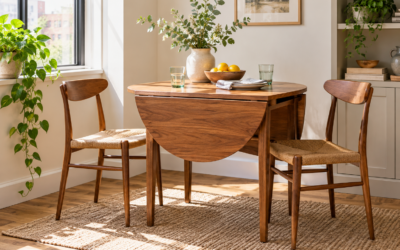
DONGMUWUJEE Solid Wood Small Dining Table, 23.6 inch to 47.2 inch Expandable
The listing gives 31.5 x 47.2 x 29.5 in open (D x W x H); 52 lb. We re-opened the page on September 30, 2026 and found these figures; other details are on the product page.
- Good for: an expandable solid-wood table for small rooms.
- Keep in mind: the page lists several extended sizes (up to 70.8 in) across variants.
Sources checked
- Wood Handbook: Wood as an Engineering Material
- Accessible routes guide
- ADA Standards
- Formaldehyde emission standards for composite wood products
- 31.5 inch Solid Wood Dining Room Table, Rectangular Kitchen Real Wooden Table
- 31.5 inch Square Dining Table, Solid Wood Kitchen Table for 2-4, Walnut
- DONGMUWUJEE Solid Wood Small Dining Table, 23.6 inch to 47.2 inch Expandable
Specifications checked on September 30, 2026. Product details and availability can change, so confirm on the product page before you buy.