As an Amazon Associate I earn from qualifying purchases. Links marked “Affiliate link” may earn us a commission at no extra cost to you. Learn more.
Quick answer
“Orthopedic” on a chair listing is a seller’s label. It is not a certification we could find on the pages we read, and it does not promise a medical result. What you can check is concrete: how far the lumbar support moves, how deep the seat is compared with your legs, whether the armrests and headrest adjust, and what weight the chair is rated for. A chair that fits you and lets you change position is the practical meaning of the word.
This article is general information about chair features, not medical advice. If you have pain that is sharp, constant or spreading, speak with a clinician before trying a new chair.
We read three Amazon listings on 2026-09-30: a high-back mesh chair with a lumbar range of 2 inches over 8 levels, a mesh chair with a U-shaped seat and adjustable lumbar cushion, and a backless kneeling chair. They are examples of what to compare, not a ranking. We have not tested or sat in any of them. All numbers come from the listings.
For more on matching a chair to a problem, see best office chair for lower back pain, back support for office chair and best ergonomic office chairs. For alternatives to a standard chair, see saddle chair vs kneeling chair vs office chair.
What “orthopedic” means on a listing
The word is used loosely by sellers. None of the three product titles we read uses it, even though all three came up when we searched for it. The pages describe ergonomic features, such as lumbar support and a flip-up armrest, and one describes a kneeling posture. Orthopedic is a medical field, but a chair called orthopedic is not automatically approved by doctors, and we did not see a medical certification on any of the pages.
So read the feature list, not the label. The federal workplace safety agency OSHA describes a good chair as one that supports the back, legs, buttocks and arms, reduces awkward postures and contact stress, and is adjustable so that it fits the user and allows different sitting positions through the day. Those are the features to look for.
Lumbar support that you can place
OSHA says the backrest should conform to the natural curve of the spine and provide adequate lumbar support. The key is being able to place the support where your lower back curves inward.
The CAPOT listing gives 2 inches of adjustable support over 8 levels. That is 2 ÷ 8 = 0.25 inch per level, a fine adjustment. The MUXX.STIL listing describes a large adjustable lumbar cushion filled with thick sponge, but gives no range. The kneeling chair has no backrest at all, so it has no lumbar support.
Seat depth and thigh support
The seat should support the thighs without pressing behind the knees. As our own planning estimate, not a standard, leave about 2 inches between the seat front and the back of the knee. The CAPOT listing gives a cushion of 19.3 inches deep, the MUXX.STIL listing gives 20.1 inches and the kneeling chair gives 16.22 inches.
A deeper seat is fine for a taller person and too long for a shorter one. The chair that feels supportive to one person can press on another person’s legs.
Seat shape and cushion
The MUXX.STIL listing describes a U-shaped seat cushion with high-density foam that conforms to the body and relieves pressure on the thighs. The CAPOT listing describes an enlarged mesh cushion. A seat with a cutout or U shape spreads pressure away from the center, but we have not tested any of these.
Mesh seats let air through. Foam seats feel softer. Neither is better for everyone, and listings do not usually state foam density.
Headrest and armrests
The CAPOT listing describes a 3D adjustable headrest and 4D flip-up arms with a 90 degree flip. The MUXX.STIL listing describes flip-up armrests. OSHA describes armrests that are soft, let the shoulders relax and keep the elbows close to the body. A headrest helps when you lean back to read or think, but it does not help while typing.
Tilt
CAPOT lists a 3-level tilt backrest and claims it serves people from 5 feet 5 inches to 6 feet 2 inches. That height range is the seller’s statement, and we have not verified it. A tilt that lets you recline a little during a phone call or a reading break is part of changing position.
Kneeling chairs are a different design
A kneeling chair tilts the pelvis forward and supports part of your weight on your shins. The DRAGONN listing describes a 3 inch vinyl cushion, a height range of 21 to 28 inches, four casters and a backless design, and it notes that you will use different muscles. That note is a caution: some people find a kneeling chair tiring after a short time, and it is not a replacement for a supportive back.
If you want a comparison of the designs, see saddle chair vs kneeling chair vs office chair.
The three listings we read
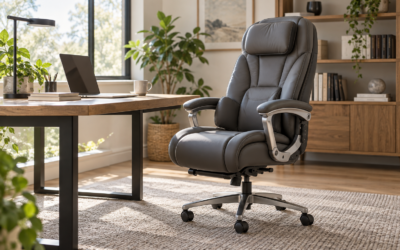
CAPOT Ergonomic Mesh Office Chair, high back with 3D headrest (model OC.017). The listing gives 22 by 25.2 by 45.3 inches, a listed weight of 38 pounds, a 400 pound maximum recommendation, a mesh back and seat, a cushion of 19.3 inches deep by 20 inches wide with a height of 18.5 to 22.05 inches, 2 inches of adjustable lumbar support over 8 levels, a 3-level tilt, a 3D headrest and 4D flip-up arms. Good for: someone who wants a finely adjustable lumbar, a headrest and a high weight rating. Keep in mind: the seat height field shows 22 inches and a single height position, which conflicts with the bullet’s 18.5 to 22.05 inch range. From the site owner’s Vietnam delivery address the page said it could not be shipped there, so we could not see an Add to Cart button; that is a geographic limit, not proof of no stock in the United States.
MUXX.STIL Office Chair, ergonomic with adjustable lumbar and flip-up armrest, khaki (model UMB01KH01). The listing gives 20.5 by 25.6 by 38.2 inches, a listed weight of 26.4 pounds, a seat depth of 20.1 inches, a seat height of 21.6 inches, a 264 pound maximum recommendation, a U-shaped foam seat cushion, an adjustable lumbar cushion and a 15-year warranty. Good for: a lighter chair with a padded lumbar cushion. Keep in mind: the listing gives one seat height figure and no range, and a warranty is a seller promise. The page showed an Add to Cart button and an In Stock message.
DRAGONN by VIVO Ergonomic Kneeling Chair (model DN-CH-K01B). The listing gives 26.2 by 18.7 by 8 inches, a listed weight of 18.4 pounds, a seat depth of 16.22 inches, a 250 pound maximum recommendation, a 3 inch vinyl cushion, a height range of 21 to 28 inches and four casters. Good for: someone who wants to try an open posture for short periods, alongside a normal chair. Keep in mind: it has no back support and uses different muscles, so it is not meant for all-day use. The page said it could not be shipped to the Vietnam delivery address we used.
A worked example
These numbers are invented. A person measures 20 inches from the back of the hips to the back of the knee and weighs 300 pounds.
Seat depth. Using our 2 inch planning gap, the ideal depth is 20 − 2 = 18 inches. The CAPOT cushion at 19.3 inches leaves a gap of 20 − 19.3 = 0.7 inch, close to the target. The MUXX.STIL at 20.1 inches gives 20 − 20.1 = −0.1 inch, so the seat reaches the knee. The kneeling chair at 16.22 inches leaves 20 − 16.22 = 3.78 inches, a short seat that suits the design.
Weight. At 300 pounds, the CAPOT’s 400 leaves 100 pounds, the MUXX.STIL’s 264 is 36 pounds under the person’s weight and is not suitable, and the DRAGONN’s 250 is 50 pounds under.
Lumbar. Suppose the person’s lumbar curve sits about 8 inches above the seat. The CAPOT’s lumbar adjusts over 2 inches in 8 levels, so a difference of 0.5 inch is two clicks. The MUXX.STIL gives no range, so we could not say.
The example shows why the label tells you less than the numbers: one of the three is not rated for this person.
Red flags in listings
A chair labeled orthopedic with no lumbar range, no seat depth and no weight rating, a seat height that differs between the field and the bullet and medical promises such as “cures” or “corrects” are signs to be careful. A chair cannot treat a condition, and a listing that says it can is overreaching.
Who should skip buying an “orthopedic” chair
If your pain is new, severe or spreading, see a clinician before buying anything. If your desk is the wrong height, a chair will not fix it, so look at the desk and your monitor first. If you sit only a short time each day, a simple chair with a cushion may be enough.
Frequently asked questions
Is an orthopedic chair approved by doctors?
Not automatically. The word is a seller’s label, and the listings we read show no medical certification. Judge the chair by its adjustments.
What should I look for in an orthopedic chair?
Lumbar support that adjusts, a seat depth that suits your legs, adjustable armrests and a weight rating above your weight.
Is a kneeling chair orthopedic?
Kneeling chairs are sold with that label sometimes, but they have no back and use different muscles. Try one for short periods, not as your only chair.
Can a chair fix back pain?
A chair can change how you sit, but it is not a treatment. See a clinician for pain that is persistent or severe.
What weight rating should I choose?
One above your weight with some margin. The ratings are the sellers’ figures and we have not verified them.
Bottom line
Judge an orthopedic chair by lumbar range, seat depth, adjustability and weight rating, not by the label. Of the three listings above, the CAPOT is the most adjustable, with the highest stated rating, the MUXX.STIL is the lighter chair with a U-shaped seat and the DRAGONN is the backless kneeling option for short sessions. If pain is the reason you are shopping, talk to a clinician as well.
Products worth checking
We have not tested these products. Sizes and features come from the Amazon listings, checked on September 30, 2026; where a listing does not say, we say so.
Ergonomic Mesh Office Chair, Adjustable Lumbar High Back Desk Chair 400lbs, 4D Flip-up Arms, 3-Level Tilt Backrest, 3D Headrest
The listing gives 2 in lumbar range over 8 levels; 400 lb maximum recommendation. We re-opened the page on September 30, 2026 and found these figures; other details are on the product page.
- Good for: comparing against the measurements in the guide above.
- Keep in mind: we have not tested it, and the listing may show more than one size or finish, so pick the variant that matches your numbers.
Office Chair, Ergonomic Desk Chair with Adjustable Lumbar Support and Flip up Armrest, Breathable Mesh Computer Chair, Khaki
The listing gives 20.1 in seat depth; 264 lb maximum recommendation. We re-opened the page on September 30, 2026 and found these figures; other details are on the product page.
- Good for: comparing against the measurements in the guide above.
- Keep in mind: we have not tested it, and the listing may show more than one size or finish, so pick the variant that matches your numbers.
DRAGONN by VIVO Ergonomic Kneeling Chair for Home and Office
The listing gives 21 to 28 in height range; 250 lb maximum recommendation. We re-opened the page on September 30, 2026 and found these figures; other details are on the product page.
- Good for: comparing against the measurements in the guide above.
- Keep in mind: we have not tested it, and the listing may show more than one size or finish, so pick the variant that matches your numbers.
Sources checked
- Computer Workstations eTool: Chairs
- CAPOT Ergonomic Mesh Office Chair, High Back
- MUXX.STIL Office Chair, Ergonomic Desk Chair
- DRAGONN by VIVO Ergonomic Kneeling Chair
Specifications checked on September 30, 2026. Product details and availability can change, so confirm on the product page before you buy.