As an Amazon Associate I earn from qualifying purchases. Links marked “Affiliate link” may earn us a commission at no extra cost to you. Learn more.
Quick answer
The best office chair is the one whose adjustment ranges match your body, not the one with the longest feature list. Check four numbers first: the seat height range (so your feet rest flat), the seat depth (so the seat edge stays clear of the back of your knees), whether the lumbar support moves up and down, and the weight rating. Then check the extras.
OSHA’s computer workstation guidance says a good chair supports the back, legs, buttocks and arms, that the backrest should follow the natural curve of the spine, and that the seat should let your feet rest flat on the floor or a footrest. It also says to try chairs before buying one, which is hard to do online, so read the listing numbers carefully.
We read three listings on Amazon on 2026-09-30: a mid-back mesh chair with a stated 250 pound rating, a mesh chair with a full lumbar adjustment, and a big-and-tall chair with a 330 pound rating and adjustable seat depth. They are examples of what to compare, not a ranking. We have not tested any of them; every number below comes from the listing.
What “best” means for an office chair
Nobody sits in the same way for eight hours, so a chair that feels fine for a 20 minute trial can still tire you by mid-afternoon. A useful definition of “best” is: the chair that lets you change position often and keeps your feet, back and forearms supported in each position. That is why OSHA stresses adjustability, particularly when a chair has more than one user.
It also means the best chair for one person is wrong for another. A tall person needs a longer seat height range and seat depth. A smaller person may need a seat that can be raised less, but with a front edge that does not press behind the knees. A heavier person needs a higher weight rating and a wider seat. If you want a chair for a specific problem, these guides go further: best ergonomic office chairs, best office chair for lower back pain and best office chairs for tall people.
The four fit checks
1. Seat height range. Sit with your feet flat and your thighs roughly level, then measure from the floor to the back of your knee while wearing the shoes you use at the desk. The chair’s lowest seat position should be at or below that number. A listing that states only one seat height, instead of a range, does not tell you whether the chair will go low enough.
2. Seat depth. This is the front-to-back length of the seat. A common fitting rule of thumb, which is our planning assumption and not a standard, is to leave about 2 inches between the front edge of the seat and the back of your knee. Measure from the back of your hips to the back of your knee while sitting, and subtract the seat depth. If the answer is negative, the seat edge will press into your legs.
3. Lumbar support. OSHA asks for a backrest that conforms to the natural curve of the spine and provides adequate lumbar support. A fixed bump fits some people and misses others. A lumbar support that moves up and down, and ideally forward and back, lets you place the curve where your lower back actually sits.
4. Armrests. OSHA describes soft armrests that let your shoulders relax with your elbows close to your body. Armrests that flip up or slide forward help when you need to roll close to the desk. If your desk is tight, see office chair with or without arms and will an office chair fit under my desk.
OSHA also lists a five-leg base with casters as a feature of a good chair. Most listings show five casters in photos, but a listing that does not say so is worth a question to the seller.
The three listings we read
BestOffice Ergonomic Office Chair, mid-back mesh (model VN-H03). The listing gives a mesh back, lumbar support, adjustable armrests, a seat height range of 17.1 to 20.3 inches, a seat depth of 20 inches, a 20 pound chair weight and a 250 pound maximum recommendation. Good for: a smaller or average-height person who wants a light chair with a stated seat-height range. Keep in mind: the page gives three different size lines (18 x 18 x 38 inches, 19.7 x 18.9 x 38 inches and 22 x 9 x 18 inches), the last of which looks like a package size. The bullets say the chair meets BIFMA standards; we did not see a certificate, so treat it as a seller claim. From the site owner’s Vietnam delivery address, the page showed a message that it could not be shipped there, so we could not see an Add to Cart button. That is a geographic limit, not proof that the chair is out of stock in the United States.
marrap Ergonomic Office Chair (model KW701). The listing gives a mesh back and seat, a lumbar system that adjusts up and down and forward and back, armrests that flip up, slide and rotate, a rocking range of 90 to 120 degrees, a 20.02 inch seat depth, a 28 pound weight and a 250 pound maximum recommendation. Good for: someone who wants to fine-tune the lumbar position and who needs armrests that move out of the way. Keep in mind: the fields and bullets we read do not state a seat height range, so you cannot tell from the page whether it goes low enough for you. Its overall size line (20.5 x 27.6 x 51.99 inches) appears to be the chair at maximum height. The page also showed the same shipping message from Vietnam.
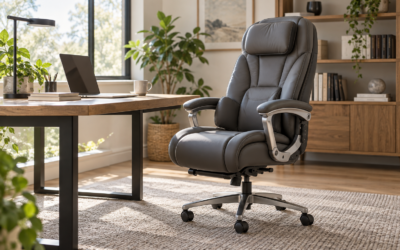
Marsail Big and Tall Ergonomic Office Chair (model HNOFC48B-H-US). The listing gives a high mesh back, adjustable seat depth, a 3D adjustable headrest, armrests that move in six directions, a tilt lock at 95, 104, 114 and 123 degrees, a 330 pound maximum recommendation, a 38.6 pound weight, a 21.6 inch seat depth and a 19.29 inch seat height. Good for: a larger or taller person who wants a higher rating and a seat that can be set deeper or shallower. Keep in mind: the listing does not give the seat-depth adjustment range or a seat height range, and at 38.6 pounds it is the heaviest chair here to move. This page did show an Add to Cart button and an In Stock message.
A worked example
These numbers are invented to show the method; they are not from a real person.
Person A sits with a hip-to-back-of-knee length of 22 inches. Using our 2 inch planning gap, the ideal seat depth is 22 − 2 = 20 inches. The BestOffice listing’s 20 inch seat depth and the marrap listing’s 20.02 inch depth both land almost exactly on it.
Person B has a hip-to-back-of-knee length of 18 inches. Against a 20 inch seat the gap is 18 − 20 = −2 inches, meaning the seat edge would run 2 inches past the back of the knee. Against the Marsail’s 21.6 inch setting it would be −3.6 inches. Person B should look for a chair with a shallower seat or a seat depth adjustment, and should use the adjustment at its shortest setting.
Now the height check. Suppose Person A measures 17.5 inches from the floor to the back of the knee, and their work shoes add 1 inch, giving 18.5 inches. The BestOffice range of 17.1 to 20.3 inches contains 18.5 inches, so the chair can be set correctly. A second person who measures 21 inches needs a chair that reaches above 20.3 inches, and this listing would not do it.
The weight check is simple: compare your weight to the listing’s rating. A listed “maximum recommendation” is the seller’s figure. We have not verified it, so pick a rating with room above your weight instead of one that just meets it.
Listing problems to watch for
Budget chair listings often contradict themselves. The BestOffice page shows three size lines; another chair’s overall height can be labeled as seat height; the Marsail listing quotes a seat height but no range. Do not quote a minimum seat height unless the listing states a range. When two numbers disagree, use neither and ask the seller, or pick a listing whose numbers agree.
Also check what the word “ergonomic” is doing in the title. It is not a certification. The real information is in the list of adjustments: does the lumbar move, does the seat depth move, do the armrests move, and what is the tilt range?
Adjustments that matter more than padding
A thick seat can feel great for ten minutes and fail later; adjustments keep working. Tilt tension lets the backrest follow you instead of pushing you forward. A tilt lock, like the four positions listed on the Marsail page, lets you fix the backrest at an angle for a task. Armrest height matters for typing, because armrests set too high push the shoulders up. Seat depth matters for everyone but shows up on only some listings.
If your problem is a specific pain, read the matching guide instead of looking for a universal winner: best office chair for back pain and long hours. If you are working to a budget, best budget office chairs for a home office compares cheaper listings the same way.
When you may not need a new chair
If your current chair already has a height adjustment and your feet sit flat, try fixing the small things first. A rolled towel or a lumbar cushion can shift the lumbar support, and a footrest helps if the desk is too high for your feet. See office chair with footrest and best seat cushions for office chairs. Buy a new chair only if the seat is too deep, the height does not reach your knee height, or the weight rating is too low.
Frequently asked questions
What is the most important spec on an office chair?
Seat height range, because it decides whether your feet can rest flat. Seat depth and lumbar adjustment come next. Weight rating matters if you are near the listed limit.
How do I know if the seat is too deep?
Sit all the way back and see whether the seat edge touches the back of your knees. If it does, the seat is too deep for you. Seat depth adjustment or a smaller chair fixes it.
Is a mesh chair better than a padded one?
Mesh lets air through, which suits warm rooms, but the choice depends on comfort and support. See mesh vs fabric vs leather office chair.
Do the weight ratings on listings mean the chair is tested?
Not necessarily. The figure is what the seller states; we have not verified it. Choose a rating that leaves room above your weight.
Can I trust a listing that does not show a seat height range?
Treat the chair as unproven for your height. Ask the seller for the minimum and maximum seat height before ordering, or choose a listing that states them.
Bottom line
Pick the best office chair by measuring yourself, not by reading the feature list. Get your knee height, your hip-to-knee length and your weight, then choose a chair whose stated ranges cover them. Of the three listings above, the BestOffice states a seat height range, the marrap offers the most lumbar adjustment, and the Marsail offers the highest rating and adjustable seat depth. If the listing does not state the number you need, ask before you buy.
Products worth checking
We have not tested these products. Sizes and features come from the Amazon listings, checked on September 30, 2026; where a listing does not say, we say so.
BestOffice Ergonomic Office Chair, Mid-Back Swivel Desk Chair, Black
The listing gives seat height range 17.1 to 20.3 in; 250 lb maximum recommendation. We re-opened the page on September 30, 2026 and found these figures; other details are on the product page.
- Good for: comparing against the measurements in the guide above.
- Keep in mind: we have not tested it, and the listing may show more than one size or finish, so pick the variant that matches your numbers.
marrap Ergonomic Office Chair, Adjustable Lumbar Support
The listing gives 20.02 in seat depth; 250 lb maximum recommendation. We re-opened the page on September 30, 2026 and found these figures; other details are on the product page.
- Good for: comparing against the measurements in the guide above.
- Keep in mind: we have not tested it, and the listing may show more than one size or finish, so pick the variant that matches your numbers.
Marsail Big and Tall Ergonomic Office Chair with 6D Armrests
The listing gives 21.6 in seat depth; 330 lb maximum recommendation. We re-opened the page on September 30, 2026 and found these figures; other details are on the product page.
- Good for: comparing against the measurements in the guide above.
- Keep in mind: we have not tested it, and the listing may show more than one size or finish, so pick the variant that matches your numbers.
Sources checked
Specifications checked on September 30, 2026. Product details and availability can change, so confirm on the product page before you buy.