As an Amazon Associate I earn from qualifying purchases. Links marked “Affiliate link” may earn us a commission at no extra cost to you. Learn more.
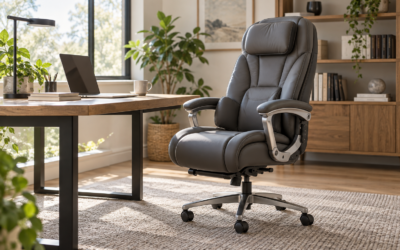
An ergonomic mesh office chair can be a good fit for a warm room or a small workspace because the backrest feels lighter and allows more airflow than thick padding. Mesh alone does not make a chair ergonomic. The useful features are the adjustments that let the seat, back, arms, and recline work with your desk and body.
Before comparing colors, headrests, or marketing labels, check the seat-height range and the usable seat depth. Those two measurements decide whether you can sit back with your feet supported and still reach the keyboard comfortably.
What to look for in the mesh back
Mesh varies from firm and springy to soft and flexible. A firmer mesh can feel supportive but may create pressure if the back shape does not match you. Softer mesh feels less structured and can sag over time. Neither option is universally better, so focus on the location and adjustment of the lumbar support rather than calling one type more ergonomic.
The frame around the mesh matters too. A wide plastic edge can touch your shoulders or sides when you lean back. Look for product photos and dimensions that show the usable back area, not only the overall chair width.
The adjustments that matter most
Seat height
Check the lowest and highest seat setting, not the total chair height. This is the starting point for feet, knee angle, and keyboard height.
Seat depth
An adjustable seat depth is useful when available, but a fixed seat can still work if it supports most of your thighs without pressing behind your knees. Do not judge depth from a front-facing photo.
Lumbar support
Look for a support that can at least move vertically. More adjustments can help, but only if you can position them comfortably rather than simply adding complexity.
Armrests
Adjustable arms can support your forearms, but they should also lower enough to fit beneath the desk or move out of the way. Flip-up arms are worth considering in a small room.
Recline and tilt lock
A recline that can hold position gives you more options for short breaks. Check whether the listing describes actual lock positions or only says “rocking.”
Mesh chair versus padded chair in a small room
Mesh chairs often look visually lighter, which can help a cramped office corner feel less crowded. They are also easier to clean around the backrest than thick fabric upholstery. A padded chair may still be the better choice if you prefer a softer seat or need a shape that mesh options do not provide.
Do not make the decision from material alone. Compare the room footprint, desk clearance, and adjustments. Our small-space office chair guide covers footprint planning, and our office-chair armrest guide helps when arm clearance is the limiting factor.
When a mesh chair is not the answer
A mesh chair is not automatically cooler, more supportive, or easier to fit. Skip it if the frame presses into your shoulders, the lumbar support cannot reach the right spot, the seat depth is wrong, or the chair lacks the height range you need. A chair with less fashionable material but better fit is the wiser choice.
For common setup problems after you buy, see our guide to sitting at a desk all day. It covers the chair, desk, screen, and movement habits as one system.
What OSHA says about chair features
OSHA describes a good chair as having a seat height that lets the sole of the foot rest on the floor, a seat that supports most of the thigh, height-adjustable lumbar support, recline of at least 15 degrees from vertical and a strong five-legged base (OSHA chair guidance). Mesh is a cover material, not a feature of any of these. See our mesh vs fabric vs leather guide for how the covers compare, and our lower back chair guide for lumbar ranges as listed.
Products worth checking
These products match the topic above. We have not tested them. Sizes and features come from the Amazon listings, checked on September 30, 2026; where a listing does not say, we say so.
CAPOT Ergonomic Mesh Office Chair: highest stated weight limit
The listing states a lumbar that adjusts about 2 inches over 8 levels, an enlarged mesh seat, a headrest that adjusts in height and depth, locking recline at 90, 110 or 125 degrees, flip-up soft arms, an SGS gas lift and a stainless steel base rated to 400 lb. Seat height is 18.5 to 22.05 inches.
- Good for: a user in the stated range who wants a defined lumbar range and a high weight rating.
- Keep in mind: the seat depth appears as 19.3 in in one place and 20 in in another, and the listing repeats percent claims we cannot verify.
Marsail Ergonomic Office Chair: clearest lumbar range with flip-up arms
The listing gives a lumbar that moves 1.18 inches forward and back and 2.16 inches up and down, a 2D headrest, a 90 to 120 degree recline, 3D armrests that flip up, a 3.14 inch high-density foam seat and a 330 lb rating.
- Good for: someone who wants a stated lumbar range and arms that flip up under a desk.
- Keep in mind: the headrest moves in two ways only, and the user height range is not stated.
VECELO Mid-Back Swivel Ergonomic Office Chair with Adjustable Arms
A simpler mid-back mesh chair with height-adjustable armrests, a high-resilience sponge seat, a steel structure and a stated capacity of 275 lb. The listing gives a seat height of about 45 cm and a seat depth of 18.9 inches.
- Good for: someone who wants a lighter chair with a shallower seat, and for whom lumbar adjustment is not essential.
- Keep in mind: the listing says mesh lumbar support but does not say it adjusts, so it may not suit you if the lumbar position matters.
Frequently asked questions
Are mesh office chairs ergonomic?
They can be, but mesh is only a material. Ergonomics depend on usable seat height, depth, back support, arms, and recline.
Is mesh better than fabric for an office chair?
Mesh usually allows more airflow and can look lighter in a small room. Fabric may feel softer. Fit and adjustment matter more than material alone.
Do mesh chairs have good lumbar support?
Some do and some do not. Check whether the lumbar support can move to the right height instead of relying on the word “ergonomic.”
Are mesh chairs good for small spaces?
They can be if the base width, armrests, and depth leave enough room to roll and walk. Measure the full footprint, not only the seat.
Last updated: September 29, 2026. General information, not medical advice.
Related guides
- Best Computer Desks for Small Spaces
- Best Office Chairs for Small Spaces
- Office Chair With Footrest: When Does It Make Sense?
- Back Support for an Office Chair: What Actually Helps?
- High-Back Office Chair: When Is the Extra Height Worth It?
- How to Choose an L-Shaped Desk With Drawers for a Small Room
- Standing Desk With Storage or Drawers: Which Layout Works Better?