As an Amazon Associate I earn from qualifying purchases. Links marked “Affiliate link” may earn us a commission at no extra cost to you. Learn more.
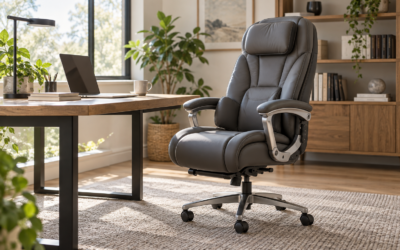
A high-back office chair can be worth the extra size if the backrest fits your torso and you use recline breaks. It is not automatically more ergonomic than a mid-back chair. In a small room, a tall backrest, headrest, and larger base can also make the chair harder to tuck away or place beneath a window.
Choose a high-back chair for the support it gives in your normal working and reclining positions, not because a taller silhouette looks more substantial.
What “high back” usually means
The phrase is not a standard measurement. One listing may call a chair high-back because it reaches your shoulders; another may include a headrest and reach higher. Look for the backrest height, the seat-height range, and whether the headrest adjusts independently. Overall chair height alone is not enough.
A backrest that reaches your upper back can feel supportive during longer sessions. A headrest is most useful when you lean back. When you type upright, it should not push your head forward or force your neck into one position.
Who benefits most?
People with a longer torso may prefer a taller backrest, especially if a mid-back chair ends in the middle of the shoulder blades. People who take recline breaks may also value an adjustable headrest. But a shorter person can find a fixed tall backrest or high headrest intrusive if it cannot be moved to the right position.
Seat fit still comes first. Check the seat-height range, seat depth, and armrest clearance before comparing back height. Our desk-height calculator helps you compare a fixed work surface with your setup, while the small-space chair guide helps balance those measurements against room size.
Measure the room as well as the chair
Measure from the floor to any window sill, shelf, or wall art behind the desk. A tall chair can block light or visually fill a room even when the seat fits beneath the desk. Then measure the chair’s base width and total depth; the backrest’s height is only one part of the footprint.
If you plan to store the chair under a desk, check armrest height and the backrest tilt. A high-back chair may need to recline or turn before it fits through a narrow opening. Use our chair-under-desk fit checker for the basic clearance measurement.
High-back versus mid-back chair
| Question | High-back chair | Mid-back chair |
|---|---|---|
| Upper-back coverage | Usually more | Usually less |
| Reclined breaks | Often better with an adjustable headrest | Often simpler but less head/neck support |
| Small-room visual weight | Can feel larger | Usually lighter and easier to tuck away |
| Fit risk | Fixed tall back or headrest can sit in the wrong place | May end too low for some torsos |
| Best decision factor | Backrest and headrest adjustability | Seat fit and desk clearance |
Do a five-minute fit check
Before you choose a high-back chair, sit in a chair you already own and note where its back ends relative to your shoulders. Then measure the available height behind your desk and the space between the desk and the nearest wall or bed. Write down the seat height you use comfortably, the desk underside height, and whether you actually recline during the day. These notes make product listings easier to compare: you can rule out a chair with a fixed headrest that would sit too low, a base that is too wide for the path, or arms that cannot pass below the desk.
What OSHA says about the backrest and recline
OSHA lists a height-adjustable lumbar support, recline of at least 15 degrees from vertical and a strong five-legged base as features of a good chair (OSHA chair guidance). A tall backrest does not change those requirements, so check them on any chair, tall or not. For chairs built for taller users, see our guide for tall people, and for headrest and armrest adjustment see our neck and shoulder guide.
Products worth checking
These products match the topic above. We have not tested them. Sizes and features come from the Amazon listings, checked on September 30, 2026; where a listing does not say, we say so.
VECELO High Back Ergonomic Big and Tall Mesh Desk Chair
The listing describes a 3D adjustable headrest, armrests with 2.8 inches of vertical lift, a recline that locks at 90, 110 and 120 degrees, a reinforced steel base rated to 500 lb, silent casters and a class-3 gas lift. Overall size is listed as 21.7 by 26 by 49 inches.
- Good for: a taller user who wants a headrest, or a heavier user who wants a 500 lb rating.
- Keep in mind: the text we read does not state the seat height range, seat size or user height range, so confirm them before you buy.
CAPOT Ergonomic Mesh Office Chair: highest stated weight limit
The listing states a lumbar that adjusts about 2 inches over 8 levels, an enlarged mesh seat, a headrest that adjusts in height and depth, locking recline at 90, 110 or 125 degrees, flip-up soft arms, an SGS gas lift and a stainless steel base rated to 400 lb. Seat height is 18.5 to 22.05 inches.
- Good for: a user in the stated range who wants a defined lumbar range and a high weight rating.
- Keep in mind: the seat depth appears as 19.3 in in one place and 20 in in another, and the listing repeats percent claims we cannot verify.
XiGoal S9 Ergonomic Office Chair with 3-Zone Lumbar Support
The listing describes a 3-zone lumbar that adjusts vertically and up to 1.57 inches in depth, adjustable backrest height and seat depth (1.57 inches), 6D armrests, a 4D headrest and a recline from 90 to 140 degrees. It states the chair is for people from 5 ft 3 in to 6 ft 5 in and supports up to 300 lb, with SGS and TUV certifications.
- Good for: a taller or heavier user, or someone who wants lumbar, headrest and arm adjustment in one chair.
- Keep in mind: it is a large, high-back chair, so check the depth and the space behind your desk, and it is not the one for a very small room.
Frequently asked questions
Is a high-back office chair better for long hours?
Not by itself. It can offer more upper-back support, but the chair still needs a usable seat height, suitable depth, and a backrest that fits you.
Do I need a headrest on an office chair?
It is most useful when you recline. It should not push your head forward while you type upright.
Will a high-back chair fit in a small room?
It may, but measure the base, depth, room behind the chair, and anything above or behind the desk. The tall backrest is only one clearance issue.
Can a short person use a high-back chair?
Yes, if the backrest, headrest, seat height, and depth adjust to fit. A fixed tall chair is not automatically a better fit.
Last updated: September 29, 2026. General information, not medical advice.
Related guides
- Best Computer Desks for Small Spaces
- Best Office Chairs for Small Spaces
- Criss-Cross Office Chair: Is It Good for Working at a Desk?
- Office Chair With Footrest: When Does It Make Sense?
- Back Support for an Office Chair: What Actually Helps?
- How to Choose an L-Shaped Desk With Drawers for a Small Room
- Standing Desk With Storage or Drawers: Which Layout Works Better?