As an Amazon Associate we earn from qualifying purchases. Details
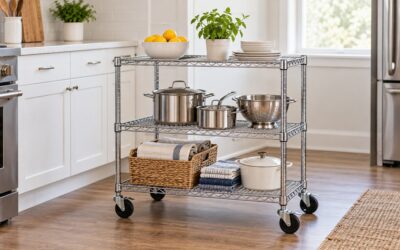
The Amazon Basics 36-inch kitchen cart is a compact rolling rack with two adjustable chrome shelves, a 1.5-inch wood top, four caster wheels (two of them locking), and four chrome hooks. The listing gives an overall footprint of about 21 by 15 inches and a height of 36.7 inches, which suits a small kitchen that needs movable prep space. The capacity is the open question: the title and specification sheet give 175 pounds, but one bullet gives a 25-pound total that the listing does not explain. This article uses only the supplied product specifications and listing text, so it does not report assembly or use in a real kitchen.
View the Amazon Basics 3-tier kitchen storage rack on caster wheels on Amazon
Naming and what the product is
The product is marketed as the Amazon Basics 36-inch kitchen cart. The listing’s own title describes it as a portable kitchen 3-tier storage rack on caster wheels. The product is the same item under either name. the available listing details describes it as a rolling cart with two shelves and a wood top, which the bullet points say can hold a microwave, a mini fridge, or a set of prep tools. When it is not needed, it rolls out of the way.
The bullet points also name other uses: offices, playrooms, laundry rooms, and garages. The listing describes the cart as multi-purpose, but its specifications and dimensions are written for a kitchen or a similar room. The most useful way to read the product is as a movable surface and a set of shelves that can sit beside a counter, under a window, or in a corner.
Who this cart suits
The listing’s intended reader is a small-kitchen owner who needs movable prep space or appliance storage. the available listing details supports that reading. A rolling cart with a wood top gives a surface that can be pulled out when the kitchen needs more room and pushed back when it does not.
The cart suits a renter or a homeowner who wants extra storage without changing the layout. It is a reasonable choice for a kitchen where the counter is fixed and the floor has space for a movable unit. The adjustable shelves help when appliances differ in height, and the locking casters help when the cart is parked beside an appliance or a counter.
It is a weaker fit in three situations. The first is a kitchen that needs a fixed, built-in workspace. The second is an appliance that is deeper or heavier than the listing’s figures suggest. The third is a buyer who needs a documented, load-tested capacity above the lower figure in the listing. the available listing details does not provide that documentation.
Dimensions and footprint
The title and the specification sheet give the footprint as 21 by 15 inches. The specification sheet’s depth and width figures, 14.96 inches and 20.87 inches, match that size. The overall height is 36.7 inches in both places. The listing’s depth is about 15 inches, and its width is about 21 inches.
Those numbers are the first thing to check. In a narrow kitchen, the 21-inch width is the dimension that matters most along a wall, because it sets how much wall the cart occupies. The 15-inch depth sets how far the cart projects into the room. Before buying, mark the 21 by 15 inch footprint on the floor with painter’s tape or cardboard. Then check whether the cart still leaves a clear path for a person, a chair, or a door as it sits in place.
The cart may be moved more often than a fixed counter, so the path should be clear both when it is parked and when it is rolled. A footprint that fits when it is parked can still block a route when it is moved between two spots, so check the route as well as the resting position.
The overall height of 36.7 inches is the figure to compare with the surfaces around it. A cart that is taller than the counter it sits beside may block a cabinet or a window. A cart that is much shorter may not provide the storage you expect. Compare the height with your counter and the cabinet above it before deciding where the cart will stand.
Shelves, height and clearance
The cart has two chrome shelves and a 1.5-inch wood top. The bullet points say that each shelf holds up to 50 pounds. The shelf height is adjustable in 1-inch increments, which is useful for appliances of different heights.
The listing does not give the usable interior clearance between shelves, and it does not say whether the adjustment is made with pins or by another method. That is an important gap for an appliance. Measure the appliance you plan to store, and then check the clearance once the shelves are assembled. Leave enough space above the appliance for its controls, vents, and door, and make sure the shelf above it does not interfere with those features.
Because the clearance is not stated, the 1-inch increments tell you how finely you can adjust, but not how much room each adjustment gives. Treat the adjustment as a way to fit a specific appliance after you have measured it, not as a guarantee that any appliance will fit.
Capacity: the conflict to resolve
The capacity figures are the most important open question in the available listing details. The listing gives three statements that agree with each other: the title and the specification sheet both give a total capacity of 175 pounds, and the bullets say each shelf holds up to 50 pounds. For two shelves plus the wood top, the 175-pound figure is the total the listing builds on.
One bullet point conflicts with the others. It says the cart has a “25 pound weight capacity total.” That figure is far lower than the 175-pound figure, and the available listing details does not explain it. It may be a typing error, or it may refer to something else in the listing. Until the listing resolves the conflict, plan around the lower figure and avoid loading the cart with a heavy appliance and other items at the same time.
The 175-pound figure is also a manufacturer claim. the available listing details includes no load test, so the figure cannot be confirmed independently.
Load planning in practice works like this. A microwave or a small appliance can add a meaningful load to a shelf, and the listing does not state the weight of any specific appliance. Look at the appliance’s own label or manual for its weight, and add the weight of anything you store with it. Keep the total well below the figure you plan around, and spread the load across both shelves rather than stacking everything on one.
Casters, mobility and moving a loaded cart
The cart has four caster wheels, and two of them lock. The locking casters are the feature to use when the cart is parked beside an appliance or a counter. Lock them before you place an appliance on the cart, and check that the cart does not roll when you add weight to it.
the available listing details does not give the caster diameter, the caster height, or the wheel material. Those details affect the clearance under the cart and how well it rolls over thresholds, rugs, or uneven flooring. If you plan to slide the cart under a counter overhang, measure the space under the cart, and check the route width at doors and corners.
Rolling a loaded cart is different from rolling an empty one. Move the cart slowly, keep the load centered, and avoid pushing it over a threshold when it carries a heavy appliance. The bullet points describe the cart as portable, and that is true for an empty cart. A loaded one needs more care, and the listing does not state a movement limit for a loaded cart.
Assembly and the first checks
The bullet points say the cart is easy to assemble and needs no tools. The specification sheet describes the assembly instructions as detailed and clear. the available listing details does not include assembly times, a parts list, or the full set of instructions, so check the packaging before you start.
When you assemble the cart, tighten each connection, make sure the shelves are level, and confirm that each caster turns and that both locking casters engage. Check the cart again after the first loaded use, because a new frame can settle as the hardware seats. This is a practical check, not a claim about the product’s durability. The listing does not describe how the frame behaves over time.
The four chrome hooks are included, according to the bullet points. Hang them only on the frame, and keep the load on each hook within what it can carry. The listing does not state a load rating for the hooks, so use them for light items unless the packaging says otherwise.
Materials and finish
The materials are described in two slightly different ways. The specification table gives the frame as alloy steel with a wood top. The bullet points describe a chrome-plated steel frame with two chrome shelves and a 1.5-inch wood top. Both descriptions point to a metal frame with a wood top, but the finish and the frame material are not stated the same way in both places. If the finish matters to you, check the packaging or the full product description.
The wood top is 1.5 inches thick, according to the listing. the available listing details does not describe its finish or its moisture resistance, so keep wet items off it unless the listing or packaging says otherwise.
Strengths and limits, side by side
the available listing details supports these strengths:
- A compact 21 by 15 inch footprint that fits a small kitchen.
- A height of 36.7 inches that adds vertical storage.
- Two adjustable chrome shelves that adjust in 1-inch increments.
- A 1.5-inch wood top for prep or appliance use.
- Assembly that the listing describes as needing no tools.
- Four casters, two of which lock.
the available listing details points to these limits:
- The footprint is small, but the cart still takes up floor space when it is parked.
- The 175-pound capacity is a listing claim, and one bullet gives a conflicting 25-pound figure.
- The listing does not give the caster size or the shelf interior clearance.
- A rolling cart moves, so it can drift if the locking casters are not engaged.
For a larger movable option, see kitchen islands on wheels, and for a laundry-focused cart, see the laundry organizer cart guide.
Who should look elsewhere
- Kitchens that need a fixed workspace or a built-in counter.
- Appliances that are deeper than about 15 inches, or taller than the shelf spacing allows.
- Buyers who need a documented, load-tested capacity above the lower figure in the listing.
- Owners whose route, doorway, or floor surface cannot accommodate a rolling cart.
For a different wheeled build, compare wooden utility carts with wheels before you decide.
What to verify before buying
- The model and dimensions. Confirm the 21 by 15 by 36.7 inch dimensions on the listing you are viewing.
- The floor space. Mark the footprint on the floor, and check the route width for rolling the cart.
- The appliance height. Measure the appliance you plan to store, plus the clearance above it.
- The weight. Check the appliance’s own label or manual, and add anything else you plan to store.
- The casters. Once assembled, confirm that each caster turns and that both locking casters engage.
- The capacity. Confirm which capacity figure the listing finally gives, given the conflict in the bullets. Until then, plan around the lower figure.
Limitations and caveats
This article is based on the supplied product specifications and listing text. It does not report assembly, use, or load behavior observed in a real kitchen. The 175-pound capacity is a listing claim and was not independently load-tested. The 25-pound figure in one bullet conflicts with the other capacity statements, and the available listing details does not resolve it. The caster size, the shelf interior clearance, and the assembly times are not given in the available listing details. Measurements of the appliances, the route, and the caster clearance must be taken in your own kitchen.
Worked example: shelf load and wall run
Worked example: each of the two shelves is listed at 50 pounds, so the shelves together carry 100 pounds (2 times 50). That sits below the 175-pound title figure and well above the 25-pound bullet figure, so the shelf limits alone do not settle the conflict. Against a wall run of 48 inches, the 21-inch footprint leaves 27 inches (48 minus 21). Plan with the lower total until the listing explains the difference.
Conclusion
The Amazon Basics 36-inch kitchen cart is a compact rolling rack with two adjustable chrome shelves, a wood top, four casters, and four hooks. Its 21 by 15 inch footprint and 36.7-inch height make it a practical option for a small kitchen that needs movable prep or appliance storage. The listed capacity is the main open question, since the available listing details gives both 175 pounds and 25 pounds.
Measure the appliance, the route, and the caster clearance. Plan around the lower capacity figure, and confirm the final figure in the listing before you load the cart.
Check the current listing for the Amazon Basics kitchen storage rack before you buy
Frequently asked questions
How big is the footprint of this cart?
The listing gives a footprint of about 21 by 15 inches and a height of 36.7 inches.
How much weight can the cart hold?
The title and the specification sheet give a total capacity of 175 pounds, and the bullets say each shelf holds up to 50 pounds. One bullet gives a 25-pound total, which the listing does not explain, so plan around the lower figure.
Does the cart need tools to assemble?
According to the bullets, it goes together without tools, though the listing gives no assembly time or parts count.
Do all the casters lock?
Two of the four caster wheels lock. The listing does not give the caster diameter, so measure the clearance under the cart if it must slide under a counter.
How are the shelves height-adjusted?
The shelf height adjusts in 1-inch increments. The listing does not give the clearance each adjustment creates, so measure your appliance and then check the fit once the shelves are set.
Sources
- – https://www.amazon.com/dp/B073P2KKXS/?tag=tinyspacepick-20