As an Amazon Associate we earn from qualifying purchases. Details
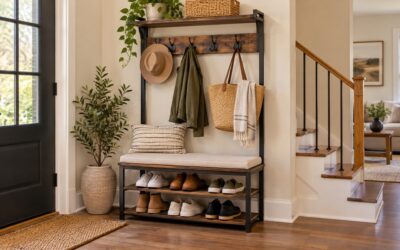
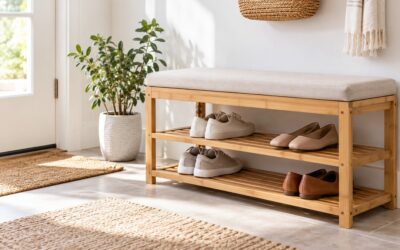
A narrow entryway often has room for only one functional piece of furniture: a bench where you can sit to put on shoes, with shelves underneath for footwear. The HOOBRO 29.5-inch shoe bench is built for that job. It measures 29.5 inches long, 11.2 inches deep and 19 inches high, with a seat at that height and two mesh shelves below the top. The listing gives a maximum weight recommendation of 136 kg, and a bullet describes the top as able to bear up to 300 pounds. This review draws only on the listing and its specification fields, and seat stability and finish wear have not been independently tested.
Who the bench is for
The bench is aimed at apartment residents who need a sit-and-store piece for a narrow space near the front door. The listing describes it for entryways, living rooms, and hallways. For a small entry, the 29.5-inch width is the key number, because it decides whether the bench will fit between a wall and a door, or against a wall with room to walk past.
Specifications at a glance
| Measure | Listed value |
|---|---|
| Size | 29.5″ L x 11.2″ W x 19″ H |
| Product dimensions (specification field) | 11.2″ D x 29.5″ W x 19″ H |
| Maximum weight recommendation | 136 kg (the bullets describe a top that bears up to 300 lb) |
| Seating capacity (specification field) | 3 |
| Material | Engineered wood and metal |
| Shelves | Two mesh shelves, described as a three-tier layout |
| Assembly | Detailed instructions included, with labeled parts |
The specification fields and the bullets agree on the 29.5-inch width, the 11.2-inch depth, and the 19-inch height. The item dimension field lists 11.22 by 29.53 by 19.09 inches, which is consistent with the rounded figures.
Size and footprint
The 29.5-inch length is the main measurement for a narrow entry. The 11.2-inch depth decides how far the bench projects into the room. Shallow depths can make a bench easier to fit against a wall, but they also limit how much room there is for your feet when you sit.
The listing does not say how much space is needed beside the bench, so plan a clear path for walking and for the door to open. Measure the full footprint, including that clearance, before ordering.
Seat height
The listing’s height of 19 inches is also the seat height in the specification field. A seat at that height may suit some users more than others, and the available listing details does not describe how it compares with other benches. If you sit down to change shoes often, try the height in a real space before you commit. Measure it against the people who will actually sit on the bench.
Weight capacity and seating
The specification field lists a maximum weight recommendation of 136 kg, and a bullet describes the top as able to bear up to 300 pounds. These figures are close to each other, and both are manufacturer claims. Use the lower of the two as a guide, and do not treat either as a guarantee for every use, especially if the bench will be used by more than one person at a time.
The specification field also lists a seating capacity of 3. A bench that is only 29.5 inches wide should not be assumed to seat three adults comfortably. Judge the seating room from the width and depth rather than from the seating-capacity field alone.
Layout: three tiers and two mesh shelves
The title describes a three-tier shoe rack, and the bullets describe two mesh shelves that keep the entry tidy and off the floor. The top is the seat, and the two shelves below it hold shoes. The bullets say the shelves keep shoes from scattering across the entryway.
the available listing details does not give the height between the shelves, the number of shoes each shelf holds, or the clearance for tall boots. Before buying, measure the boots and shoes you plan to store, and compare them with the height of the space between the shelves in the assembled bench. Do not assume that the 19-inch overall height means every shelf can take tall footwear.
The bullets describe the shelves as mesh, and they say the mesh helps keep shoes organized. The listing does not describe the mesh material beyond that, so check the product in person if the mesh and shelf layout matter for your use.
Materials and build
The listing describes engineered wood for the top and the shelves, combined with a metal frame and metal legs. The specification field lists the material as engineered wood and metal. A bullet describes the metal legs as providing support so the top stays stable during use. The listing also calls the bench sturdy and long-lasting, but those are manufacturer claims rather than test results.
The finish is listed as rustic brown and black, and the style as country rustic. The leg style is listed as industrial. Some bullets use marketing language about the look of the bench, and the look is a matter of taste. the available listing details does not describe how the finish will wear over time, so check the finish on the product before committing, especially in an entry that sees a lot of foot traffic.
Assembly
The listing says the bench comes with detailed instructions and labeled parts, and that the illustrated instructions make assembly straightforward. The specification field lists detailed assembly instructions as included.
the available listing details does not include the number of parts, the time needed to assemble, or the tools required, so plan for the time it will take and keep the instructions where you can read them during the build. Assembly is a common point of difficulty for flat-pack furniture. Work on a clear surface, check the parts against the list in the instructions before you begin, and make sure the frame is square and the legs are fully attached before you load the shelves or sit on the top.
Check the HOOBRO 29.5-inch shoe bench on Amazon
Who should consider this bench
The HOOBRO bench suits an apartment entry where a narrow, seated shoe storage piece will fit between the wall and the door, and where the owner wants two shelves of shoe storage under a seat. The listing’s rustic brown color and industrial legs may suit a home with a similar style.
It is a poor match if the bench will need to hold heavy use from several people at once, since the available listing details does not describe that kind of use. It is also a poor match if a shelf must hold tall boots and the clearance is not confirmed.
If you are comparing other entryway pieces, see best shoe racks, hall trees with a bench, and shoe storage cabinets.
What to verify before buying
- Measure the footprint: 29.5 inches long and 11.2 inches deep, plus space for walking and for the door to swing.
- Measure the seat height against the people who will sit on the bench.
- Measure the space between the shelves and check it against the shoes you own, especially boots.
- Confirm the weight recommendation, which is listed as 136 kg, and the bullet’s 300 lb figure.
- Read the assembly instructions and plan the time and workspace.
- Check the finish in person, since the wear of the finish is not described in the available listing details.
Limitations and caveats
Real-world seat stability and finish wear were not independently tested for this article. the available listing details does not give shelf heights, shelf load limits, or shoe-height clearance, so those points need to be checked directly. The seating capacity field and the weight claims are listing figures, not test results.
Start with the job, not the feature list
The right HOOBRO shoe bench is the one that removes a specific problem in your entryway footprint and household shoe load. Begin by describing the job in one sentence: where the product will sit, who will use it, how often it will be handled, and what must fit or connect. That sentence is a better filter than a long list of advertised benefits. It also exposes conflicts early. A design that offers more capacity may occupy more room; a portable option may demand more setup; a stronger mounting method may be harder to reverse.
Use dimensions, shelf clearance, and stated seat capacity as the first-pass screen. Eliminate an option when a required measurement or compatibility detail clearly fails. Treat an omitted specification as unknown, not as evidence that the product will work. When two candidates remain, choose according to the inconvenience you most want to avoid in normal use. That approach produces a more defensible decision than picking the option with the largest number or the longest accessory list.
Best for—and when to avoid it
This category is most useful for a buyer who can define the installation or use conditions in advance. a narrow organizer where seating is secondary is the sensible direction when the job is predictable and convenience matters more than maximum flexibility. a larger bench when boot storage and generous seating matter makes more sense when the environment is larger, more varied, or less forgiving.
Avoid buying until you can resolve blocking a walkway and assuming every boot will fit. Those are not minor details: each can turn an otherwise capable product into a poor fit. Also avoid assuming that two products described with similar marketing words are interchangeable. Compare the actual dimensions, interfaces, limits, and included parts. If a critical figure is absent or contradictory, confirm it with the manufacturer or current listing before ordering rather than filling the gap with an assumption.
A practical measurement plan
Do the physical checks before comparing secondary features. tape out the footprint and measure the tallest footwear. Write the numbers down and keep the units consistent. Include clearance for hands, doors, drawers, cranks, cords, hoses, handles, or moving parts—not merely the product’s static footprint. A cardboard outline or painter’s-tape mock-up often reveals conflicts that a specification table does not.
Then check the route from delivery to final position. Doorways, stairs, cabinet frames, wall trim, and nearby fixtures can matter as much as the final space. For anything mounted, identify the substrate and choose hardware appropriate to it; included hardware is not automatically correct for every wall. For anything electrical or mechanical, compare the complete label and manual requirements rather than relying on a similar-looking connector or a near-identical listing title.
How to interpret capacity and performance claims
Capacity figures describe a stated test condition, not every real installation. Usable capacity can change with object shape, routing, surface condition, weight distribution, and the space needed to operate the product. Performance language such as heavy duty, quiet, waterproof, rust resistant, or universal should therefore be read alongside measurable details and explicit exclusions.
For HOOBRO shoe bench, compare dimensions, shelf clearance, and stated seat capacity. Give the most weight to facts that directly affect your setup, then to features that reduce daily friction. Give the least weight to broad adjectives that are not tied to a method or limit. If the listing presents conflicting values, use the conservative interpretation until the maker confirms otherwise. This keeps the buying decision anchored to what is documented without pretending that a specification predicts long-term durability.
Installation and first-use checklist
- Compare the delivered model and all labels with the order before assembly or installation.
- Lay out the included components and identify anything the instructions require but do not include.
- Recheck the available space, operating clearance, and connection points.
- Assemble or mount the product in the sequence specified by the maker; do not tighten or load it prematurely.
- Test movement, access, or operation with a light load first.
- Increase to the normal load gradually while watching for slipping, binding, interference, unusual noise, or flex.
- Keep the instructions and model information where they can be found later.
This staged setup is useful because it catches fit problems before the product is fully loaded or difficult to remove. It is not a substitute for the manufacturer’s safety directions, especially for electrical work, pet transport, powered equipment, or wall mounting.
Daily-use tradeoffs that are easy to miss
The feature that looks impressive on a product page may not be the feature that saves time. Think through one complete use cycle: approach, load or connect, operate, put away, clean, and inspect. Note every point that requires two hands, extra clearance, repeated bending, tool access, or removal of other stored items. Small obstacles become important when repeated every day.
Also decide who will maintain the HOOBRO shoe bench. A design with more joints, layers, wheels, drawers, or accessories creates more places to check and clean. Simpler construction can be preferable when several people use the product or when maintenance is likely to be irregular. Conversely, additional adjustment may be worthwhile when the setup changes often. The useful question is not whether a feature exists, but whether it improves the routine in your particular setting.
Worked example: bench footprint and a wall run
Worked example: the bench is 29.5 inches long and 11.2 inches deep. Along a wall run of 48 inches, the bench leaves 18.5 inches free (48 minus 29.5). Add the walking and door-swing clearance on top of that before you decide the spot works.
Conclusion
The HOOBRO 29.5-inch shoe bench is a rectangular, rustic brown entry bench with a 19-inch seat height, two mesh shelves below the top, and a metal frame with engineered wood. Its strongest case is a narrow entry where a seat and shoe storage need to share a small footprint.
Before buying, measure the space, check whether the shelf height suits your footwear, and read the weight and assembly details on the live product page.
Frequently asked questions
What are the bench dimensions?
The bench measures 29.5 inches long, 11.2 inches deep, and 19 inches high.
How much weight can the top hold?
The specification field lists a maximum weight recommendation of 136 kg, and a bullet describes the top as bearing up to 300 pounds. Both figures are manufacturer claims, so treat the lower one as your guide.
Does the bench have shoe shelves?
Yes, two mesh shelves sit below the top. The listing does not give the height between the shelves or the clearance for tall boots, so measure your footwear first.
Are assembly instructions included?
Detailed instructions and labeled parts are included. The listing gives no assembly time, part count, or list of tools, so plan the workspace before you start.
Is the 19-inch height a comfortable seat height?
The specification field treats the 19-inch overall height as the seat height. Test it against the people who will sit on the bench before you commit.
Sources
- https://www.amazon.com/dp/B0B8CMDLBT/?tag=tinyspacepick-20